How Hong Kong business travellers can use eSIM to slash roaming costs, maintain separate work and personal numbers, manage data across multi-country itineraries, and work reliably from anywhere in Asia and beyond.
Hong Kong is one of Asia's most active business travel hubs, with professionals regularly making multi-country trips across the Asia-Pacific region to meet clients, attend conferences, and manage regional operations. The roaming costs associated with frequent business travel on standard HK carrier plans represent a significant but often underexamined corporate expense. A Hong Kong business professional making 15–20 international trips per year — common for those covering regional markets including Japan, Singapore, Taiwan, South Korea, Thailand, and the United States — can accumulate HK$15,000–30,000 per year in roaming charges on a standard carrier plan. Travel eSIM usage for data can reduce this by 60–80%, representing a meaningful personal expense saving even for those whose roaming costs are reimbursed by employers.
The cost comparison becomes particularly compelling for multi-day trips. HK carrier daily roaming add-ons typically charge HK$78–120 per day regardless of how much data is used — a 3-day Singapore trip at HK$100/day costs HK$300 in roaming. A Singapore travel eSIM from Airalo providing 3GB for the trip costs approximately USD $5 (HK$39). Even accounting for the minor inconvenience of purchasing and activating a separate eSIM, the saving is substantial. For frequent Singapore travellers from Hong Kong (the city pair is one of the busiest business flight routes in Asia), storing a reusable Singapore eSIM profile eliminates the need to repurchase each time — activate the stored profile on arrival and deactivate on return, with billing starting and stopping accordingly.
Corporate travel managers in Hong Kong organisations are increasingly recognising eSIM as a cost management opportunity rather than an individual employee preference. Some companies have begun issuing eSIM-compatible devices to travelling employees and establishing approved eSIM provider relationships (typically with Airalo Business or similar enterprise accounts) that allow centralised billing and expense management. The eSIM activation process is self-service and instantaneous, eliminating the logistical delays of ordering physical roaming SIM cards for each trip destination. For finance and operations teams managing employee travel expenses, the shift to eSIM-based data roaming creates clear, itemised data charges per trip rather than opaque all-inclusive roaming day-pass charges that vary by usage.
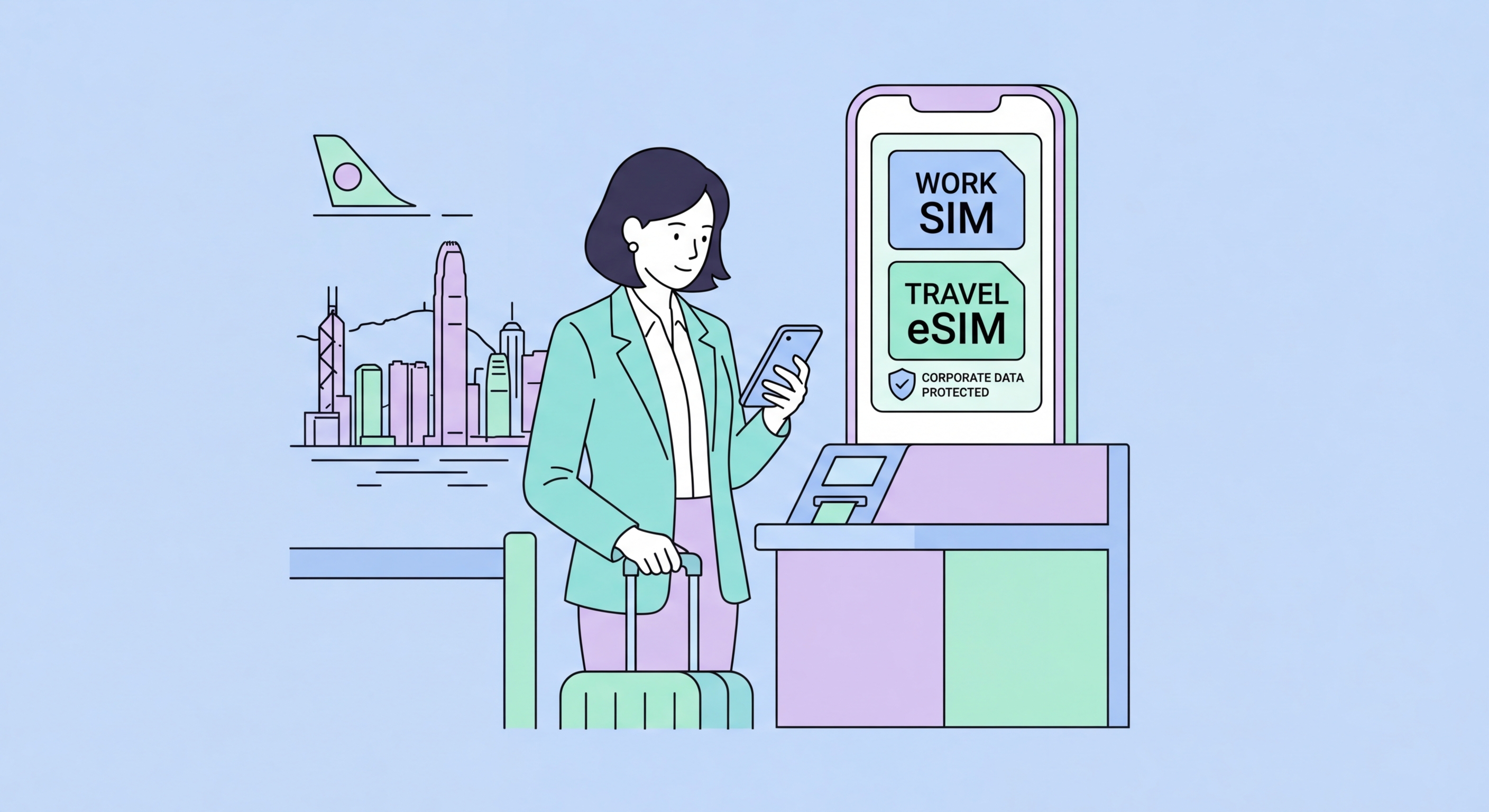
Hong Kong business professionals increasingly carry both a personal phone number and a separate work phone number, and eSIM makes managing both on a single device significantly more practical than carrying two physical SIM cards or two separate devices. The dual SIM capability of modern smartphones — one physical SIM plus one eSIM, or dual eSIM on newer devices — allows both a personal HK number and a corporate HK number to operate simultaneously on the same device. Incoming calls and messages on each number are clearly differentiated through the device interface, and outgoing calls can be configured to use the appropriate line depending on whether you are contacting a colleague (work number) or a personal contact (personal number).
For business travel specifically, the three-line management challenge — personal HK number, work HK number, and a destination data eSIM — is handled through the dual SIM architecture with a stored third profile. On iPhone, the approach is: activate personal HK number as one active line and work HK number as the second active line in Hong Kong. When travelling, deactivate the work HK number (since it is reachable via WiFi calling), activate the destination data eSIM in its place, and use the destination data eSIM for mobile data while both HK numbers remain reachable via WiFi. This configuration means the business traveller is reachable on their personal HK number and work HK number through WiFi calling and messaging while using affordable local data from the destination eSIM.
Some Hong Kong businesses are moving toward corporate eSIM plans that provide employees with a managed second number specifically for work use, separate from their personal carrier account. csl/HKT's enterprise eSIM management portal allows IT administrators to provision work eSIM profiles to employee devices remotely — the employee's personal SIM remains their own account while the corporate eSIM profile is managed, updated, and deactivated by the company IT team. This separation of personal and corporate mobile identity on the same device is a strong privacy and security model: the employee's personal number and data are under their own control, while the corporate number can be remotely deactivated when the employee leaves the company without needing to recover a physical SIM card.
Hong Kong business professionals frequently travel multi-country itineraries — a week visiting Singapore, Kuala Lumpur, and Bangkok; a 10-day trip covering Tokyo, Seoul, and Taipei; or a two-week European roadshow hitting London, Paris, Frankfurt, and Amsterdam. For multi-country Asia-Pacific trips, two eSIM strategies work well: purchasing a regional Asia-Pacific eSIM plan (Airalo's Asia plan covers 22 countries) that handles all destinations on a single profile, or purchasing individual country eSIMs for each destination and storing them as separate profiles that you switch between as you travel. The regional plan provides convenience (one purchase, one data pool shared across all countries); individual country plans provide potential cost savings if the per-country pricing is lower than the regional plan's per-GB rate.
For European business trips, the EU "Roam Like at Home" regulation makes regional European eSIM plans the obvious choice — one plan covering all EU member states on a single profile eliminates the need for country-by-country eSIM management. Airalo's Europe plan at 10GB for approximately USD $20 is adequate for most 10-day European business trips with moderate data use (email, maps, business apps). For video-heavy remote workers doing conference calls throughout a European trip, Holafly's unlimited Europe plan provides the peace of mind that bandwidth will be available for each call regardless of where in Europe the meeting is held. Business travellers should note that conference centre and hotel WiFi in major European business cities is generally excellent and provides a better connection for video conferencing than mobile data.
For complex global itineraries covering multiple continents in a single month, a global eSIM plan from Airalo (130+ countries) or Roamless (pay-per-use global data) eliminates the management overhead of purchasing and switching between regional eSIM plans. The per-GB cost is higher on global plans, but the convenience of a single profile that works across Hong Kong, the US, Europe, and Singapore without any switching is valuable for very frequent multi-continent travellers. Business professionals at multinational corporations who travel four or more times per month across multiple continents are the strongest candidates for global eSIM plans — the convenience premium pays for itself in reduced time managing mobile connectivity logistics.
Business travellers handle sensitive corporate data on mobile devices — client information, financial data, strategic documents, and internal communications. Using a travel eSIM for data rather than public airport or hotel WiFi provides a more secure network environment for business activities abroad. Travel eSIM data traffic routes through the local carrier's cellular network, which is substantially more difficult to intercept than public WiFi where man-in-the-middle attacks are a documented risk. For business travellers handling sensitive communications in airports, conference centres, and hotels, using mobile data via a travel eSIM is a meaningful security improvement over connecting to unmanaged public WiFi networks.
VPN usage on travel eSIM data is fully supported in most countries and provides an additional layer of encryption for sensitive business traffic. Unlike mainland China where VPN use on licensed mobile networks has regulatory complications, most business travel destinations (Japan, Singapore, US, Europe, South Korea) support VPN use on mobile data without restriction. Hong Kong employees with corporate VPN access should connect through the corporate VPN whenever accessing company systems on a travel eSIM, consistent with their corporate IT security policy. The travel eSIM provides the underlying internet connection while the corporate VPN provides encrypted tunnel protection for all corporate traffic — the same security architecture that applies to home WiFi VPN use, applied to travel eSIM data.
Productivity practices for business eSIM travel include pre-loading key files and documents for offline access before the trip, ensuring your work email is configured to work offline, and downloading any large presentation files or reports on HK WiFi rather than consuming travel eSIM data. Video conference tool apps (Zoom, Microsoft Teams, Webex) should be updated on HK WiFi before departure as large app updates can consume significant data on a travel eSIM. Set data usage alerts in your phone's data settings to notify you when you approach the travel eSIM data limit — avoiding an unexpected data cutoff during a critical business call abroad. Most travel eSIM providers allow in-app top-up within 5–15 minutes if you monitor your data proactively and top up before exhausting the plan.