What Is eSIM? The Complete Beginner's Guide
Everything you need to know about eSIM technology — how it works, which devices support it, and why eSIM is changing the way Hong Kong residents connect to mobile networks.
Published: March 29, 2026
Everything you need to know about eSIM technology — how it works, which devices support it, and why eSIM is changing the way Hong Kong residents connect to mobile networks.
Published: March 29, 2026
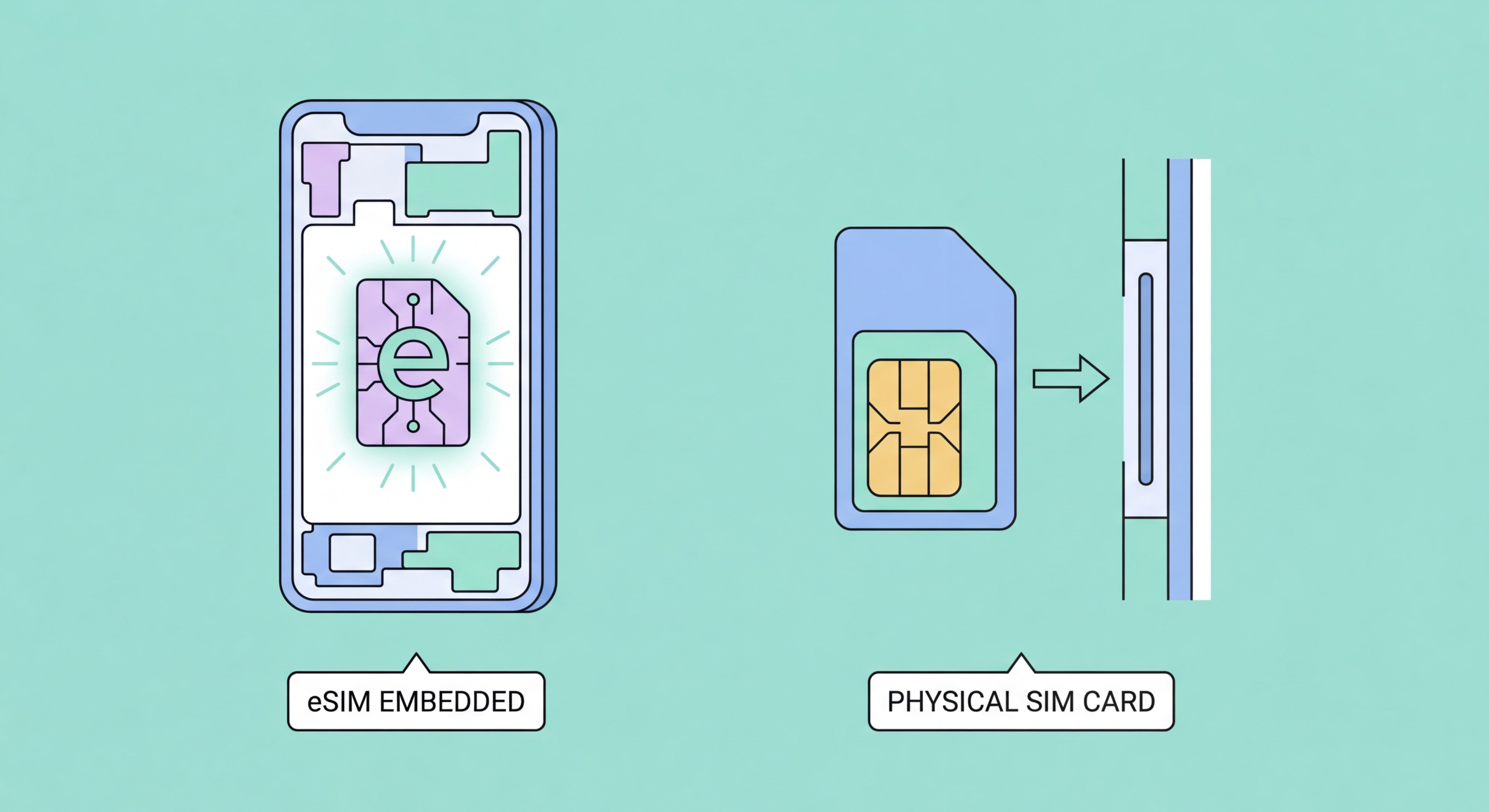
eSIM ↗ stands for embedded SIM (Subscriber Identity Module). Unlike a traditional SIM card — a small removable plastic card that stores your mobile network credentials — an eSIM is a tiny chip soldered directly onto your device's motherboard during manufacturing. It cannot be physically removed, lost, or swapped. Instead of inserting a physical card from your carrier, you activate an eSIM by downloading a carrier profile to the chip using a QR code, an activation code, or directly through a carrier app. The profile contains all the information — network credentials, to Spot and Avoid Attacks on Your Phone">Your Phone Number">phone number, data plan details — previously stored on a physical SIM card.
The "embedded" nature of eSIM does not mean you are locked to a single carrier permanently. An eSIM can hold multiple carrier profiles and switch between them in software. Most consumer devices support between 5 and 20 stored eSIM profiles, though only one or two can be active simultaneously. You can store your Hong Kong carrier profile, your regular travel eSIM for Japan, and a business travel eSIM for Europe all on the same device, switching between them through the phone's settings without any physical hardware changes. The profiles remain stored even when inactive, so returning from a trip is as simple as reactivating your regular HK profile.
eSIM technology is governed by specifications published by the GSMA ↗ (the global mobile industry association). The consumer eSIM standard (SGP.22) defines how carrier profiles are downloaded, authenticated, and managed. This standardisation means that an eSIM in an iPhone purchased in Hong Kong works identically with the same activation processes as an eSIM in a Samsung Galaxy purchased in Japan — the underlying technology is interoperable regardless of device manufacturer or home country. This interoperability is what enables international eSIM providers to sell data plans that work across multiple countries and devices.

eSIM ↗ support has become standard across most premium and mid-range smartphones sold in Hong Kong since 2020. Apple introduced eSIM support with the iPhone XS and XR in 2018, and all iPhone models from the iPhone 11 onwards support eSIM. The iPhone 14 series and later models sold in the United States are eSIM-only (no physical SIM slot), though the same models sold in Hong Kong retain a physical SIM slot alongside eSIM capability. iPhone 15 and 16 models sold globally — including Hong Kong — support dual eSIM (two simultaneous eSIM profiles) in addition to a physical nano-SIM slot.
Samsung has offered eSIM across its Galaxy S and Galaxy Z Fold/Flip lines since the Galaxy S20 series in 2020. Google Pixel phones have supported eSIM since the Pixel 2 in 2017 — one of the earliest mainstream Android eSIM implementations. Xiaomi, Oppo, OnePlus, and Huawei (on non-US models) have progressively added eSIM support across their mid-range and flagship devices. When purchasing a device for use in Hong Kong, always verify the specific regional model supports eSIM — some manufacturers release different hardware variants for different markets, and the China market variant of a phone often does not include eSIM support due to carrier requirements in mainland China.
eSIM is not limited to smartphones. Apple Watch Series 3 and later support eSIM for cellular connectivity independently from a paired iPhone. iPad Pro, iPad Air, and iPad with cellular connectivity support eSIM for data connections. Some Windows laptops (Microsoft Surface, selected Lenovo ThinkPads, and Qualcomm-powered ARM laptops) include built-in eSIM for always-on LTE or 5G connectivity. As of 2026, an increasing number of IoT devices, connected cameras, and wearables incorporate eSIM for remote management and connectivity in M2M (machine-to-machine) applications — a separate eSIM profile type (SGP.02/M2M) governs these non-consumer use cases.

The most common eSIM activation method is scanning a QR code provided by your carrier. When you purchase an eSIM plan — either from a Hong Kong carrier, an international travel eSIM provider, or an online marketplace — you receive a QR code either by email, in a carrier app, or displayed in your browser. On iPhone, navigate to Settings > Cellular > Add Cellular Plan and point your camera at the QR code. On Android (Samsung/Pixel), the path is Settings > Connections or Network > SIM Manager > Add Mobile Plan. The device contacts the carrier's SM-DP+ (Subscription Management Data Preparation Plus) server, downloads the encrypted profile, installs it on the eSIM chip, and the profile becomes available for use immediately.
Manual activation using an activation code is the alternative for situations where scanning a QR code is inconvenient — for example, when purchasing an eSIM on a computer and needing to activate on your phone. The activation code (typically a long string starting with "LPA:1$...") can be manually entered in the same eSIM configuration screen where you would normally scan a QR code. Many carriers and eSIM providers also support activation directly through their carrier apps — in this flow, authentication with your carrier account triggers the profile download without requiring any QR code or manual code entry.
Push provisioning is the most seamless activation method, where carriers initiate the profile download to your device automatically following account setup or plan purchase. Apple's carrier direct activation (available for some HK carriers when setting up a new iPhone) uses push provisioning to deliver the eSIM profile during device setup without any QR code or code entry. Similarly, eSIM marketplace platforms like Airalo and Holafly have improved their activation flows to where the QR code is displayed immediately after payment, and the profile is typically fully active within 60–90 seconds of scanning. Network availability is usually instant upon activation, though some plans specify a start date or require a first connection trigger before billing begins.

Hong Kong's unique geography and the travel patterns of its residents make eSIM particularly valuable. As a major international hub, Hong Kong residents travel frequently to mainland China, Japan, South Korea, Southeast Asia, Europe, and the United States for both business and leisure. Before eSIM, this meant either paying expensive roaming charges to Hong Kong carriers, buying local SIM cards at destinations (requiring a trip to the carrier shop and often a language barrier), or juggling multiple physical SIM cards. eSIM eliminates all of these friction points by allowing travel data plans to be purchased and activated entirely digitally, often within minutes.
The mainland China use case is particularly significant. Hong Kong residents crossing to Shenzhen, Guangzhou, or other mainland cities for work, shopping, or family visits have historically faced the choice between expensive HK carrier roaming or buying and inserting a mainland China SIM card. CMHK's parent China Mobile network access through CMHK plans provides one solution, while dedicated mainland China eSIM plans from providers that have partnerships with China Unicom or China Telecom provide another. Having a mainland China data eSIM installed and ready for immediate activation when crossing the border — without any physical SIM swapping — is a significant convenience for the many Hong Kong residents who cross regularly.
From a device design perspective, eSIM enables slimmer, more water-resistant devices by eliminating the SIM card tray and its associated waterproofing challenges. Apple's iPhone 14 eSIM-only models (in the US) demonstrated that removing the physical SIM slot allows for improved structural integrity and easier IP68 water resistance certification. Future iPhone and Android flagship models are expected to adopt eSIM-only designs in Hong Kong as carrier infrastructure and customer familiarity with eSIM continues to mature. Understanding eSIM now positions Hong Kong users well for this transition, which will likely be complete by 2027–2028 for premium smartphone lines.
