What Are Residential Proxies and When Do You Need Them?

Residential proxies use real IP addresses assigned to home broadband users — making them trusted by websites and far harder to detect and block than datacenter proxies.

Residential proxy network illustration
1What They Are

Understanding Residential Proxy Networks

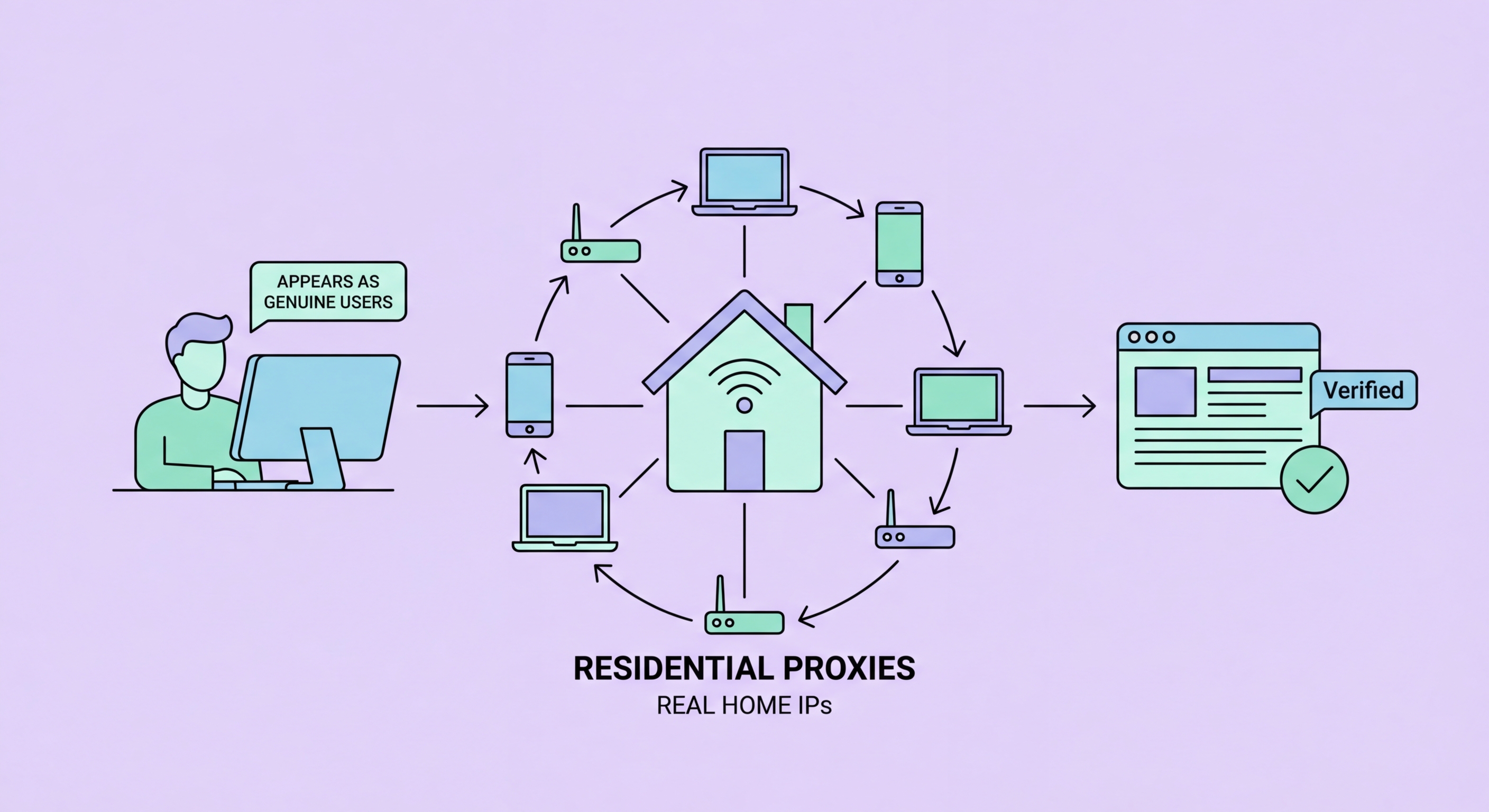
A residential proxy uses an IP address that an Internet Service Provider has assigned to a real residential customer — someone with a home broadband connection. When a website receives a request from a residential IP, it sees what appears to be a regular home internet user making a normal request. This is fundamentally different from receiving a request from a datacenter IP range, which websites can easily identify as commercial server infrastructure and treat with suspicion or block outright.

Residential proxy networks are built by aggregating IP addresses from real users who have agreed — ideally explicitly and knowingly — to share their internet connection in exchange for some benefit, typically a free app, premium service, or direct payment. The proxy provider installs software on the user's device that routes commercial proxy traffic through their connection when they're not actively using it. The commercial user pays the proxy provider per gigabyte of data consumed, and the provider shares a portion with the device owner.

The largest residential proxy networks contain tens of millions of IPs from across the globe. Bright Data claims over 72 million residential IPs; Oxylabs advertises more than 100 million. These pools are geographically diverse and span every country and major city in the world. For businesses that need to appear as local users from specific cities — checking local search results in Seoul, verifying ad delivery in São Paulo, or testing a website from rural Australia — residential proxies are often the only technically viable solution.

  • Real ISP IPs: Addresses assigned by consumer ISPs to home broadband subscribers, not commercial server farms.
  • Peer Network Model: IPs sourced from devices running the proxy provider's software with user consent.
  • Geographic Diversity: Major networks span 195+ countries with city-level targeting capability.
  • High Trust Score: Websites treat residential IPs as legitimate consumer traffic, reducing detection and blocking.
  • Dynamic Allocation: IPs are allocated dynamically from the pool as residential devices come online.
  • Premium Pricing: Typically priced per GB at $5–15/GB, reflecting their higher value over datacenter proxies.
Residential proxy network diagram
2Why They're Harder to Block

Why Websites Can't Easily Block Residential Proxies

Websites use several techniques to detect and block proxy and bot traffic, but most of these techniques rely on characteristics that distinguish commercial server IPs from real consumer connections. The primary signal is the IP address's ASN (Autonomous System Number) — datacenter IPs belong to ASNs registered to cloud providers like AWS, Google Cloud, or Alibaba Cloud, which websites can identify and block in bulk. Residential IPs belong to ISP ASNs like HKT, PCCW, or China Telecom, indistinguishable from legitimate customer traffic at the network level.

Advanced anti-bot systems like Cloudflare, Akamai Bot Manager, and Imperva analyse dozens of signals beyond IP reputation: browser fingerprinting, cookie behavior, mouse movement patterns, JavaScript execution, TLS fingerprint, HTTP/2 settings, and more. Residential proxies alone don't defeat these systems — they simply remove the easiest-to-check signal (datacenter IP detection), requiring anti-bot systems to work harder. This is why residential proxies often work where datacenter proxies fail, even if neither solution is perfect against sophisticated anti-bot platforms.

The dynamic nature of residential IPs also complicates blocking. A datacenter proxy pool uses a fixed set of IP addresses that can be added to blocklists permanently once identified. Residential IPs change frequently as devices come on and offline, making persistent blacklisting impractical — blocking a residential IP range risks also blocking legitimate customers whose ISPs use the same address space. This asymmetry — easy to block datacenters, costly to block residential ranges — is the fundamental economic reason residential proxies command a price premium.

  • ISP ASN Membership: Residential IPs belong to consumer ISP networks, not identifiable commercial data center ASNs.
  • Dynamic IP Assignment: Home broadband IPs change regularly, making persistent blocklisting ineffective.
  • Consumer Traffic Mix: Blocking residential ranges risks blocking legitimate paying customers — websites avoid this.
  • Anti-Bot Limitation: Residential IPs pass the IP reputation check, forcing anti-bot systems to rely on behavioural signals.
  • Geographic Authenticity: City-level geo-targeting matches expected user locations, reducing location-based anomaly detection.
  • Not Unblockable: Sophisticated anti-bot systems detect residential proxy traffic through behavioural and browser fingerprint analysis.
Why residential proxies are harder to block
3Legitimate Use Cases

Legitimate Business and Personal Use Cases

The most common legitimate use case for residential proxies is market research and competitive intelligence. E-commerce companies monitor competitor pricing across dozens of platforms using residential IPs to avoid being blocked and to receive unmodified, location-accurate pricing rather than prices inflated for scraping bots. Price comparison services aggregate tens of millions of product listings daily — at this scale, residential proxy networks are the only economically viable way to collect accurate, unmanipulated data.

Ad verification is another major professional use case. Brands and their agencies need to confirm that digital advertising campaigns are displaying correctly to real users in specific geographic markets. This requires viewing ad placements from genuine local residential IPs — the same ISP connections a real target consumer would use. Ad fraud detection companies use residential proxies extensively to identify cases where publisher traffic is being faked or where ads are being served in non-brand-safe environments.

For individuals, residential proxies are most relevant when trying to access region-locked services that aggressively block datacenter IPs. Some streaming services, ticketing platforms, and e-commerce sites with geographic pricing restrictions detect and block datacenter proxy ranges, making a residential IP necessary for reliable access. Sneaker collectors and limited-release merchandise buyers often use residential proxies to compete with automated purchase bots that dominate popular drops — a cat-and-mouse game that has driven significant residential proxy market growth.

  • Price Monitoring: Track competitor pricing accurately without IP bans or manipulated responses.
  • Ad Verification: Confirm ads display correctly to real users in target geographic markets.
  • SEO Rank Tracking: Check actual search rankings from specific cities without personalisation bias.
  • Travel Fare Research: Access unmanipulated flight and hotel pricing from different national markets.
  • Streaming Access: Access streaming services that block datacenter proxy ranges for geographic licensing compliance.
  • Market Research: Collect publicly available web data for business intelligence without detection.
Learn how proxies enable large-scale web scraping →
Residential proxy use cases
4Choosing a Provider

How to Choose a Residential Proxy Provider

Not all residential proxy providers operate ethically. The central concern is how IPs are sourced: legitimate providers clearly disclose to device owners how their connection will be used and obtain explicit informed consent. Less scrupulous operators bundle proxy software into popular apps without adequate disclosure, effectively turning users into unwitting proxies. When selecting a provider, look for transparency about network sourcing and an explicit consent framework for IP contributors.

Pool size and geographic coverage are practical evaluation criteria. A provider with 5 million IPs concentrated in a few countries will struggle to provide accurate geo-targeted access compared to one with 70 million IPs distributed across 195 countries. City-level targeting is increasingly important for many use cases — ad verification and local SEO monitoring require city-level precision that country-level proxy allocation cannot provide. Check whether the provider offers city and ASN-level targeting in their API documentation.

Pricing models vary significantly. Per-gigabyte pricing is standard and typically ranges from $5–15/GB for residential proxies from reputable providers. Some providers offer bandwidth subscriptions at flat monthly rates, which suits users with predictable, regular data needs. Unlimited residential plans rarely exist at reasonable prices — be sceptical of any provider claiming unlimited residential bandwidth at low cost, as this often indicates poor IP pool ethics or shared resources that degrade performance under load.

  • Consent Transparency: Verify the provider explicitly discloses usage to IP contributors and obtains informed consent.
  • Pool Size: Larger pools provide better IP diversity and reduce repeated-IP detection risk.
  • Geographic Targeting: Look for city and ASN-level targeting for precision market research needs.
  • Pricing Model: Per-GB pricing is standard; flat subscriptions work for predictable usage patterns.
  • Uptime and Reliability: Check provider SLAs and customer reviews for consistent connection quality.
  • API Documentation: Good providers offer comprehensive APIs for IP rotation, geo-targeting, and session management.
Compare the top residential proxy providers →
Choosing a residential proxy provider

Ready to Deploy Residential Proxies?

Compare the leading residential proxy providers and understand the full datacenter vs residential tradeoff before committing to a solution.

Related VPN Articles