How to build genuine security awareness in your Hong Kong organisation — from training programme design to phishing simulations, role-based content, and measuring real behaviour change.
Cybersecurity research consistently attributes 80-90% of successful security incidents to human behaviour — clicking phishing links, using weak passwords, or being socially engineered into authorising fraudulent transactions. For Hong Kong businesses where technical controls may be limited by budget or IT expertise, well-trained employees represent the most accessible and cost-effective security investment available. A workforce that identifies phishing emails, follows secure password practices, and reports suspicious activity provides defence depth that complements technical controls.
The distinction between compliance training and effective behaviour change training is critical. Annual one-hour mandatory sessions satisfy tick-box requirements but produce minimal lasting change. Learning science demonstrates that security knowledge and behaviour develop best through frequent, brief, contextually relevant exposures rather than infrequent lengthy sessions. Monthly five-minute security bulletins, just-in-time training triggered by simulation failures, and security topics integrated into team meetings produce better retention and behaviour outcomes than annual training marathons.
Hong Kong-specific content is significantly more effective than generic global materials. Employees engage more deeply with examples that reflect their actual environment — phishing templates mimicking HSBC, Hang Seng, or Octopus cards; social engineering scenarios involving Hong Kong government impersonation; fraud cases from local news. Training providers who customise content to the Hong Kong context, including bilingual delivery in English and Traditional Chinese, produce measurably better outcomes for HK organisations than off-the-shelf global content.
An effective programme for a Hong Kong SME is built around six core content topics, regular reinforcement activities, practical testing, and clear metrics. The core curriculum should cover: phishing identification and reporting, password hygiene and password manager use, safe browsing and link verification, physical security and device protection, social engineering recognition, and incident reporting procedures. These six topics address the human vulnerabilities most frequently exploited in real attacks and should be covered with all staff before more specialised topics are introduced.
Programme delivery formats should vary to maintain engagement — video modules for core content, interactive quizzes to test retention, infographic one-pagers for quick reference, and team discussions of real-world examples for deeper understanding. Many Hong Kong-based security training providers offer LMS platforms with pre-built content libraries that can be customised and assigned to staff with automated completion tracking. For businesses without dedicated platform budgets, free resources from the HKPC, CISA, and SANS Security Awareness provide reasonable baseline content.
Role-based training recognises that different functions face different threats. Finance and accounts payable staff need intensive training on BEC recognition and payment verification procedures. IT staff need more technical content. Executive assistants who manage calendar and correspondence for senior leaders are disproportionately targeted for spear phishing. A layered programme addressing common baseline content plus role-specific additions is significantly more effective than one-size-fits-all delivery.
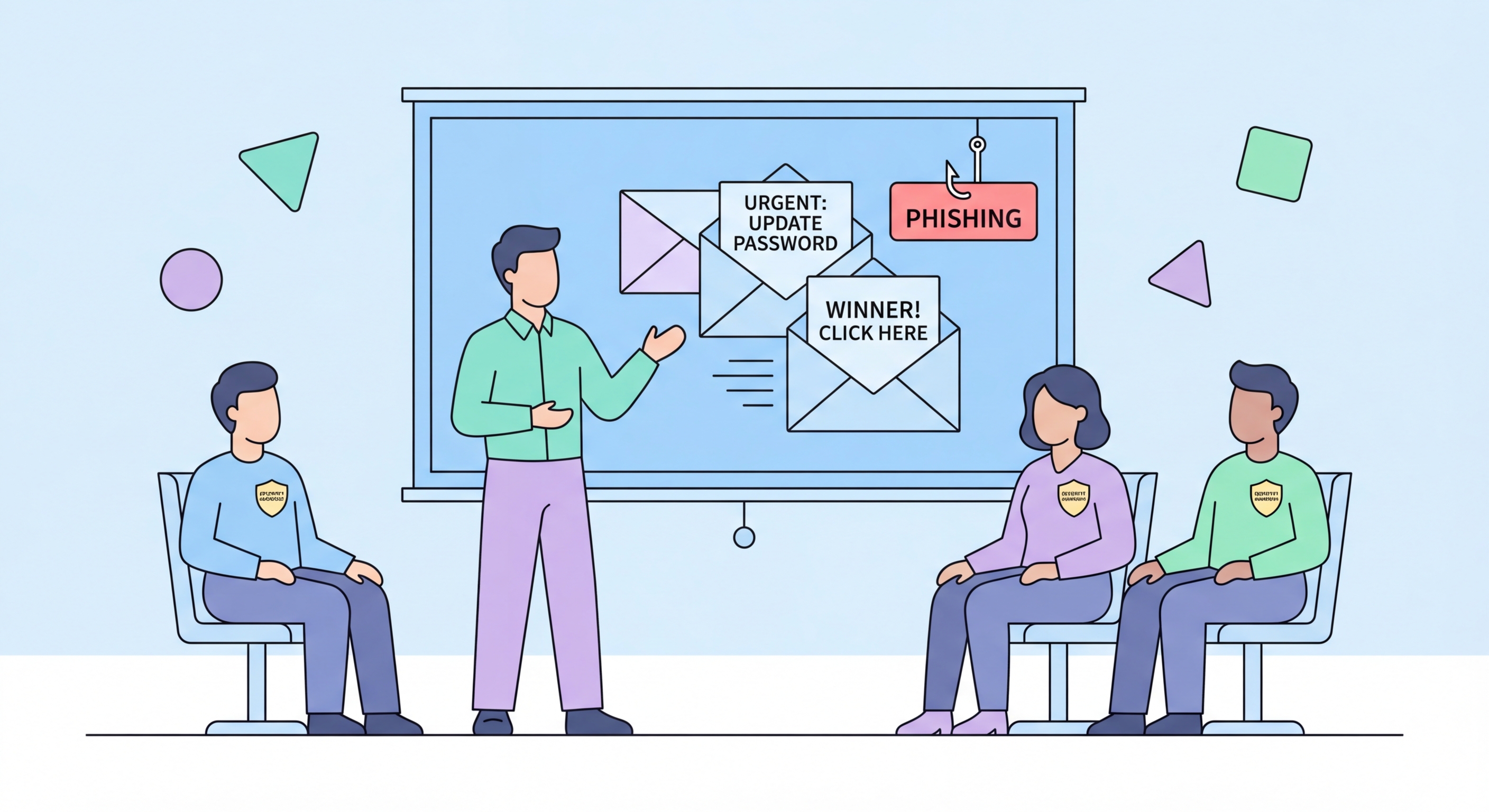
Phishing simulations — controlled tests where IT or security teams send realistic but harmless fake phishing emails to staff — are the most effective tool for assessing real-world susceptibility and providing immediate, contextual training to those who click. Unlike classroom training, simulations create a realistic test environment and, when followed by immediate supportive training for clickers, change behaviour more effectively than passive instruction. Organisations running quarterly phishing simulations consistently see click rates decline significantly over time.
Effective simulations balance realism with fairness. Templates should reflect actual phishing attacks targeting Hong Kong businesses — fake HSBC security alerts, IRD notifications, Octopus card updates, Microsoft 365 credential requests. Simulations that are unrealistically obvious underestimate real susceptibility; those that are too clever undermine trust if staff feel manipulated rather than educated. The key is non-punitive immediate feedback explaining what the clicker saw, why it was a simulation, and how to identify the real version — this teachable moment is where behaviour change actually occurs.
Simulation metrics provide valuable programme data. Track the phishing click rate, the report rate (percentage who reported the email as suspicious — higher is better), and trend across successive simulations. A declining click rate and increasing report rate indicate effective training. Breaking results by department reveals gaps requiring targeted supplemental training. Share aggregated results with leadership to demonstrate programme effectiveness and sustain ongoing support.
Demonstrating training value to business leadership requires quantitative metrics connecting training activity to security outcomes. The most direct metrics are phishing simulation click rate trend, reported suspicious email volume, and training completion rates. Beyond these leading indicators, trailing metrics such as security incidents attributed to human error and percentage of incidents promptly reported by staff provide business-level outcome data that justify ongoing investment.
Benchmarking contextualises your metrics. The average phishing click rate for untrained organisations is 30-40% — well-performing programmes after consistent training achieve below 5%. Comparing your organisation's rates to benchmarks and your own historical trend demonstrates progress. The HKPC and international security awareness organisations publish benchmark data that contextualises metrics in HK and regional terms. Presenting this benchmark comparison to leadership is more compelling than raw numbers alone.
Qualitative feedback from staff — collected via brief surveys after training modules and simulations — provides insights that quantitative metrics miss. Employees who find training relevant, non-condescending, and actionable are more likely to engage seriously and retain knowledge. Negative feedback about training quality or format should be actioned in the next programme iteration. Treating training participants as consumers whose experience matters produces better outcomes than mandated compliance box-ticking.