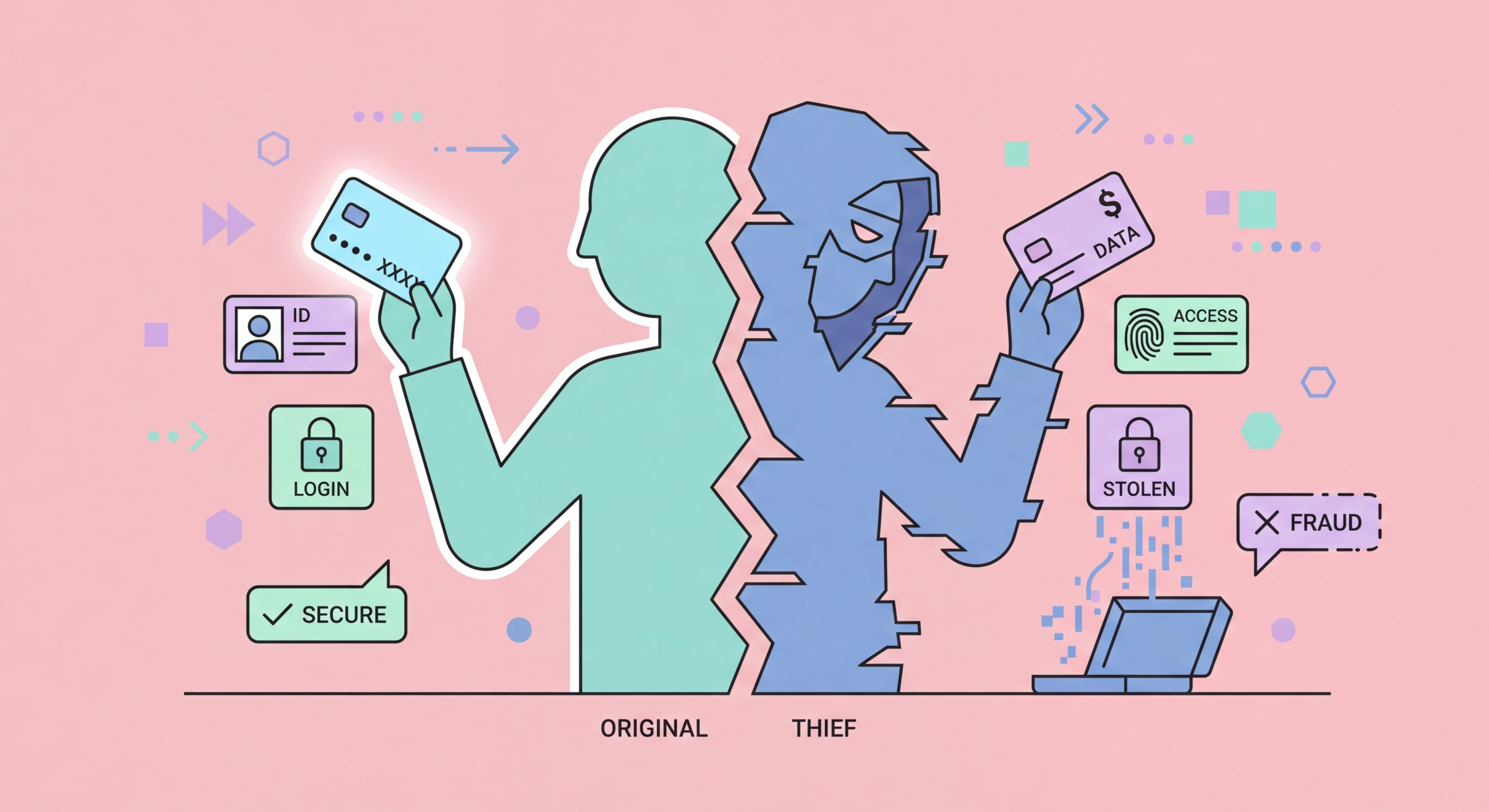
Identity theft is Hong Kong's fastest-growing financial crime. Understand how criminals steal and exploit your HKID, banking credentials, and personal data — and build a complete protection strategy under the PDPO framework.
Identity theft in Hong Kong follows several well-established pathways, each exploiting a different aspect of the territory's digital infrastructure. The most common starting point is credential theft — criminals obtain your username and password for a high-value account (banking, email, government portal) through phishing, Data Breach?">data breaches, or to Check If Your Data Is on the Dark Web">dark web purchases, then use those credentials to access accounts, reset passwords across linked services, and ultimately extract funds or personal data. Because most Hong Kong residents reuse passwords across multiple services, a single breach can cascade rapidly.
The HKID number is the central vulnerability in Hong Kong's identity ecosystem. Unlike countries with separate account numbers for different purposes, Hong Kong uses the HKID as the primary identifier across banking, healthcare, government, and telecommunications. A criminal who obtains your HKID number, combined with your date of birth and a spoofed phone number or email, has enough information to impersonate you to many institutions. Banks are required to verify identity for account changes, but social engineering attacks against bank call centres have succeeded in gaining account access using only HKID details plus answers to knowledge-based questions sourced from social media or public databases.
SIM swapping — convincing a mobile operator to transfer your phone number to a criminal's SIM card — is an increasingly common attack vector in Hong Kong. Because most Hong Kong banking uses SMS OTP (one-time password) as a second factor, controlling your phone number gives a criminal the ability to approve transactions, reset passwords, and receive 2FA codes. The HKPF Cyber Security and Technology Crime Bureau (CSTCB) reported a significant increase in SIM swap fraud complaints from 2022 onwards, particularly targeting wealthy individuals identified through social media or leaked financial data.
Financial identity theft is the most immediately damaging category. In Hong Kong, this typically manifests as unauthorised bank transfers via FPS (Faster Payment System), fraudulent credit card applications in your name at local banks, or unauthorised access to investment accounts through brokerages. FPS fraud is particularly concerning because FPS transactions are near-instantaneous and often difficult to reverse once initiated. The HKMA's Operation Stablecoin has addressed some vulnerabilities, but social engineering attacks that manipulate victims into approving fraudulent FPS transfers remain prevalent. In 2023, Hong Kong reported over HK$5.4 billion in total fraud losses, a significant portion involving identity-enabled financial crimes.
Tax and government identity theft targets Hong Kong's eTAX and MyGovHK systems. Criminals who obtain your HKID number and relevant personal details can attempt to file fraudulent tax returns to claim refunds, apply for government benefits, or access citizen records. While Hong Kong's government systems have improved security in recent years, the consequences of government identity theft extend beyond immediate financial loss — incorrect government records can affect employment checks, credit assessments, and background verifications. The Immigration Department maintains HKID records and has reporting mechanisms for identity document misuse.
Medical identity theft — using someone's identity to obtain medical services, medications, or insurance reimbursements — is less commonly reported in Hong Kong but is a growing concern given the territory's Hospital Authority records system. Medical identity theft is particularly insidious because victims often don't discover it until they encounter incorrect medical records, denied insurance claims, or unexpected bills. With the increasing digitisation of HA records and the rollout of the Electronic Health Record Sharing System (eHRSS), the volume of digital health data creates new targets. Victims of medical identity theft face the complex task of correcting inaccurate medical records, which can have direct patient safety implications.
Early detection of identity theft dramatically limits the financial and reputational damage. The most reliable early warning system combines regular credit report monitoring, dark web monitoring for your credentials, and careful attention to account anomalies. In Hong Kong, you can obtain a free credit report from TransUnion (the primary credit reference agency for individuals) once per year, with additional reports available at nominal cost. Your credit report shows all credit applications, existing facilities, and any defaults registered in your name — an unfamiliar credit application or account is a strong indicator of identity theft. Review your credit report at minimum quarterly if you have any reason to suspect exposure.
Banking anomalies are often the first visible sign of identity fraud. Unusual transactions, changes to account settings you didn't initiate, failed login notifications from unfamiliar locations, or security questions being reset are all warning signs. Hong Kong banks are required by HKMA guidelines to implement transaction monitoring and notify customers of unusual activity, but the speed of FPS and the sophistication of social engineering attacks means that criminals may have completed a fraud before the bank's monitoring system flags it. Enable all available account notifications — per-transaction SMS or app alerts provide the earliest warning of unauthorised activity.
Non-financial signals are equally important but often overlooked. Unexpected calls from debt collectors about debts you don't recognise; failure to receive expected bills, statements, or government mail (which may have been redirected by a criminal); unfamiliar accounts appearing in password manager breach alerts; or receiving a MyGovHK notification about a login from an unrecognised device — each of these may indicate identity theft in progress. The PCPD (Privacy Commissioner for Personal Data) maintains a reporting mechanism for PDPO violations, and reporting suspected identity theft to both the PCPD and HKPF CSTCB (18222) creates an official record that can assist in subsequent dispute resolution.
If you discover or suspect identity theft, immediate action within the first 24-48 hours significantly limits the damage. Begin by securing your accounts: change passwords for banking, email, and government portals; contact your bank's fraud line immediately (HSBC: 2233 3000, Hang Seng: 2198 7111, BOC: 3988 2388) to place holds on accounts and review recent transactions; and contact your mobile operator to verify no SIM swap has been processed. For government account compromise, contact the Immigration Department (2824 6111) and eTAX helpline (183 5500). Document everything with screenshots, reference numbers, and timestamps — this documentation will be critical for dispute resolution.
Under Hong Kong's Personal Data (Privacy) Ordinance (PDPO, Cap. 486), you have specific rights when your personal data has been misused. The PCPD has the authority to investigate complaints about data breaches and misuse of personal data. If a company's data breach contributed to your identity theft, you can file a complaint with the PCPD ([email protected] or 2827 2827) requesting investigation into whether the data user failed their obligations under the PDPO. The 2021 PDPO amendments introduced mandatory breach notification requirements for data users and enhanced penalties — up to HK$1 million and imprisonment for serious breaches. While the PCPD cannot directly compensate identity theft victims, a successful complaint creates legal leverage and may result in the data user assisting with remediation.
Longer-term recovery from identity theft in Hong Kong involves credit file remediation, fraudulent account dispute resolution, and prevention of recurrence. Contact TransUnion to flag fraudulent accounts and add a fraud alert to your credit file — this alerts lenders to take additional verification steps when applications are made in your name. For each fraudulent account or loan, submit a written dispute to the lender with your PCPD complaint reference number and HKPF report number. Banks and credit companies in Hong Kong are generally responsive to well-documented disputes with supporting police report numbers. The full recovery process typically takes 3-12 months depending on the complexity of the fraud, but with persistent documentation and formal complaint channels, most Hong Kong victims successfully resolve fraudulent accounts.