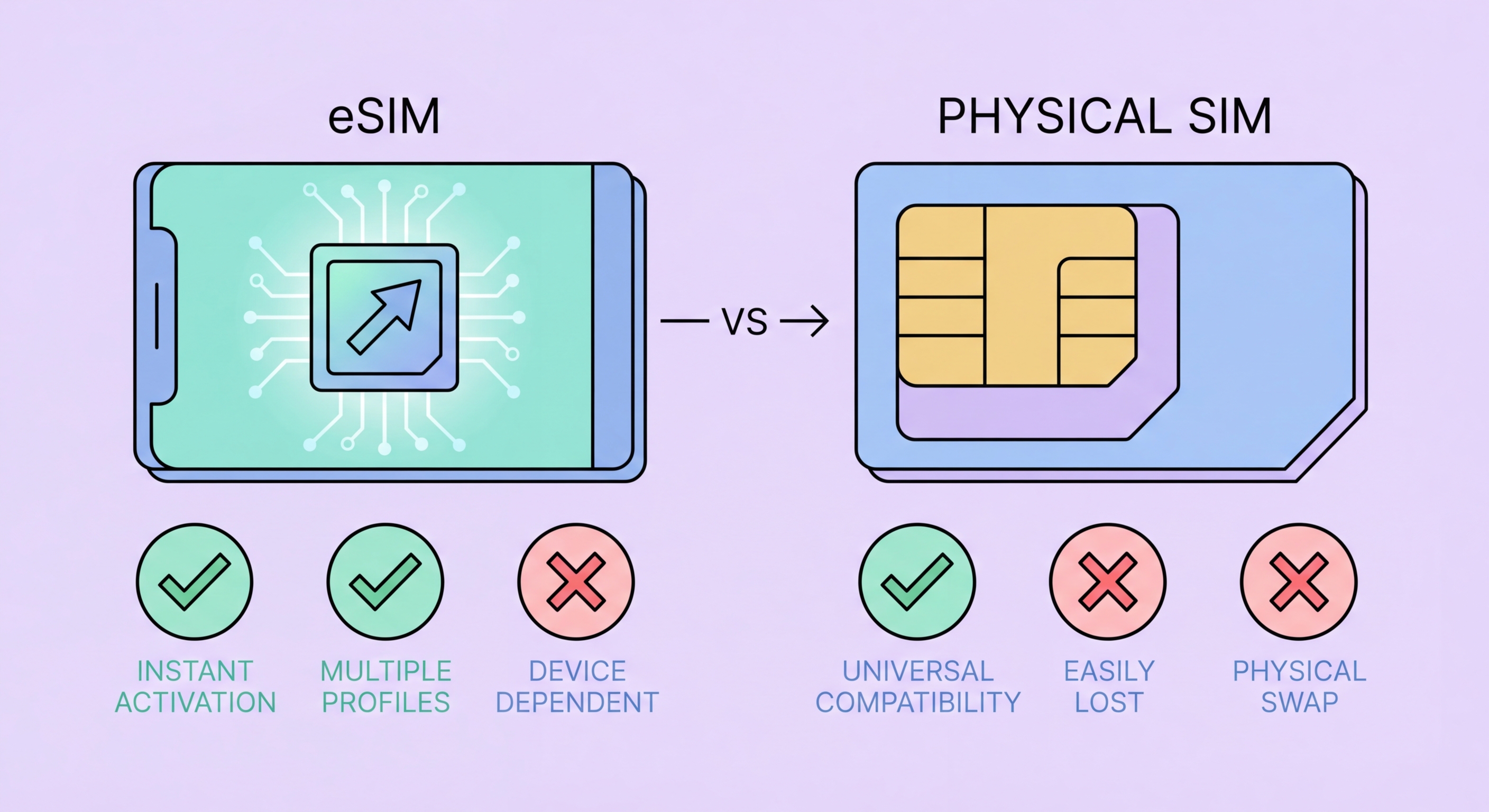
A complete comparison of eSIM and traditional SIM cards across convenience, security, flexibility, and compatibility — and which makes more sense for Hong Kong users in 2026.
The most immediate and obvious advantage of eSIM over physical SIM is convenience for carrier changes, plan additions, and travel connectivity. With a physical SIM, switching carriers requires visiting a store, waiting for a new SIM card to be issued, and physically swapping it into to Spot and Avoid Attacks on Your Phone">your phone. If you lose your SIM or it is damaged, you are without mobile service until you can get to a carrier store during business hours. With eSIM, switching carriers, adding a travel plan, or replacing a lost or damaged plan takes minutes from your phone without leaving your location.
Physical SIM cards also create practical challenges for travellers. Buying a local SIM at a destination requires navigating carrier stores in a foreign country, sometimes facing language barriers, and always requiring a wait. The physical SIM card must be safely stored while abroad (to reinstall your home SIM on return), creating the risk of loss or damage. eSIM eliminates all of this — purchase a destination eSIM online before your flight, scan the QR code at home, and arrive with connectivity already active. Your home carrier profile remains stored on the eSIM, ready to reactivate instantly when you return.
For users who need multiple numbers — a separate work number, a mainland China number, and a Hong Kong primary number — eSIM makes managing multiple identities more practical. A physical dual-SIM phone requires carrying two physical cards. An eSIM-capable device can store and switch between multiple carrier profiles entirely in software. The practical limitation is that most devices only support one or two active eSIM profiles simultaneously, meaning you still need to manually switch active profiles, but the switching itself takes seconds rather than requiring physical hardware access.
Physical SIM cards retain genuine advantages in several scenarios that are relevant for Hong Kong users. The most significant is device compatibility — if you have an older smartphone that does not support eSIM, or a feature phone, or specific industrial or IoT devices, a physical SIM is simply your only option. Device flexibility is another physical SIM advantage: you can move a physical SIM from one phone to another instantly without any carrier involvement or account access, which is useful when you need to use a temporary phone, lend your SIM to a family member, or use your card in multiple devices over time.
Physical SIMs also offer an advantage in some device replacement scenarios. If your phone is broken or lost, you can take the physical SIM from the damaged device and insert it into any compatible phone to immediately restore your number and connectivity — no internet connection required for activation, no carrier account login needed. With eSIM on a new device, you need internet access (WiFi or from another device) to download the carrier profile, and some carriers require carrier account authentication which can be challenging if your primary 2FA method was on the lost device.
In Hong Kong specifically, older citizens and users who prefer carrier store interactions may find the physical SIM process more accessible. Carrier stores in Hong Kong are well-distributed across shopping centres and MTR station areas, and many Hong Kong residents are accustomed to the walk-in service model. The physical SIM experience also involves more certainty about what you are getting — you leave the store with a working SIM in hand rather than trusting that a remote eSIM profile download will succeed. For users who are not technically confident with digital activation processes, physical SIM remains a more comfortable and reliable experience.
From a security perspective, eSIM offers meaningful improvements over physical SIM cards in several dimensions. Physical SIM cards can be cloned using specialised hardware — an attacker who gains physical access to your SIM for a period of time can extract the authentication keys and create a duplicate that operates as your number. Modern SIMs include countermeasures against cloning, but the attack remains possible with the right equipment. An eSIM's credentials are stored in a secure element on the device that cannot be physically removed or directly accessed — cloning an eSIM requires device-level compromise, a significantly higher bar.
Physical theft is the most obvious security advantage of eSIM. If your phone is stolen, a physical SIM can be removed and used in another device to receive your calls and SMS messages — enabling the thief to intercept 2FA codes sent to your number. An eSIM cannot be removed from the stolen device — and if the thief does not know your device PIN, they cannot access the phone at all. The eSIM profile remains locked behind the device's security credentials. This physical security advantage is particularly relevant for the theft risk in busy Hong Kong public spaces — eSIM provides a meaningful security improvement in theft scenarios involving number hijacking.
SIM swap attacks — where an attacker social engineers a carrier to transfer your number — remain possible with eSIM as with physical SIM, though the processes differ. Physical SIM swap requires presenting fraudulent ID at a carrier store; eSIM swap can potentially be triggered through online carrier account access if the attacker has compromised your carrier account credentials. This means eSIM users should pay particular attention to securing their carrier account: use a unique strong password, enable 2FA on the carrier account, and add a carrier PIN/account PIN that must be provided before any SIM-related changes are processed. All HK carriers allow you to set such a PIN on your account.
For most Hong Kong users with a relatively recent smartphone (iPhone XS or later, Samsung Galaxy S20 or later, Google Pixel 2 or later), switching to eSIM for your primary Hong Kong carrier is straightforwardly beneficial. The convenience advantages — particularly for travel, carrier management, and the ability to add data plans without physical store visits — outweigh the limitations in most everyday scenarios. The security improvements over physical SIM are a genuine additional benefit rather than the primary reason to switch, but they are real.
The most compelling scenario for keeping a physical SIM alongside eSIM (on a dual SIM capable device) is for the primary Hong Kong number that receives banking 2FA messages. While eSIM is more secure against physical theft for this use case, many users feel more comfortable with the physical SIM option for their most critical number until they are fully familiar with the eSIM ecosystem and have migrated their most critical accounts away from SMS 2FA. Using eSIM for a secondary number or for travel data while keeping a physical SIM for your primary Hong Kong number is a common and sensible transitional approach.
The bottom line is that for Hong Kong users who travel regularly, the eSIM decision is a clear yes — the travel cost savings and convenience alone more than justify the switch. For users who do not travel frequently and are happy with their current physical SIM experience, there is no urgent reason to switch unless your carrier offers a compelling eSIM-only plan. The technology is mature, carrier support in Hong Kong is comprehensive, and the transition process is simple. The question for most Hong Kong users in 2026 is no longer whether eSIM is ready — it clearly is — but when your specific situation makes the switch most worthwhile.