Free vs Paid VPN: Which Should You Choose?
Free VPNs look attractive, but the business model behind most of them means your data is the product. Here's what you're actually trading away.
Published: March 29, 2026
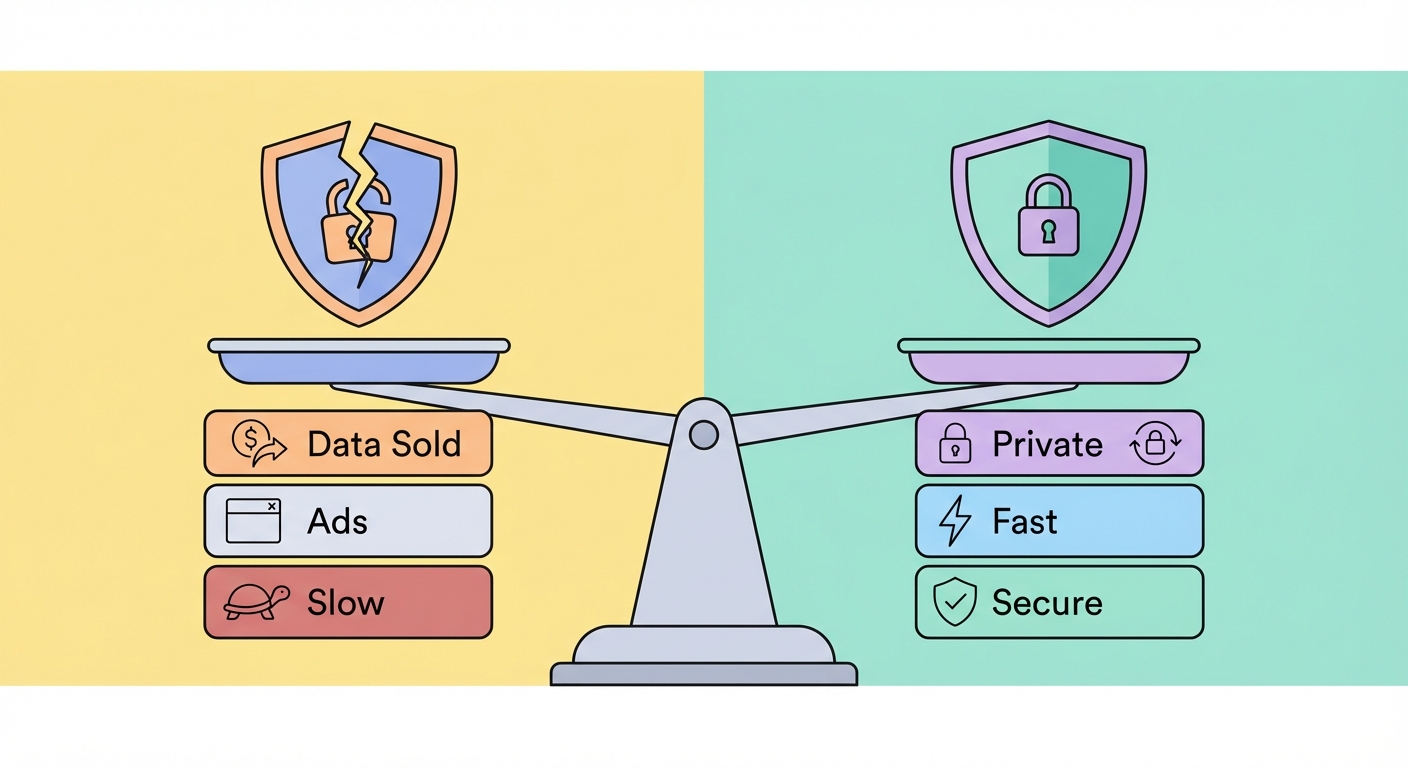
Free VPNs look attractive, but the business model behind most of them means your data is the product. Here's what you're actually trading away.
Published: March 29, 2026
Running a VPN service is expensive. Server infrastructure across dozens of countries, bandwidth costs for millions of users, technical staff, security audits, and legal compliance all require significant investment. When a VPN provider offers their service for free, the question isn't whether they have costs — they do — but how they're recouping them. The answer almost always involves your data.
A landmark 2019 study by CSIRO (Australia's national research agency) analysed 283 free VPN apps on the Android Play Store and found that 38% contained malware, 82% requested permissions to access sensitive user data, and 18% didn't actually encrypt traffic at all — despite claiming to be VPNs. More recently, top-10 free VPN apps on both iOS and Android app stores have been linked to Chinese ownership structures that create concerning conflicts with data privacy.
The business models sustaining free VPNs include: selling browsing history and behavioural data to advertisers (Hola VPN was caught doing this at scale), injecting tracking cookies and advertisements into web traffic, serving as bandwidth-sharing networks where free users' connections are resold as a "residential proxy" service (a practice that has been used for large-scale fraud), and in worst cases, installing malware or adware that generates revenue regardless of VPN usage.
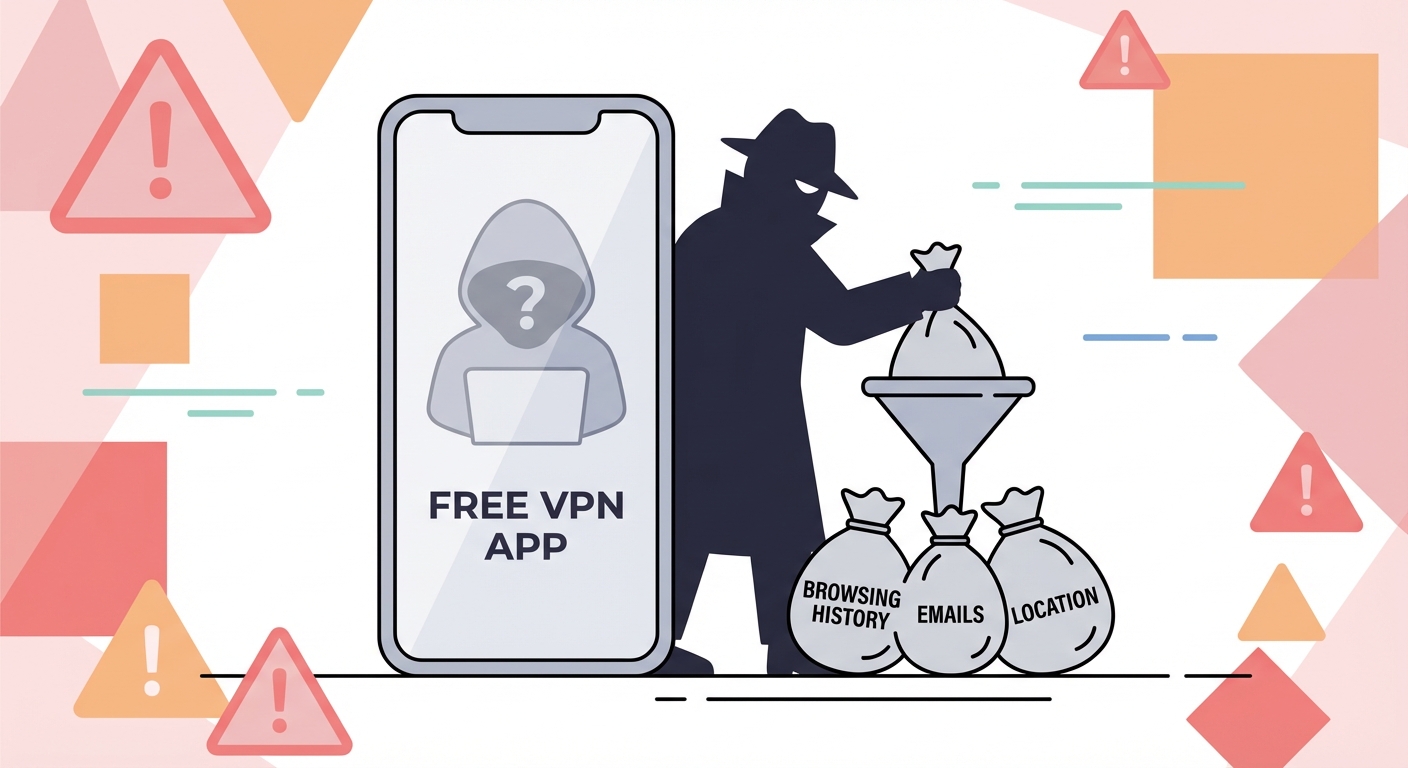
Reading the privacy policies of popular free VPN apps reveals disturbing clauses that most users never notice. Hola VPN's terms of service explicitly stated that free users' devices could be used as exit nodes for their paid Luminati proxy network — meaning other people's internet traffic could route through your home IP address and bandwidth, potentially associating you with others' online activities. This practice was exposed after Hola's network was used to launch DDoS attacks.
SuperVPN, one of the most-downloaded free VPNs with over 100 million installs, was found by researchers at VPNpro to have critical vulnerabilities allowing man-in-the-middle attacks — the very attack a VPN is supposed to prevent. It also connected to Chinese servers despite claiming to be a privacy tool. Turbo VPN, another popular free app, was acquired by Innovative Connecting, a company linked to Chinese investment that also owns several other free VPN apps — creating a single ownership structure across ostensibly competing products.
Even apparently legitimate free VPNs impose severe functional limitations that render them unsuitable for real privacy use: bandwidth caps of 500MB–2GB per month (enough for perhaps a few hours of use), speed throttling that makes streaming impossible, limited server selection (often just 2–5 countries), no access to streaming-optimised servers, no kill switch, and no customer support. These limitations aren't bugs — they're the mechanism for pushing users toward paid plans.
A quality paid VPN inverts the free VPN model entirely: their revenue comes from you, so their product is serving you — not selling you. This alignment of incentives produces dramatically better outcomes across every dimension that matters for privacy and performance. Paid VPNs invest in large, fast server networks; employ full-time security researchers; commission independent audits; and build features that genuinely protect privacy rather than harvest it.
The speed difference is often dramatic. While free VPN servers are typically shared by thousands of users causing severe congestion, paid VPN providers invest in premium bandwidth. In independent speed tests, NordVPN consistently achieves 400–500 Mbps on WireGuard from It Protects and How to Use It">on Public WiFi: Why It's Essential in Hong Kong">Hong Kong — fast enough to stream 4K HDR content simultaneously on multiple devices without buffering. ExpressVPN's Lightway protocol achieves similar results. Free VPNs typically deliver 1–5 Mbps in real-world conditions.
Privacy features available only on paid VPNs include: verified no-logs policies confirmed by independent audits, kill switches that prevent traffic exposure when the VPN drops, split tunnelling for routing specific apps through the VPN, multi-hop routing through two VPN servers for enhanced anonymity, dedicated IP addresses for services that block shared VPN IPs, and obfuscation protocols for use in censorship-heavy environments. These aren't luxuries — they're the features that make a VPN actually functional for privacy.
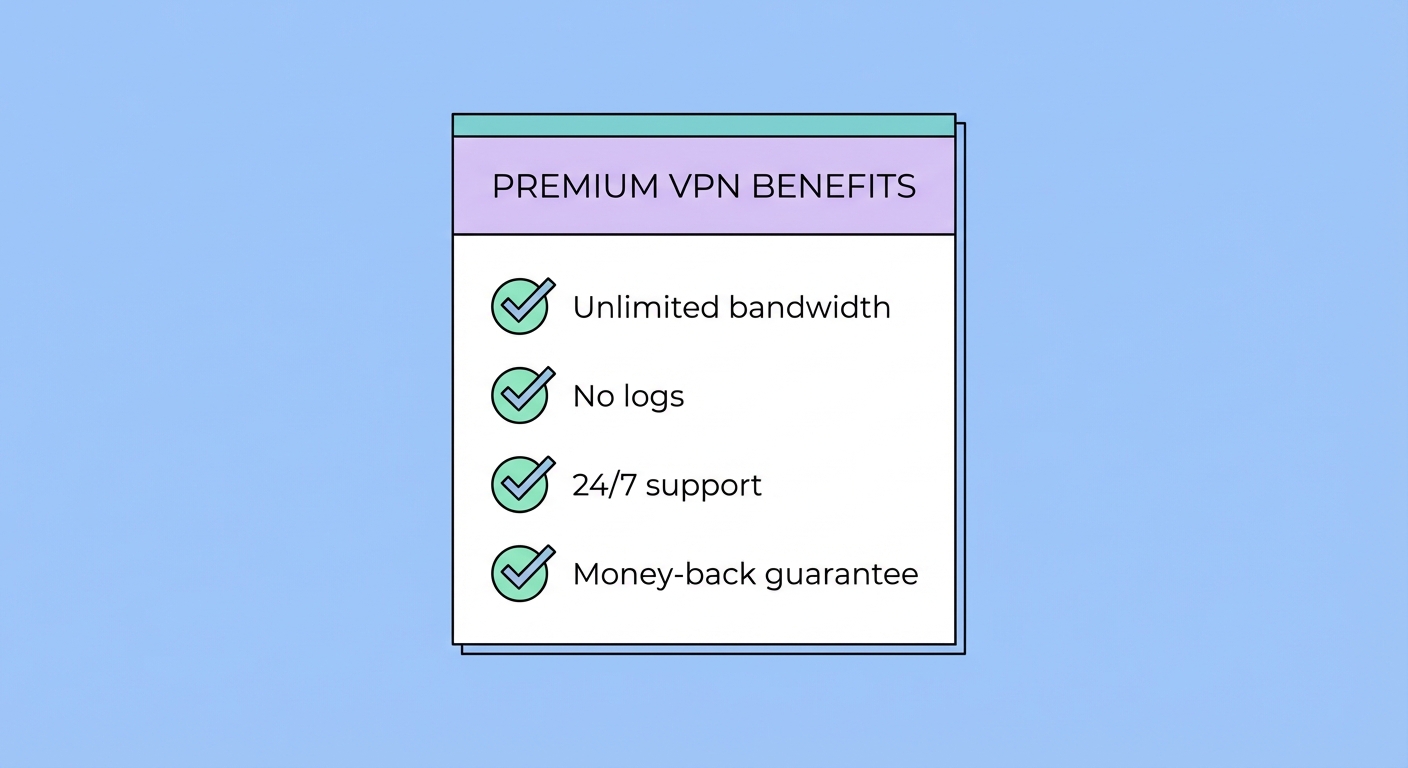
Our general recommendation is unambiguous: avoid free VPNs for any use case involving real privacy or security needs. The business models are incompatible with genuine user privacy, and the security risks are well-documented. A quality paid VPN costs less than two cups of coffee per month — it's a genuinely affordable investment in your digital security.
That said, two providers offer free tiers that can be trusted to a limited extent. ProtonVPN's free plan is the gold standard: it's operated by the same team behind ProtonMail, imposes no bandwidth caps, connects to 5 countries (Netherlands, USA, Japan), and operates under Swiss privacy law with a verified no-logs policy. The limitations are one connection at a time and no access to streaming or P2P servers — but it's genuinely useful for light browsing and email. Windscribe's free plan offers 10GB/month (generous), servers in 11 countries, and a surprisingly capable feature set including a firewall and ad blocker, though speed and streaming reliability are limited.
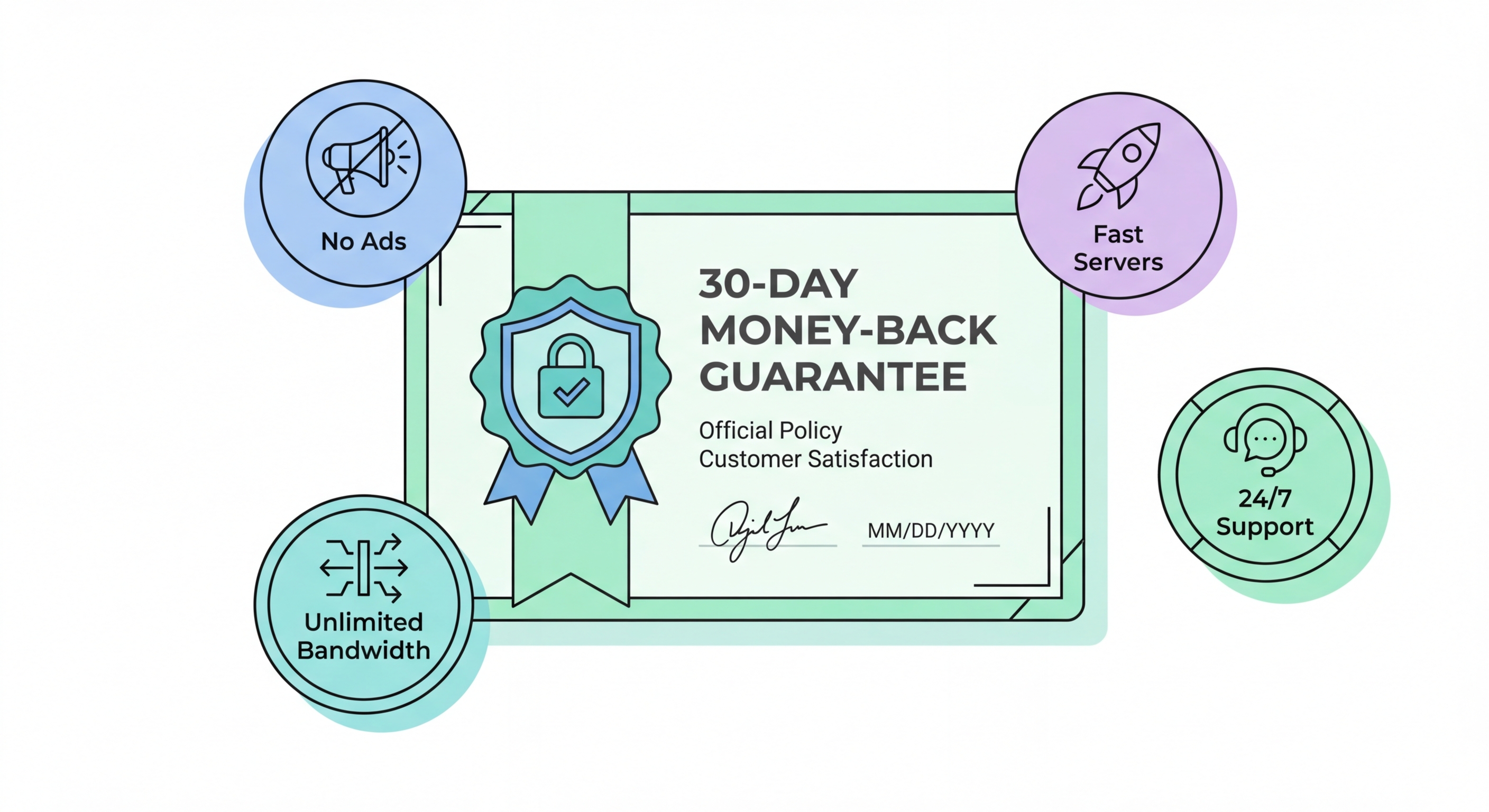
If budget is the primary concern, the most economical approach is purchasing Surfshark or NordVPN on a two-year plan during one of their frequent promotional periods — prices can drop as low as HK$20–30/month, less than a single MTR journey. Both offer 30-day money-back guarantees, making them risk-free to try.