How to Create a Cybersecurity Incident Response Plan

A practical framework for Hong Kong businesses to prepare for, detect, contain, and recover from cybersecurity incidents — covering IRP structure, team roles, communication protocols, and lessons learned processes.

Cybersecurity incident response plan Hong Kong
1Why You Need an IRP

Why Every Hong Kong Business Needs an Incident Response Plan

Cybersecurity incidents — ransomware attacks, data breaches, business email compromise fraud, account takeovers — are not theoretical risks for Hong Kong businesses. The Hong Kong Police Force's Cyber Security and Technology Crime Bureau (CSTCB) receives thousands of cybercrime reports annually, with financial losses in the billions of dollars. The question for most HK SMEs is not whether they will experience a cybersecurity incident, but whether they will be prepared to respond effectively when one occurs. An incident response plan (IRP) is the difference between a contained, recoverable incident and an uncontrolled crisis that causes lasting operational, financial, and reputational damage.

The cost of an unprepared incident response is substantially higher than the cost of preparation. Research consistently shows that organisations with tested incident response plans contain breaches faster, recover more quickly, and incur lower total costs than those responding ad hoc. In an unprepared response, critical decisions are made under extreme time pressure by people who have never practiced them — which services to take offline, who has authority to approve containment actions, when to notify regulators, whether to engage external forensic investigators, and how to communicate with affected customers. Each hour of confusion during active incident response extends exposure and increases damage.

Hong Kong businesses have specific regulatory notification obligations that make IRP preparation particularly important. The Office of the Privacy Commissioner for Personal Data (PCPD) expects data breach notifications when personal data incidents occur, with PCPD guidance indicating prompt notification is expected and delayed notification is viewed unfavourably. Financial services firms regulated by the HKMA and SFC have mandatory breach notification timelines under their respective supervisory guidance. Businesses without an IRP that specifies these notification obligations frequently miss notification windows, creating regulatory exposure on top of the underlying incident damage.

  • Incidents are inevitable for HK businesses: HKPF CSTCB data shows thousands of cybercrime incidents annually — preparation determines whether your business survives one
  • Cost of unpreparedness: Unprepared incident response results in longer breach duration, greater data loss, higher recovery costs, and more regulatory exposure
  • Regulatory notification obligations: PDPO, HKMA, and SFC all have breach notification expectations — your IRP must address these obligations and their timelines
  • Decision authority in advance: An IRP establishes in advance who can make critical containment decisions — preventing authority vacuum during the crisis
  • Third-party relationships: Your IRP should pre-identify forensic investigators, legal counsel, and PR advisors before you need them — engaging new providers during an active incident wastes critical time
  • Insurance requirements: Many cyber insurance policies require evidence of an IRP — your policy may not respond to claims from incidents where no IRP existed
Why incident response planning matters
2IRP Structure and Phases

Incident Response Plan Structure: The Six Phases

A well-structured incident response plan follows six phases: preparation, identification, containment, eradication, recovery, and lessons learned. Preparation occurs before any incident — it is the planning, training, and tooling that makes the subsequent phases effective. Identification is the detection and initial assessment of a potential incident — determining whether an anomaly represents an actual security incident, what type, and its apparent scope. Containment stops the incident from spreading while preserving evidence for investigation. Eradication removes the threat entirely. Recovery restores normal operations. Lessons learned captures what happened and improves future response.

For the identification phase, your IRP should define what constitutes a security incident for your organisation and establish clear escalation triggers. Potential incident indicators include: unusual system alerts from endpoint protection or SIEM, employee reports of suspicious emails or behaviour, unusual account activity flagged by cloud application monitoring, reports from customers or partners of suspicious communications claiming to be from your organisation, or external notification from HKPF CSTCB or your internet service provider. The IRP should specify who receives these reports, how they are assessed for severity, and the criteria for declaring a formal security incident that activates the full IRP response.

Containment strategy in your IRP should provide pre-approved action playbooks for the most likely incident types your business faces. Ransomware containment requires different immediate actions than a phishing credential harvest — ransomware requires rapid network isolation to prevent lateral spread, while credential compromise requires immediate password reset and session revocation. Having incident-type-specific playbooks that detail the sequence of containment actions, the systems and personnel involved, and the authority required for each action eliminates the need to design containment strategy from scratch during an active crisis. NIST SP 800-61 provides detailed guidance on incident response procedures that HK businesses can adapt for their context.

  • Six-phase IRP framework: Preparation, identification, containment, eradication, recovery, and lessons learned — each phase requires specific pre-defined procedures
  • Incident severity classification: Define severity levels (critical, high, medium, low) with clear criteria — severity determines response urgency, escalation path, and resource allocation
  • Incident type playbooks: Create specific playbooks for ransomware, phishing, data breach, BEC fraud, and account takeover — each requires different containment actions
  • Eradication completeness verification: The eradication phase must verify complete threat removal — partial eradication leaves backdoors that result in repeat incidents within weeks
  • Recovery sequencing: Restore systems in priority order based on business criticality — define system criticality rankings in advance in your IRP
  • Lessons learned process: Conduct a structured post-incident review within 2 weeks — capture timeline, root cause, what worked, what failed, and specific IRP improvements
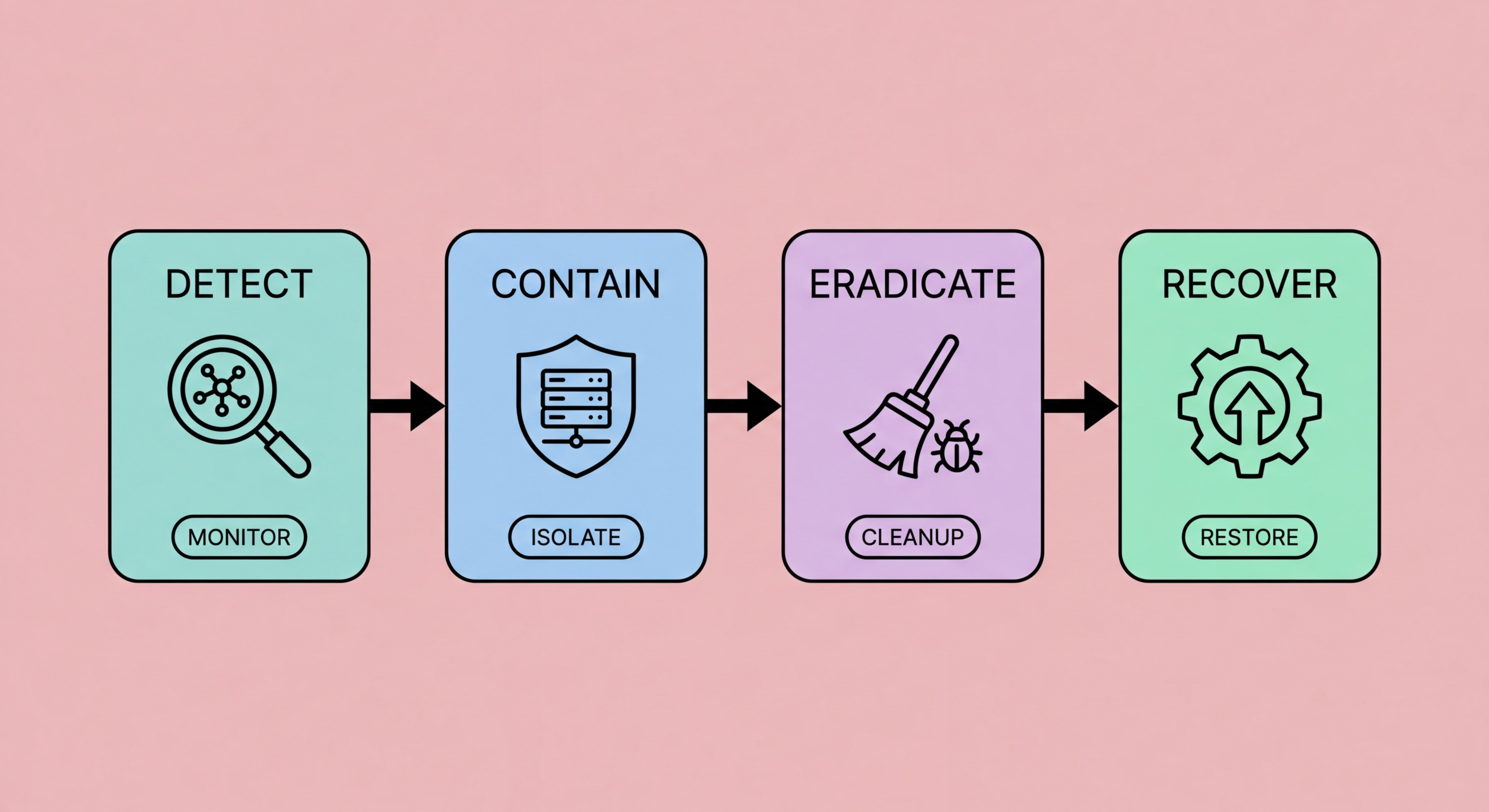
Incident response phases
3Incident Response Team

Building Your Incident Response Team and Roles

Every IRP requires a defined incident response team (IRT) with clear roles, responsibilities, and contact information. For large enterprises, the IRT may be a dedicated internal security operations team. For the majority of Hong Kong SMEs, the IRT will be a small group of existing staff with designated incident response responsibilities alongside their primary roles. The core IRT for an SME typically includes: an incident commander who coordinates the overall response and makes escalation decisions, a technical lead who executes containment and remediation actions, a communications lead who manages internal and external communications, and a legal/compliance advisor who addresses regulatory notification obligations.

External resources pre-identified in your IRP are as important as internal IRT members, because most HK SMEs will require external expertise for significant incidents. Your IRP should include pre-vetted contacts for: a cybersecurity forensic investigation firm capable of conducting digital forensics and providing expert evidence if law enforcement becomes involved, a law firm with data breach and PDPO expertise, a public relations firm experienced in crisis communications for cyber incidents, and your cyber insurance broker or insurer's incident response hotline. Engaging these providers reactively during an active incident wastes hours that directly affect incident outcome — pre-qualification and relationship establishment before any incident occurs is critical.

HKPF CSTCB is a key external stakeholder for significant Hong Kong cybersecurity incidents, particularly those involving financial fraud, ransomware, or data theft. Your IRP should include CSTCB contact information and specify the criteria for making a police report. Prompt police notification is important for BEC fraud cases where the HKPF may be able to assist with transaction tracing through the Anti-Deception Coordination Centre (ADCC). The HKMA's Cyber Resilience Assessment Framework (CARAF) and circulars provide specific incident notification requirements for banking institutions, and relevant SFC-licensed firms must follow the SFC's cybersecurity guidelines on notification timing.

  • Incident commander role: Designate a primary and backup incident commander with clear authority to make containment decisions and activate external resources
  • Technical lead responsibilities: The technical lead executes containment actions, coordinates with IT staff, and preserves forensic evidence — document specific technical procedures they must follow
  • Communications lead: Designate who manages internal communications to staff, external communications to customers, and media enquiries — not the technical team's responsibility during active response
  • Pre-vetted external providers: Identify and qualify forensic investigators, legal counsel, and PR advisors before any incident — include emergency contact numbers in the IRP
  • HKPF CSTCB reporting: Include CSTCB contact details (2860 5012) and specify criteria for police reporting — particularly for financial fraud and data theft incidents
  • 24/7 contact tree: Document out-of-hours contact information for all IRT members and key external providers — incidents do not occur only during business hours
Incident response team structure
4Communication and Testing

Incident Communication Protocols and IRP Testing

Communication during a cybersecurity incident requires careful management — both what is communicated and through which channels. If your primary email system is compromised or unavailable (a common situation in ransomware incidents that encrypt all company systems), your IRP must specify out-of-band communication methods. A pre-established group messaging channel on a personal messaging platform (WhatsApp or Signal group with all IRT members), pre-printed contact lists, and personal mobile numbers for all IRT members provide communication capability independent of corporate systems. Never assume corporate email or phone systems will be available during incident response.

External communication during an incident — to customers, partners, regulators, and media — requires a structured approach that balances transparency with legal caution. Your IRP communications plan should define: who is authorised to make public statements about the incident, pre-drafted notification templates for different incident types (data breach customer notification, partner warning of BEC activity), the regulatory notification timeline obligations under PDPO and sector-specific regulations, and the criteria for engaging media relations professionals. Inconsistent or premature public communication during an active incident can compromise investigations, create legal liability, and amplify reputational damage beyond the incident itself.

Testing your IRP through tabletop exercises is the single most effective way to identify gaps and build team competence before a real incident. A tabletop exercise presents a realistic incident scenario to IRT members and walks through how the team would respond at each phase — without actually taking systems offline. Scenarios might include: ransomware discovered on a finance workstation at 2am, BEC fraud discovered after a wire transfer has been executed, a senior executive's Microsoft 365 account showing signs of compromise, or a data breach notification from a cloud service provider affecting customer data. HK cybersecurity consultants and the HKPC offer tabletop exercise facilitation services appropriate for SME contexts.

  • Out-of-band communication plan: Establish communication methods that do not depend on corporate systems — pre-created messaging groups, printed contact lists, personal numbers
  • PDPO notification template: Pre-draft a PDPO data breach notification to the PCPD and to affected data subjects — notification must occur promptly and include specific required information
  • Media statement authority: Designate a single spokesperson for media enquiries and specify that no other staff comment publicly on incidents — inconsistent statements create legal and reputational risk
  • Annual tabletop exercise: Conduct at least one tabletop exercise annually with all IRT members — use realistic HK-relevant scenarios based on current threat intelligence
  • IRP review and update cycle: Review and update the IRP annually and after any real incident — plans become outdated as technology, personnel, and threat landscape change
  • Staff awareness of IRP basics: All employees should know the basics of reporting a suspected incident — who to contact, what information to preserve, and what not to do (do not reboot a ransomware-infected machine)
Incident communication and testing

Prepare Your Business for Cybersecurity Incidents

Explore our complete Business Cybersecurity guide for all aspects of protecting Hong Kong businesses before, during, and after a cyber incident.

Related VPN Articles