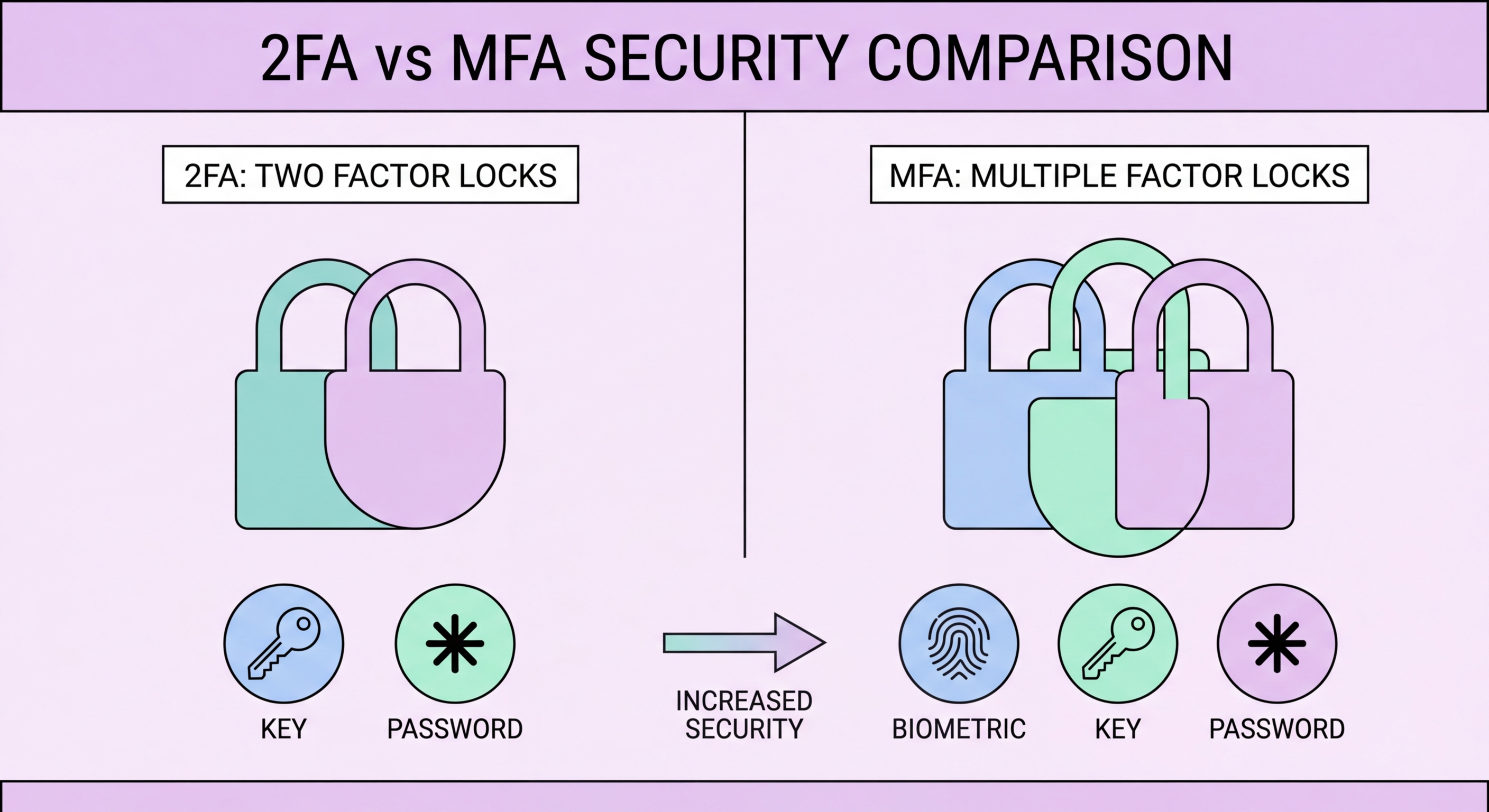
The terms "two-factor authentication" and "multi-factor authentication" are often used interchangeably — but they have a specific technical distinction. Understanding the difference matters more in enterprise and compliance contexts than it does for everyday users.
Multi-factor authentication (MFA) is the broader category. It describes any authentication process that requires two or more independent factors from different categories. The three factor categories are: something you know (password, PIN, security question), something you have (phone, hardware token, smart card), and something you are (fingerprint, face, iris scan). Any authentication system that requires two or more of these categories qualifies as MFA.
Two-factor authentication (2FA) is a specific subset of MFA that requires exactly two factors. By definition, 2FA is always MFA — but not all MFA is 2FA. A system that requires a password plus a TOTP code is 2FA (and MFA). A system that requires a password, a TOTP code, and a facial scan is MFA with three factors (sometimes called 3FA) but is not strictly 2FA. In practice, consumer authentication rarely uses more than two factors because the usability cost of three or more factors is significant relative to the security benefit for typical consumer threat models.
In everyday usage, the terms are frequently used interchangeably. Product marketing teams use "2FA" and "MFA" almost randomly, and most users treat them as synonyms. The distinction becomes meaningful in three contexts: regulatory compliance (where frameworks may specifically require MFA as opposed to 2FA, or vice versa), enterprise security policy (where policies may mandate specific factor combinations), and security research and academic literature (where precise definitions matter for claims about security properties). for Hong Kong SMEs: Where to Start">for Hong Kong Businesses">Kong Businesses: Implementation Guide">for Hong Kong Online Banking: What You Need to Know">For Hong Kong consumers enabling "2FA" on their accounts, the practical experience is identical to enabling "MFA."
The distinction between 2FA and MFA becomes practically significant in regulatory and compliance contexts. The Payment Card Industry Data Security Standard (PCI DSS) requires MFA for administrator access to cardholder data environments and for remote access to such environments. PCI DSS version 4.0 extended MFA requirements broadly across access to the cardholder data environment. For Hong Kong businesses processing card payments, understanding precisely what PCI DSS requires — and confirming your implementation satisfies the requirements — is important. PCI DSS requirements are satisfied by two or more authentication factors, so most typical 2FA implementations are compliant.
ISO 27001 information security management standards, Hong Kong's Cybersecurity Fortification Initiative (CFI) for the financial sector, and HKMA's "Cyber Resilience Assessment Framework" all reference strong authentication requirements that effectively require MFA. The HKMA expects authorised institutions to implement strong customer authentication for online banking transactions, which is fundamentally an MFA requirement even if the specific term varies. For financial institutions and their technology vendors in Hong Kong, understanding these requirements and mapping your authentication implementation to them is an important compliance activity.
In enterprise security architecture, the distinction matters when designing authentication policies. A policy that requires "MFA for all privileged access" is broader than a policy that requires "2FA for all privileged access" — because MFA could include three-factor requirements for the highest-privilege accounts (root access, financial systems) while 2FA applies to all others. Some enterprise security frameworks like NIST SP 800-63 use specific assurance levels (AAL1, AAL2, AAL3) rather than the 2FA/MFA terminology to avoid ambiguity about factor count and factor type requirements.
Beyond basic 2FA and MFA, enterprise environments increasingly implement step-up authentication and adaptive MFA. Step-up authentication means that a user can access some resources with standard authentication (just a password) but is prompted for an additional factor when attempting to access higher-sensitivity resources. For example, you log in to a corporate portal with a password, but when you attempt to access the HR system or financial reports, you are prompted for a second factor. This balances security with convenience by reserving the friction of MFA for the transactions that justify it.
Adaptive MFA (also called risk-based authentication) uses contextual signals to determine whether to require MFA, and sometimes which type. If you log in from your usual office in Central, Hong Kong, on your registered laptop — the risk signals are familiar and you may not be challenged for MFA. If you log in from a new country, at an unusual hour, from an unfamiliar device, the risk signals are elevated and the system requires stronger authentication — possibly asking for a hardware key rather than just an authenticator code. Identity platforms like Okta, Microsoft Azure AD, and Google Identity Platform implement adaptive MFA through risk-scoring engines.
Continuous authentication is an emerging concept that goes further, evaluating trust signals throughout a session rather than just at login. The device's behaviour, typing pattern, mouse movement, and geographic location are monitored continuously, and the session is challenged or terminated if signals deviate significantly from the user's established patterns. This approach is particularly relevant in zero-trust security architectures, which treat every access request as potentially hostile regardless of network location, and authenticate continuously rather than assuming a successfully logged-in session is trustworthy.
For individual Hong Kong users, the 2FA vs MFA distinction is not something you need to track carefully. Whether a service calls it "two-step verification," "2FA," or "MFA," the user experience is the same. Enable it. Use an authenticator app rather than SMS where possible. Save your backup codes. For individuals, the priority is broad adoption of second-factor authentication across all important accounts — the terminology used to describe it is secondary.
For Hong Kong SME owners and IT managers, the distinction becomes relevant when interpreting compliance requirements. When your cyber insurance policy requires "MFA," confirm whether your current implementation satisfies the requirement — most policies specify that email accounts and VPN access must use MFA, and standard authenticator app 2FA satisfies this. When PCI DSS requirements apply to your business, review the specific MFA requirement text with your QSA (Qualified Security Assessor) to confirm compliance. When implementing MFA platforms like Microsoft Azure AD Conditional Access, use the platform's documentation to understand how MFA policies are expressed and enforced.
The practical hierarchy for most HK users is: no second factor (weakest) → SMS 2FA → authenticator app TOTP → hardware security key FIDO2 → passkey with phishing resistance (strongest available for consumers). Regardless of whether you call it 2FA or MFA, moving up this hierarchy improves your real-world security. The nomenclature matters in compliance contexts and security documentation, but the underlying security property — requiring more than one independent verification factor — is what actually protects your accounts.