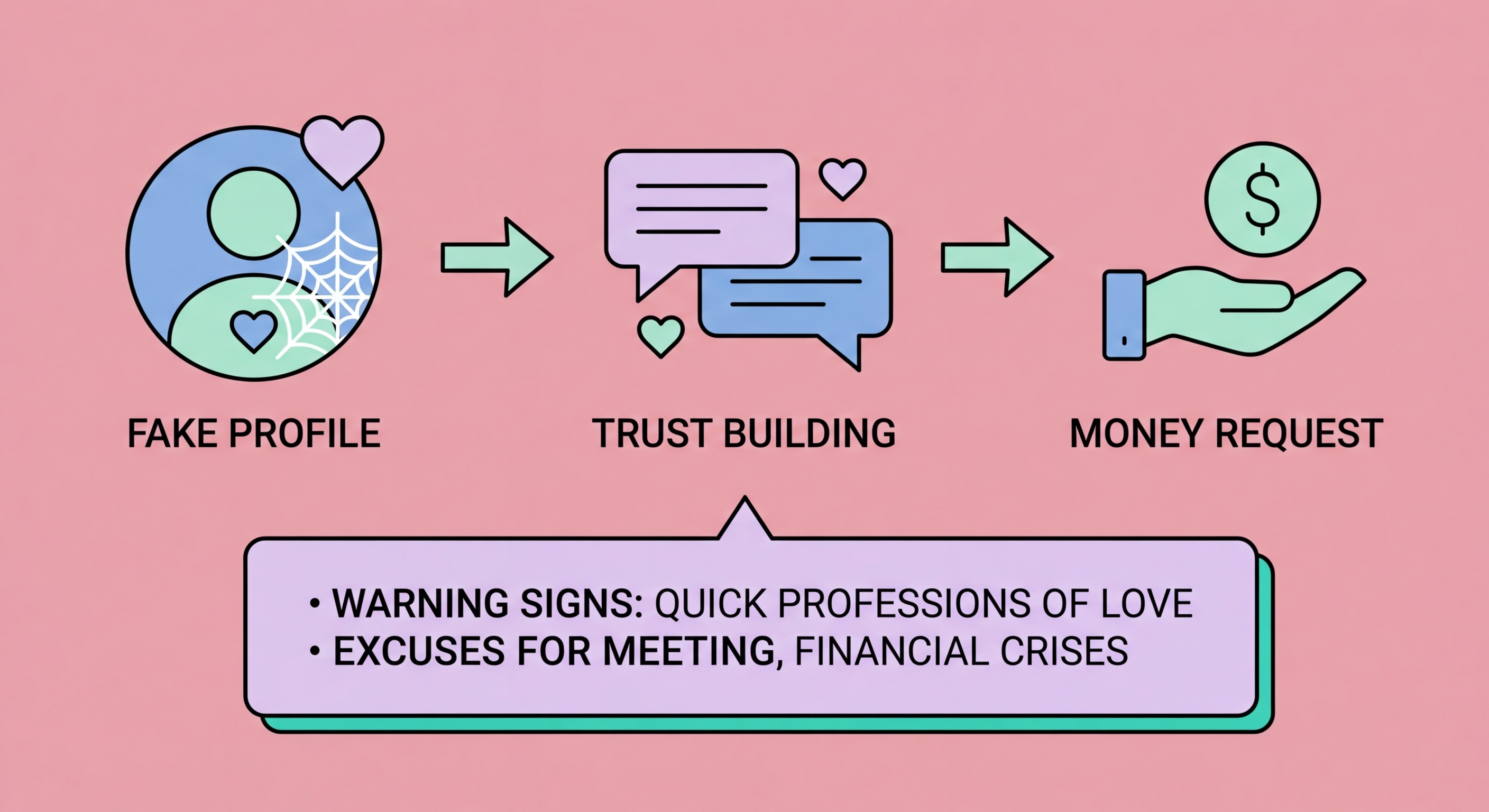
Romance scams cause some of the largest individual financial losses of any fraud type in Hong Kong, compounded by the emotional betrayal of a manufactured relationship. Understanding how they work is the first step to not becoming a victim.
Romance scams are long-duration, high-investment fraud operations that begin by establishing a genuine emotional connection with the victim before extracting money. Unlike quick-strike fraud, romance scammers invest weeks or months in building an attentive, caring relationship — daily messages, personal questions, emotional support, apparent shared values and interests. The relationship feels real because the emotional investment from the victim is real, even though the other party's persona is entirely fabricated. By the time money is requested, the victim has a psychological commitment to the relationship that makes it genuinely difficult to accept that the person they have connected with does not exist.
Contact is initiated through dating apps (Tinder, Bumble, Hinge, Tantan), social media (Instagram, Facebook), WhatsApp, and LinkedIn. Scammers often open with an "accidental" message — a wrong number, a connection request from an apparent professional peer — that quickly develops into a warm friendship before moving to more personal territory. The constructed persona is typically aspirational: an overseas-based professional (doctor, engineer, international business person, military officer) with a wealthy lifestyle visible through their curated profile and conversation. The backstory explains why they cannot meet in person — working in a war zone, on an oil rig, or in a remote location — which removes the most obvious fraud check of meeting the person before any financial transactions occur.
The request for money typically arrives in the context of an emergency that makes immediate financial assistance seem natural and urgently needed — a medical emergency, a legal problem, a business crisis that threatens a lucrative opportunity. Alternatively, as in the pig butchering variant, the request is framed not as charity but as a shared investment opportunity where the victim benefits financially. The first request is typically modest relative to the relationship's apparent value and the victim's resources, establishing a precedent of financial assistance that is subsequently escalated. Each successful request reinforces the victim's commitment — having already helped once, the psychological cost of believing the relationship is fraudulent increases.
Several consistent behavioural patterns appear across documented romance scam cases that can help identify an online contact as potentially fraudulent. The most reliable is the combination of strong emotional progression with consistent inability to meet in person or communicate via unrehearsed video call. Scammers who communicate extensively via text but repeatedly find reasons to cancel or avoid video calls (poor connection, work requirements, camera broken) are likely working from a fabricated identity. AI-generated profile photos cannot be verified by reverse image search, but live, unscripted video calls — particularly those requested spontaneously rather than pre-arranged — are significantly harder to fake, and genuine romantic interests will accept them readily.
Excessive and early declarations of deep affection, strong romantic attachment, or love — particularly when the relationship is still relatively new — are a documented pattern in romance scams. This is sometimes called "love bombing": overwhelming the victim with affection to create emotional dependency quickly. Combined with declarations that the victim is uniquely special, that the contact has never felt this way about anyone else, and that they foresee a shared future together, this emotional acceleration is a manipulation technique designed to build maximum psychological commitment in minimum time. Real relationships develop more organically; extreme affection very early in a relationship that has no in-person dimension should prompt scepticism rather than reciprocal emotional investment.
Any request for money, gift cards, cryptocurrency, or wire transfers — regardless of the pretext — from someone you have met exclusively online and have not met in person should be treated as a high-probability romance scam. This applies even if the financial request is framed as an investment opportunity where you will benefit, not just as a gift or loan. The framing varies (emergency, opportunity, convenience), but the financial request from an online-only contact is the definitive red flag. Neither the length of the relationship nor the quality of the emotional connection changes this assessment — scammers deliberately build both to obscure this signal. Before making any financial transaction based on an online relationship, consult a trusted family member or friend who knows about the relationship.
The pig butchering fraud methodology explicitly combines romance and investment fraud into a single operation. The romantic relationship is not an end in itself — it is the trust-building phase that precedes the investment fraud. Once sufficient emotional and relational investment has been established, the scammer introduces a financial element: typically, casual mention of exceptional investment returns they are personally experiencing, followed by an offer to share the opportunity. The emotional connection created in the romantic phase makes the victim significantly more willing to entrust money to the apparent romantic partner than they would to an unknown investment advisor, and significantly more reluctant to accept that the person they trust is defrauding them when warning signs emerge.
In Hong Kong, documented pig butchering operations have caused individual losses ranging from tens of thousands to multiple millions of Hong Kong dollars. The operations are sophisticated: they use professional platform designs, fabricated profit dashboards, and even customer service teams to handle victim queries during the "fattening" phase. Some operations allow victims to withdraw small amounts initially — specifically to build confidence in the platform's legitimacy and encourage larger subsequent investments. The moment the victim attempts a larger withdrawal, the platform becomes unresponsive, demands escalating fees, or simply disappears. The concurrent emotional relationship is usually maintained briefly after the fraud is revealed, with the scammer sometimes claiming to be a victim themselves of the platform, further extending the psychological manipulation.
Secondary victimisation through recovery scams is common in romance and pig butchering fraud cases. After suffering a loss, victims are frequently targeted by follow-on scams claiming to offer fund recovery services for an upfront fee, or by "investigators" who claim to be working with law enforcement to recover their funds. These are uniformly fraudulent secondary scams that exploit victims' desperation. No legitimate service charges upfront fees to recover fraud losses. Any contact received by a romance or investment fraud victim that offers recovery services, particularly if it references the specific details of the original fraud (which the secondary scammer may have obtained through scammer networks), should be reported to HKPF as a secondary fraud attempt.
If you suspect you may be involved in a romance scam — either from the warning signs described or from a sudden emergence of financial requests — the most important immediate step is to pause all financial transactions. Do not send any further money, cryptocurrency, or gift cards. Do not make any additional investments on any platform introduced by the contact. Take stock of what has already been transferred before taking further steps, as this information will be needed for any report. The psychological difficulty of accepting that a relationship you have invested in is fraudulent is real and documented — this is why consulting a trusted family member or friend before taking further action is strongly recommended.
Verification steps can help confirm your suspicion. Request a spontaneous, live video call on a different platform than usual — suggest FaceTime or a different WhatsApp video call at a time the scammer would not expect. If the person consistently refuses or finds reasons Hong Kong: Types and How to Avoid">to avoid an unscripted live video call, this is a significant indicator. Consider asking the contact to perform a specific action in the video (write your name on paper, hold up a particular object) that would be difficult to fake with pre-recorded video. Contact details like claimed employers, addresses, and professional credentials can often be cross-checked through independent sources to identify inconsistencies in the constructed persona.
Report the fraud to HKPF at 182 388, providing all communication records, transaction details, and platform information. If funds were transferred, contact your bank's fraud team and the ADCC at 18222 immediately. Report the profile on the platform where contact was established — dating apps, social media platforms, and messaging apps all have fraud reporting mechanisms that can disable the account and prevent other potential victims from being targeted. Seek emotional support — the psychological impact of romance fraud is significant and often involves not just financial loss but a profound sense of betrayal and shame. The HKPF victim support unit and organisations including the Hong Kong Family Welfare Society can provide appropriate referrals for support.