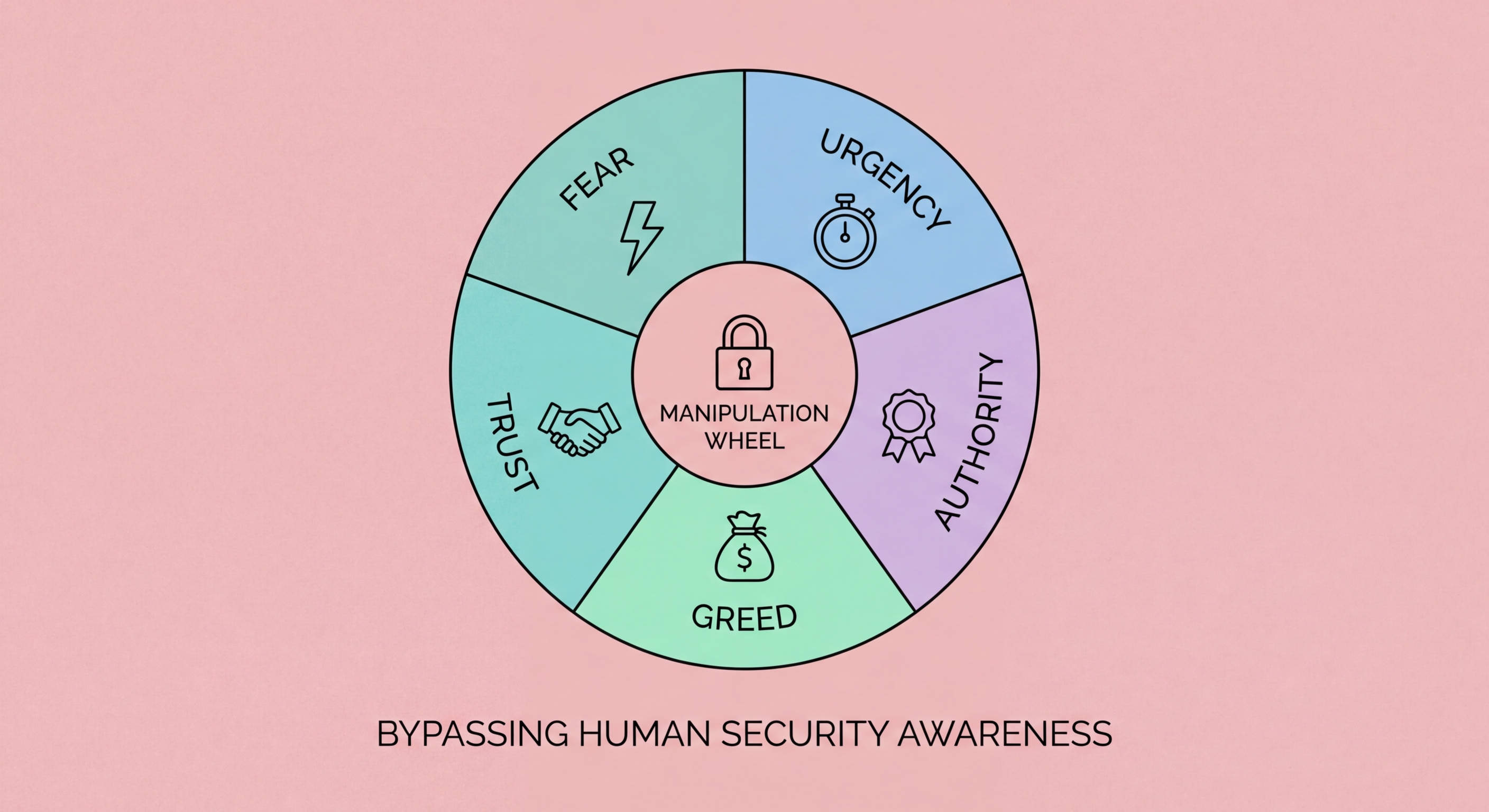
Phishing succeeds not because technology fails, but because human psychology is predictably exploitable. Understanding the specific psychological triggers that scammers use is the foundation of genuine phishing resistance.
Social engineering attacks exploit documented psychological principles rather than technical vulnerabilities. Robert Cialdini's research on influence identified six principles — authority, social proof, scarcity, reciprocity, commitment, and liking — that reliably influence human decision-making in ways that can be exploited by attackers. Phishing campaigns are not random: they are designed around specific psychological triggers that are known to drive compliance before careful reflection can intervene. Understanding which triggers are being activated in a message is a more reliable detection method than looking for technical red flags, because the psychological manipulation is the invariant element even when all technical indicators are obscured.
Authority is the most frequently exploited trigger in phishing. People are conditioned to comply with apparent authority figures — government officials, police, senior managers, financial institutions — even when the request is unusual. The HKPF conducts thousands of cases annually where victims transferred large sums to apparent "mainland police" or "ICAC investigators" specifically because the authority framing bypassed their normal scepticism. Authority bias is particularly strong in Hong Kong's cultural context, where deference to institutional authority and hierarchical seniority is well-established. Scammers exploit this consciously, framing messages with official language, case numbers, and institutional branding to trigger compliance before the victim has time to question the legitimacy of the source.
Urgency and scarcity work by narrowing the decision-making window. "Your account will be closed in 24 hours", "this offer expires tonight", "act now to prevent arrest" — these formulations are not accidental. Under time pressure, people rely on heuristic shortcuts rather than deliberate analysis, making them more susceptible to manipulation. The urgency is almost always artificial: genuine financial institutions do not close accounts within hours of an email notification, and genuine law enforcement does not arrest people because they failed to respond to a phone call quickly enough. Recognising urgency as a manipulation technique — rather than as evidence that the situation is genuinely urgent — is one of the most valuable phishing-resistance habits to develop.
Trust is built through familiarity and prior positive experience, and scammers systematically manufacture both. Pig butchering Scams in Hong Kong: How to Recognise and Avoid Them">Scams in Hong Kong: Fake Offers and How to Spot Them">Scams in Hong Kong: How to Spot and Avoid Them">Scams in Hong Kong: Pig Butchering and Crypto Fraud">investment scams invest weeks or months in building genuine warm relationships before introducing fraud elements — by the time the investment pitch arrives, the victim's trust has been earned through consistent, attentive contact over an extended period. This manufactured trust is then leveraged: the emotional connection with the scammer makes it psychologically difficult for the victim to believe they are being defrauded even when warning signs emerge. The feeling of being betrayed by a "friend" adds an additional layer of shame that often prevents victims from reporting or even fully acknowledging the fraud.
Visual familiarity — the appearance of a trusted brand — is exploited in email, SMS, and web-based phishing. Phishing sites and emails are designed to look identical to the genuine service: the same logo, colour scheme, layout, and language that the victim has seen and trusted for years. This visual pattern matching creates an automatic sense of legitimacy that bypasses critical evaluation. The fraudulent HSBC login page that is pixel-perfect in its visual replication of the genuine one is designed specifically to exploit the victim's accumulated positive experience with the real HSBC website. Against this type of trust exploitation, the reliable defence is not visual inspection but structural analysis — checking the actual URL, not the visual appearance of the page.
Social proof — the tendency to follow the apparent behaviour of others — is used in several phishing contexts. Messages claiming "thousands of Hong Kong residents have already claimed their refund — verify now before it expires" exploit social proof by implying that others have acted and that acting is therefore safe. Fake testimonials, inflated user counts, and references to "most of our customers" on fraudulent investment platforms serve the same function. In WhatsApp group-based scams, where a fake group is populated with apparent "members" who enthusiastically discuss their profits, social proof is engineered through the fake group dynamics. Recognising manufactured social proof as a manipulation technique — rather than genuine evidence of safety — requires specifically questioning the source of the evidence being presented.
Fear and greed are the two dominant emotional states targeted by social engineering attacks, because both override careful analysis and drive immediate action. Fear-based attacks create the threat of severe consequences — arrest, account closure, financial loss, deportation, criminal prosecution — that trigger a fight-or-flight response. This physiological stress state reduces higher-order reasoning and increases compliance with urgent demands. The "mainland police" vishing scam is a near-perfect fear-based attack: the threat of arrest activates profound fear, the authority framing suppresses scepticism, and the isolation instruction ("do not tell your family") removes the external check that would most likely break the deception.
Greed-based attacks offer unexpected windfalls — unclaimed prizes, refunds, investment opportunities with extraordinary returns, business opportunities. The initial emotional response to unexpected good news is positive and receptive rather than sceptical. Phishing emails claiming a lottery win, an Octopus refund, or an inheritance from a distant relative exploit this receptive state. The action required to "claim" the benefit — providing personal information, paying an upfront fee, clicking a link — is presented as a minor step to access a significant gain. The rationalisation "I'm not being scammed, I'm just claiming what I'm owed" suppresses the scepticism that would otherwise be applied to an unsolicited financial communication.
The most sophisticated scams combine fear and greed sequentially. Investment scams often begin with greed (the exceptional investment returns) and transition to fear when the victim attempts withdrawal — suddenly there are "taxes", "compliance fees", or "penalties" that must be paid or the invested funds will be forfeited. At this point, the victim is motivated by both the fear of losing everything they have invested and the greed of the apparent profits still showing on their dashboard. This combination creates a powerful motivation to comply with further payment demands even after warning signs should have triggered disengagement. Recognising the transition from greed-motivation to fear-motivation in an ongoing financial relationship is a key indicator that the situation is fraudulent.
Technical knowledge about social engineering tactics does not automatically translate into resistance — knowing that urgency is a manipulation technique does not eliminate the urgency response when you are in a genuine fear state during a convincing vishing call. Genuine resistance requires internalising specific behavioural protocols that are applied as habits regardless of emotional state, and practising them in low-stakes situations so they are available under pressure. The most important protocol is the pause-and-verify rule: before acting on any unexpected request involving money, personal information, or unusual access, stop, end the current interaction, and verify through an independent channel. This single habit, reliably applied, prevents the majority of social engineering attacks.
Isolation tactics — instructions not to tell anyone or not to hang up — are a reliable indicator of social engineering precisely because legitimate organisations have no reason to prevent you from consulting others or taking time to verify. When any communication instructs you to keep something confidential from family, colleagues, or your bank, or insists you must not break off contact to verify, this instruction itself confirms the communication is fraudulent. Real police investigations, legitimate business transactions, and genuine financial services processes do not require the victim's cooperation to be maintained under isolation conditions. Training yourself to treat isolation instructions as a bright-line fraud signal provides an immediate exit strategy regardless of how convincing the surrounding narrative is.
Metacognitive awareness — the ability to observe your own emotional state — is a transferable skill that improves social engineering resistance across all attack vectors. The practice is simple: when you are reading an important message or on a significant phone call, periodically ask yourself "what emotion is this communication trying to create in me?" If the answer is fear, urgency, or unexpected excitement, apply additional scrutiny. The emotional response is the attack surface, and noticing it in real time gives you the opportunity to choose a deliberate response rather than an automatic one. This practice can be developed through regular reflection on communications you receive, building the metacognitive habit before you need it in a high-pressure fraud situation.