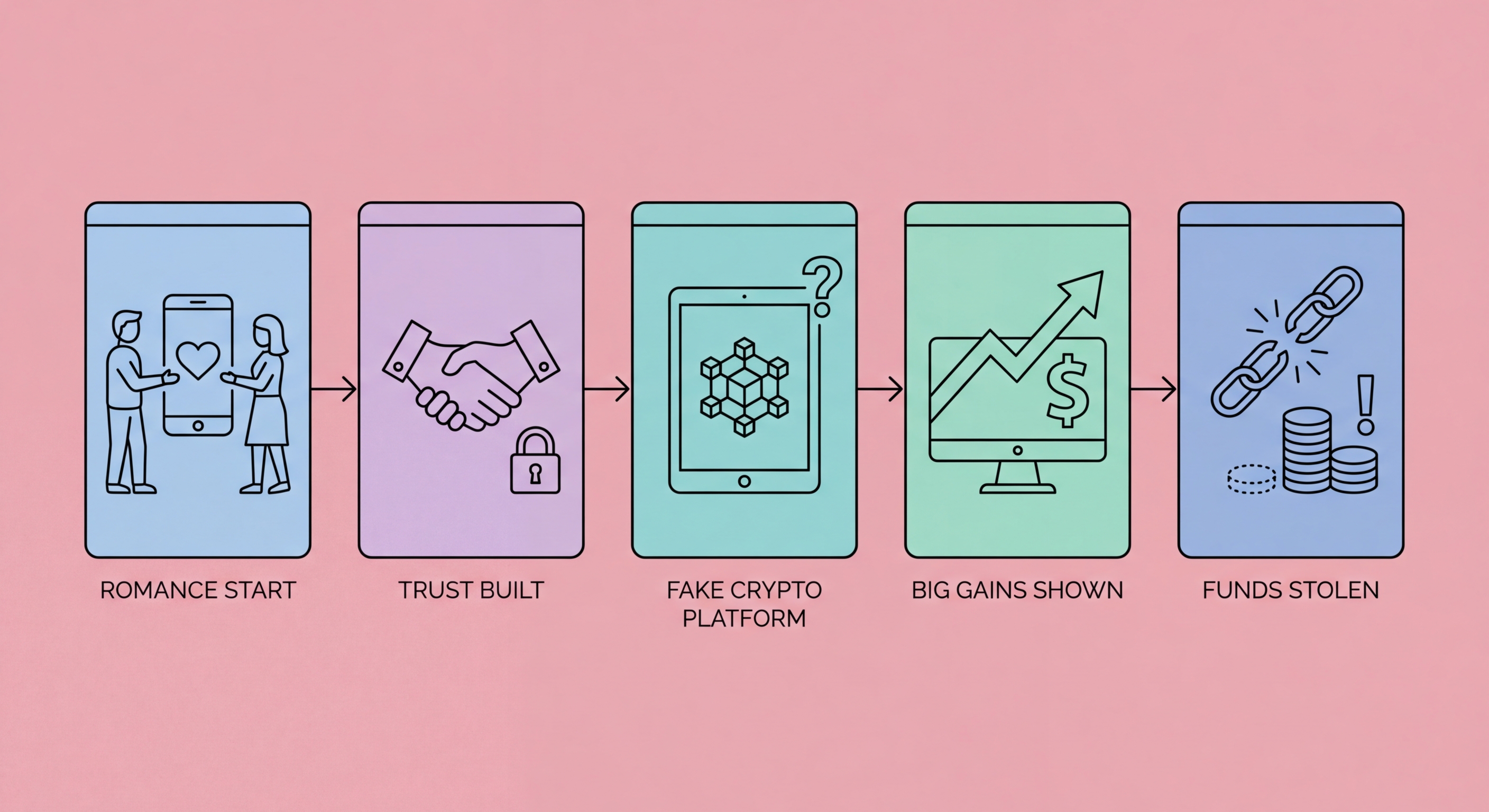
Investment scams cause the largest average financial losses of any fraud category in Hong Kong. The pig butchering technique — extended trust-building followed by a fake investment platform — now accounts for billions in annual losses across the region.
Pig butchering (sha zhu pan — literally "killing the pig") is an investment fraud methodology that originated in Southeast Asia and now accounts for some of the largest individual financial losses reported to Hong Kong Police. The name describes the technique: the scammer "fattens the pig" — building the victim's trust and financial commitment over weeks or months — before "slaughtering" it by disappearing with all invested funds. Unlike quick-strike scams that attempt to extract money immediately, pig butchering is a long-game operation requiring sustained investment of time by scammers who are often themselves victims of human trafficking working in scam operations in Cambodia, Myanmar, and neighbouring countries.
The operation begins with initial contact that appears accidental or incidental — a WhatsApp message to the wrong number, a connection request on LinkedIn, a match on a dating app, or a seemingly random message on Instagram or Facebook. The scammer quickly establishes that the contact was "coincidental" but continues the conversation, which gradually develops into a warm, attentive friendship or romantic relationship. The scammer is typically well-resourced: they use a curated social media presence with consistent backstory, photos, and lifestyle details, and communicate daily to build genuine emotional connection. In Hong Kong, scammers often claim to be successful professionals in finance, trading, or international business — plausible in a city where such careers are common.
After weeks or months of relationship-building, the investment element is introduced — usually casually, as something the scammer is personally involved in. They share apparent trading success, showing screenshots of profits, and eventually offer to help the victim access the same opportunity. The investment platform they introduce is either entirely fabricated or a legitimate-looking clone of a real exchange. Initial small investments appear to generate impressive returns, visible on the platform's dashboard. The victim is encouraged to invest more. When they eventually attempt to withdraw profits or principal, they encounter demands for "taxes", "fees", or "verification deposits" — and eventually the platform disappears, taking everything with it. HKPF reports consistently place pig butchering losses among the highest of any fraud category, with individual victims losing millions of HK dollars.
Cryptocurrency investment scams are particularly prevalent in Hong Kong because the city has a sophisticated financial services sector whose residents are comfortable with investment concepts, and because cryptocurrency's genuine complexity makes fraudulent platforms harder to detect. Fake cryptocurrency exchanges and trading platforms are technically convincing — they feature real-time price charts, portfolio dashboards, deposit and withdrawal interfaces, and even customer support chat. The platforms are built to generate apparent profits on the dashboard that are never backed by real assets, creating a compelling illusion of legitimate returns that encourages victims to invest increasingly large sums.
Unlicensed investment schemes are also common in Hong Kong, sometimes operating through legitimate-appearing company structures. The SFC (Securities and Futures Commission) maintains an Investor Alert List of suspicious investment products and unregulated entities, and HKMA maintains a list of suspicious virtual asset platforms. These resources are underused by the public — many victims are unaware that checking regulatory status before investing is straightforward and takes minutes. Any investment platform offering returns significantly above market rates, guaranteeing profits, or claiming special access to exclusive opportunities that others cannot access should be verified against SFC and HKMA records before committing any funds.
The Hong Kong Monetary Authority introduced the Virtual Asset Service Provider (VASP) licensing regime requiring crypto exchanges operating in Hong Kong to be licensed. Licensed platforms are listed on the SFC website. Any platform not appearing on this list that is accessible to Hong security Guide for Hong Kong Residents">Kong residents and accepts HK dollar deposits is operating without a licence and carries significant fraud risk. Scammers frequently clone the branding and interfaces of legitimate licensed platforms to make their fraudulent version appear authorised. Always access investment platforms through the official URL found through the SFC's register rather than through any link provided in a message, email, or social media post.
The most reliable early warning sign of a pig butchering or investment scam is the combination of an unexpected new contact who quickly becomes very attentive and eventually steers the conversation toward an investment opportunity. Legitimate investment advisors in Hong Kong are licenced professionals who do not contact potential clients through WhatsApp, dating apps, or social media. Any investment discussion that originates from an unsolicited contact on a personal messaging platform — regardless of how long the relationship has developed — should be treated with extreme caution. The quality and warmth of a relationship built online is not an indicator of the other party's legitimacy as an investment source.
Be alert to specific conversational patterns that signal the transition from relationship-building to the investment pitch. These include: the contact mentioning their own investment success casually, sharing screenshot profits without being asked, offering to "show you how" to invest on a platform they use, explaining that a family member or uncle who works in finance has provided them access to a special opportunity, or suggesting that you start with a small amount to "see for yourself". These are scripted elements of a documented fraud methodology, not coincidental details — they appear across hundreds of reported pig butchering cases in Hong Kong with remarkable consistency.
Technical red flags for any investment platform include: the domain is recently registered (check via WHOIS); the platform is not listed in any SFC or HKMA registry; contact with customer support is only available via messaging apps rather than verifiable email or phone; withdrawal requests trigger demands for additional payments; and the returns on the platform consistently exceed market rates regardless of market conditions. The last point is particularly important: even during periods of significant market volatility or crypto downturns, a fraudulent platform's dashboard will show consistent growth, because the numbers are entirely manufactured and not connected to any real market position.
If you have made deposits to a platform you now believe to be fraudulent, stop making any additional payments immediately — including any "taxes", "fees", or "verification deposits" demanded before you can withdraw. These demands are a further stage of the fraud; no legitimate investment or tax authority demands payment via cryptocurrency or bank transfer to a third-party account before releasing funds. Every additional payment made after doubts arise increases your total loss and will not result in the release of any funds. Cut contact with the scammer and preserve all communication records before doing so.
Report the fraud to HKPF as soon as possible. File a report with the Cyber Security and Technology Crime Bureau at 182 388, or visit any Hong Kong police station to make a formal report. If funds were transferred via bank transfer, contact your bank's fraud team immediately — while recovery of funds already transferred is rarely possible, there may be circumstances where a bank can place a hold on a transfer that has not yet been processed. Contact the Anti-Deception Coordination Centre (ADCC) at 18222, which operates a dedicated fraud interception service. The SFC also accepts reports of unlicensed investment activity at sfc.hk/complaint.
Seek support — the psychological and financial impact of investment fraud is significant, and shame often prevents victims from reporting or seeking help promptly. Victims are not foolish: pig butchering operations are professionally resourced, psychologically sophisticated operations that specifically target intelligent, financially capable individuals. The HKPF provides victim support resources, and organisations including the Hong Kong Family Welfare Society offer financial counselling. Be wary of "recovery scam" services claiming to recover lost investment funds for an upfront fee — these are a secondary fraud targeting pig butchering victims and are uniformly fraudulent themselves.