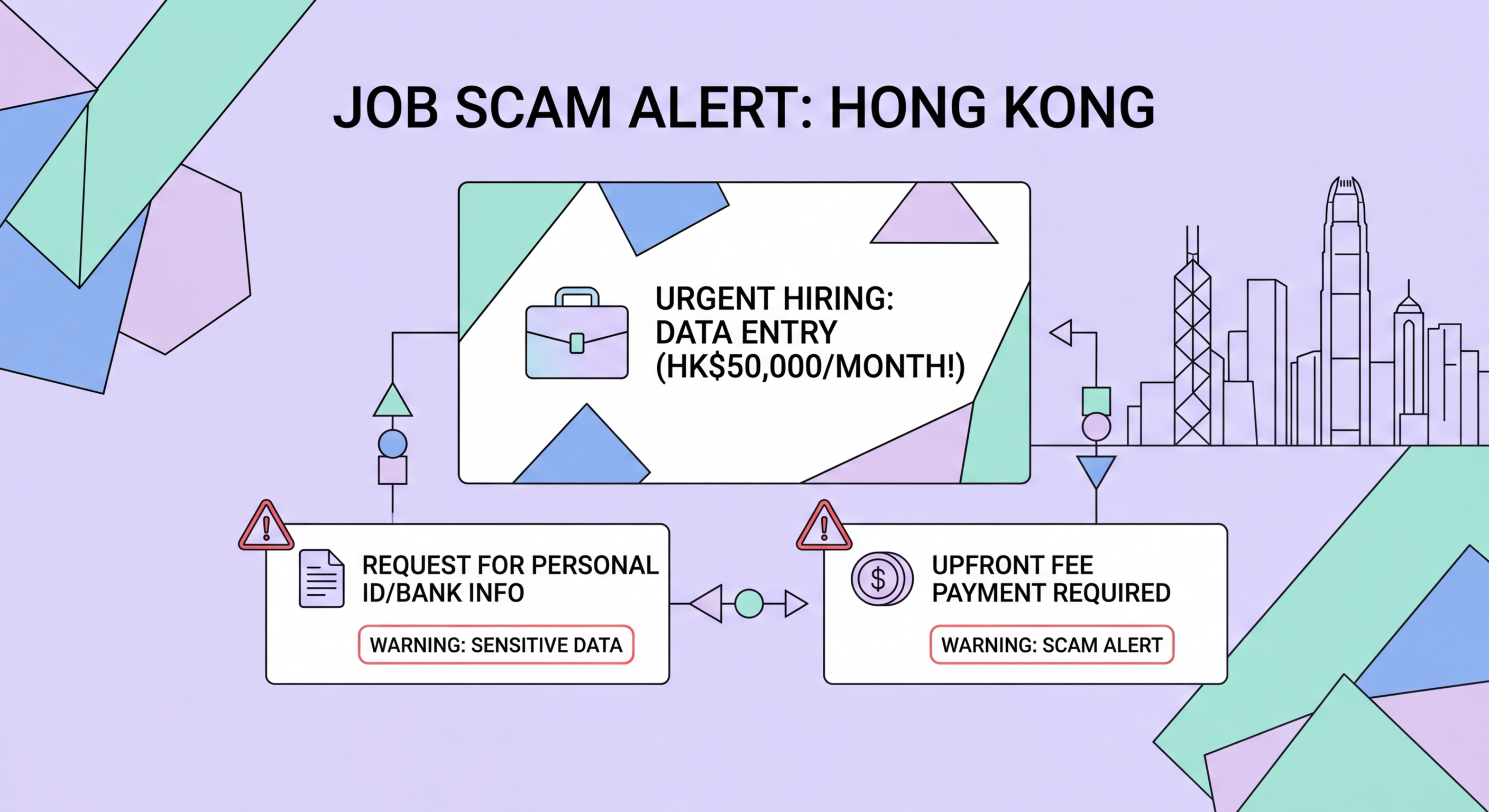
Fake job offers are one of the fastest-growing fraud categories in Hong Kong, targeting students, young professionals, and job seekers with deceptive part-time work offers that lead to financial loss, identity theft, or worse.
Task-based job scams — sometimes called "task scams" or "brushing scams" — are the most prevalent job fraud type in Hong Kong in 2024–2026. The victim is recruited for apparent part-time work involving completing simple online tasks: rating products, liking social media posts, writing reviews, or watching videos. Initial small payments are made genuinely to establish credibility. The victim is then enrolled in a tiered system where larger "missions" or "task sets" require them to deposit funds to unlock — ostensibly to process the tasks or demonstrate good faith. Initial deposits appear to generate returns, encouraging larger subsequent deposits. When the victim attempts to withdraw accumulated earnings and deposits, the platform demands fees or simply becomes inaccessible. The HKPF has documented thousands of these cases with total losses in the hundreds of millions of HK dollars annually.
Money mule recruitment is a second major job fraud type with serious legal consequences for victims. Fraudsters recruit individuals for apparent legitimate financial processing roles — often described as "bank account verification agent", "cross-border payment facilitator", or "financial compliance assistant" — that involve receiving transfers into the victim's personal bank account and forwarding them onwards, keeping a small percentage as "commission". Victims are not told, or deliberately avoid acknowledging, that these transfers represent proceeds of fraud. Allowing your bank account to be used as a conduit for fraudulent transfers makes you legally liable under Hong Kong's Organised and Serious Crimes Ordinance for money laundering — a serious criminal offence. HKPF regularly arrests and prosecutes money mules regardless of whether they were themselves initially deceived.
Human trafficking recruitment through fake employment advertising is a severe harm that sits at the extreme end of the job scam spectrum. Fraudulent advertisements offering well-paid work in technology, customer service, or casino operations in Southeast Asian countries have been used to lure Hong Kong and mainland Chinese workers to Myanmar, Cambodia, and Laos, where they are forced to work in scam operations under conditions of duress. The Hong Kong government and HKPF have issued explicit advisories about this threat. Any overseas job offer promising unusually high pay, with recruitment conducted entirely online and arrangements for the employer to handle visa and travel logistics, should be treated as a potential trafficking risk.
WhatsApp is the primary delivery channel for job Scams in Hong Kong: Pig Butchering and Crypto Fraud">Scams in Hong Kong: How to Spot and Avoid Them">scams in Hong Kong, reflecting the platform's near-universal adoption for both personal and professional communications. Scammers contact potential victims directly via WhatsApp from unfamiliar numbers, presenting themselves as recruiters from established companies or employment agencies. The message content is typically brief and high-value: a description of easy part-time work with an unusually high daily earnings figure, a request to "chat for more details", and an invitation to join a WhatsApp group where other "employees" are visible and apparently earning. The WhatsApp group dynamic serves as manufactured social proof — a room full of apparent colleagues discussing their earnings makes the opportunity seem genuine and established.
LinkedIn is used for more professionally targeted job scams, particularly those targeting finance, technology, and business professionals. Fraudulent LinkedIn profiles — often using AI-generated profile photos and fabricated work histories — send InMail messages or connection requests followed by private messages about lucrative opportunities. Because LinkedIn's professional context carries an implicit credibility assumption — particularly for job offers in the professional's stated sector — these messages receive higher engagement than equivalent cold approaches on other platforms. Fraudulent LinkedIn job postings have also been reported, where a fake company profile posts a vacancy that directs applicants to an external form collecting personal data, or to a WhatsApp conversation that transitions to a task scam onboarding flow.
Telegram has emerged as a significant job scam channel in 2025, particularly for task-based scams. Scammers operate Telegram channels claiming to provide paid tasks, with apparent administrators distributing work and processing payments. The encrypted nature of Telegram provides both operational security for fraudsters and a false sense of privacy and legitimacy for victims — legitimate business tools do use Telegram for some functions, providing plausible deniability. Telegram group chats populating with apparent fellow workers discussing earnings mirror the WhatsApp group social proof technique. Job search platforms including Indeed, JobsDB (widely used in Hong Kong), and other aggregators have also been exploited through fraudulent postings, though these platforms actively work to remove fraudulent listings.
Legitimate employment offers for jobs with established companies do not arrive as unsolicited WhatsApp messages from unknown numbers. Recruitment through personal messaging apps from cold contacts is not the standard practice of reputable Hong Kong employers — they use professional recruitment channels, established platforms, and company email addresses. Any job offer that arrives as an unsolicited message on a personal messaging platform should be treated with significant scepticism, regardless of how professional the language or how compelling the compensation claim. Ask yourself: how did this person get my number, why are they contacting me this way, and does this match how legitimate jobs in my sector are typically recruited?
Upfront payments or deposits are never a legitimate feature of employment. No genuine employer requires candidates to pay a deposit for equipment, training, or task processing before beginning work. No legitimate task platform requires you to deposit funds to unlock earning levels or access higher-value work. Any employment scenario that transitions from earnings to deposits — where you must put money in to get money out — is structurally identical to the task scam model. This transition often happens gradually, with the initial deposit framed as a minor inconvenience that will be immediately recovered through earnings. Once the first deposit is made, subsequent deposit demands increase, and recovery becomes impossible.
Unusual payment methods are a strong red flag. Legitimate employers pay salary into your registered bank account in the standard payroll cycle. They do not pay via cryptocurrency, gift cards, or FPS transfers from individual accounts. If the "payment" structure for a job involves receiving transfers into your account and forwarding them elsewhere, this is a money mule arrangement. If tasks are "rewarded" with cryptocurrency deposits to a specific wallet, this is a fraud structure. If you are asked to purchase gift cards with your own money and provide the codes as proof of task completion or deposit, this is a gift card fraud structure that has no legitimate business application. Any payment mechanism that differs significantly from standard HK employment practices should trigger immediate termination of the engagement.
If you have been defrauded through a job scam, report to HKPF at 182 388 or via the Cyber Crime Reporting Portal. File a formal police report — this is required for any financial recovery action and enables HKPF to investigate and disrupt the scam operation. If deposits were made via bank transfer, contact your bank's fraud team immediately — though recovery of transferred funds is rarely possible, early reporting helps limit losses in some circumstances. If the scam involved a platform accessed online, report the URL to HKCERT at hkcert.org/report for technical investigation and takedown. Preserve all communication records, payment receipts, and platform screenshots before reporting.
If you were recruited as a money mule — allowing your bank account to receive and forward fraud proceeds — seek legal advice promptly. Voluntary disclosure to HKPF, combined with evidence that you were deceived about the nature of the activity, may be taken into account but does not automatically prevent investigation or prosecution. Ceasing the activity immediately and cooperating fully with any investigation is the recommended approach. Your bank will likely freeze your account when fraud activity is detected — do not open new accounts to continue money mule activity as this compounds the criminal exposure significantly. The Labour Department's Employment Agencies Administration accepts complaints about fraudulent job placement services operating under the guise of licensed employment agencies.
If you received an overseas job offer that you now believe may be a human trafficking recruitment attempt, contact the HKPF immediately at 999 or 182 388. If you are already overseas in a situation where you are being held against your will or forced to work, contact the Hong Kong SAR government's overseas offices, the local Hong Kong consulate, or the IOM (International Organisation for Migration) emergency hotline. The HKPF has a dedicated anti-trafficking team and has repatriated Hong Kong residents from Southeast Asia who were recruited through fraudulent overseas job offers. Do not feel embarrassed about seeking help — the people responsible for fraudulent overseas job recruitment operations are criminal organisations engaged in serious human rights abuses.