Employee credentials, customer data, and corporate intelligence regularly appear on dark web markets following breaches. This guide helps Hong Kong businesses understand the threat, implement monitoring, and respond effectively under the PDPO framework.
Hong Kong businesses face a specific and growing dark web threat profile shaped by the territory's status as a major financial and trade centre. Employee credentials — particularly for corporate email, VPN access, and business applications — are consistently among the most valuable items traded on dark web markets. A set of Microsoft 365 credentials for a mid-size financial services firm may sell for US$500-2,000 as "initial access," purchased by ransomware groups or espionage actors seeking a foothold in the corporate network. For Guide for Hong Kong">Hong Kong businesses with international client bases, the presence of client data on dark web markets creates both direct financial risk and significant PDPO liability. The HKPF CSTCB's annual cybercrime statistics consistently show that business email compromise (BEC) and ransomware — both enabled by dark web credential trading — are among the costliest cyber threats to HK businesses.
The scope of what should concern Hong Kong businesses goes beyond individual employee credentials. Customer databases — containing names, HKID numbers, contact details, and financial information — are prime targets for theft and resale. In financial services, customer data breaches create direct PDPO notification obligations and potential regulatory scrutiny from the HKMA, SFC, and IA, depending on the sector. Professional services firms (law, accounting, consulting) hold client confidential information that has intrinsic value on dark web intelligence markets — trade secrets, M&A intelligence, litigation strategy documents. Healthcare providers hold patient data that commands premium prices on medical identity markets. Each sector has a different threat profile; dark web monitoring must be configured to detect the data types most relevant to your specific business and the criminal communities most likely to target your sector.
Supply chain and third-party risk is a growing dark web concern for Hong Kong businesses. Major breaches often occur not at the target organisation but at a vendor, service provider, or technology partner. When a payroll provider, cloud service, or IT contractor is breached, employee data from all client companies is exposed simultaneously. Monitoring must therefore extend beyond your own domain — tracking the dark web for your employee and customer data regardless of which organisation's system was the original breach source. This supply chain exposure explains why some businesses discover their employee credentials on dark web markets despite having strong internal security controls — the breach occurred at a service provider, not within their own systems.
The business dark web monitoring market is tiered by organisation size and risk profile. For small to medium businesses (SMBs) in Hong Kong, the HIBP domain search is the essential free starting point: haveibeenpwned.com/DomainSearch allows you to check your corporate domain against HIBP's breach database, identifying every company email address that has appeared in known breach data. The free check provides a historical baseline; ongoing domain monitoring (automatic alerts when any company email appears in new breaches) is available through HIBP's paid API subscription (approximately US$3,500/year) — valuable for larger organisations. For most SMBs, a monthly manual domain check supplemented by employee password manager enforcement (requiring unique passwords through policy and tools like 1Password Teams or Bitwarden Teams) provides a solid security baseline at manageable cost.
Mid-market and enterprise organisations in Hong Kong typically require dedicated threat intelligence platforms for meaningful dark web coverage. The leading enterprise platforms include Recorded Future, Flashpoint, SpyCloud, and Digital Shadows (ReliaQuest) — each provides automated monitoring of dark web markets, forums, and paste sites with alerts configured for specific organisational domains, executive names, client data patterns, and sector-specific threats. These platforms are expensive (US$25,000-200,000+/year for enterprise licences) and are most cost-effective when integrated with a security operations centre (SOC) function that can act on alerts in real time. For Hong Kong businesses that lack internal SOC capability, managed security service providers (MSSPs) including local cybersecurity firms that partner with threat intelligence vendors offer managed monitoring services at more accessible price points.
A tiered approach for Hong Kong businesses of different sizes: micro and small businesses (under 50 employees) should implement HIBP domain monitoring (free), enforce password managers with breach monitoring across all employee accounts, and subscribe to HKPF CSTCB's commercial sector alerts (free, via cstcb.police.gov.hk). Medium businesses (50-500 employees) should consider dedicated dark web monitoring services at the SMB tier (SpyCloud Business, HaveIBeenPwned Notify via API) plus cybersecurity awareness training to reduce credential phishing. Large businesses and regulated financial institutions should invest in enterprise threat intelligence platforms integrated with their SOC, supplemented by sector-specific intelligence feeds (FS-ISAC for financial services) and regular threat intelligence briefings from their primary cybersecurity partners.
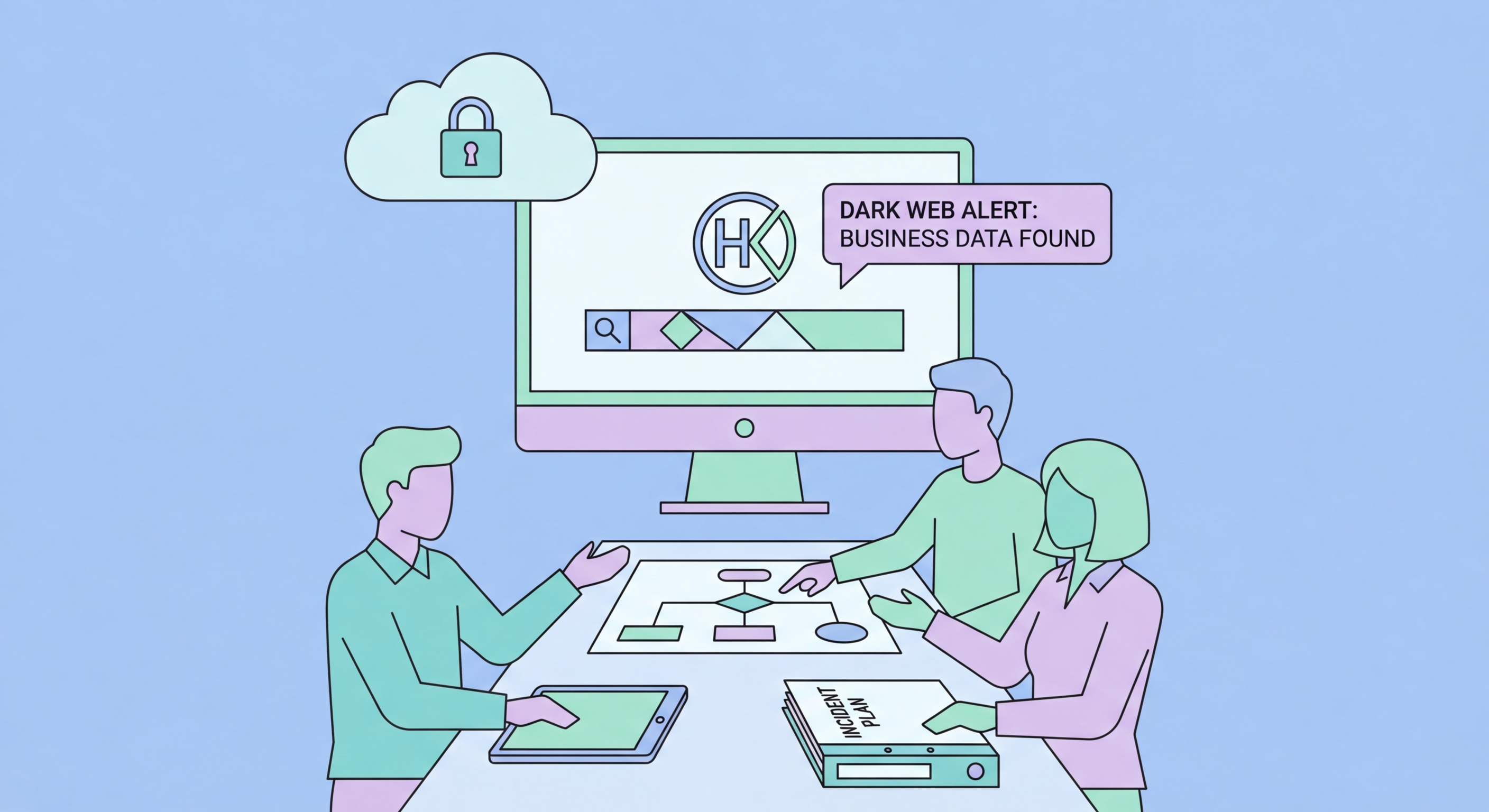
When a dark web monitoring alert indicates that employee credentials or customer data has appeared on dark web markets, the business response needs to be rapid, systematic, and documented. The first action upon receiving a credential alert is to force password resets for all affected accounts — not requesting that the employee change their password (which may happen slowly), but IT-forcing an immediate reset that prevents login with the old credential. Simultaneously, review logs for recent access to the affected account: when was it last used, from what IP addresses or devices, and was there any unusual access pattern suggesting the credential was already exploited? If any anomalous access is found, treat it as a confirmed compromise and escalate to full incident response rather than the standard remediation workflow.
For customer data alerts — when a dark web market listing indicates that your customers' personal data is being sold — the response triggers PDPO obligations. Under the 2021 amendments, you must notify both the PCPD and affected customers "as soon as practicable" once the breach is confirmed. The notification must include the data types exposed, the likely consequences, the steps taken, and a contact point for enquiries. Before notifying, confirm with your cybersecurity team and legal counsel whether the dark web listing constitutes confirmation of a breach (as opposed to a listing that may be fabricated or refer to an older incident). Document your assessment process — demonstrating that you investigated thoroughly and acted promptly will be important in any subsequent PCPD inquiry or regulatory examination. Engage your cyber insurance carrier immediately if you have coverage, as early notification affects coverage for incident response costs.
The longer-term response to a business dark web incident should include a root cause analysis to identify how the credentials or data were obtained — this determines whether the incident is isolated (a single employee's personal device was compromised) or systemic (a credential harvesting attack across multiple employees, or a database breach affecting customer data). Document findings, implement corrective controls, and assess whether the incident meets the threshold for HKPF CSTCB reporting (recommended for all incidents involving financial loss or customer data; required for incidents involving electronic fraud under the Computer Crimes Ordinance). Conduct a post-incident review to update your incident response plan and improve monitoring and detection for future incidents — each incident provides intelligence about your specific threat profile that should be used to refine your defences.
Dark web monitoring is most valuable as part of a comprehensive corporate security programme that reduces both the probability of data ending up on dark web markets and the damage when it does. The foundational controls that reduce dark web exposure are primarily credential security measures: mandatory password manager adoption (1Password Teams, Bitwarden Teams, or equivalent) ensures employees use unique credentials per service, eliminating credential stuffing as an attack vector; mandatory MFA (multi-factor authentication) on all corporate systems ensures that even credentials appearing on dark web markets cannot be used to access corporate systems without the second factor; and phishing resistance training reduces the primary means by which employee credentials are harvested for dark web sale. These three controls — password manager, MFA, phishing training — provide the highest return on investment for credential security across all business sizes.
Zero trust network architecture provides a more sophisticated approach for larger organisations: rather than trusting anyone inside the corporate network, zero trust verifies identity and device health for every access request, regardless of location. In a zero trust model, a compromised credential found on the dark web is significantly less useful to an attacker because it must be combined with device health verification, location-based access policies, and other contextual signals. Implementing zero trust is a multi-year journey for most organisations, but the foundational elements — identity verification for all access, device health checking, and network segmentation — can be implemented progressively. For Hong Kong financial services firms subject to HKMA cybersecurity requirements, the progression toward zero trust architecture aligns with regulatory guidance on advanced cyber resilience.
Regular tabletop exercises and incident response rehearsals are the final piece of corporate dark web resilience. When a dark web monitoring alert fires in a real incident, the response must be immediate and well-coordinated — people need to know their roles, the decision tree for escalation, and the communication protocols. Practice scenarios that begin with a dark web monitoring alert: who receives the alert, who decides whether it's a confirmed incident, who initiates the PDPO assessment, who communicates with the PCPD and affected customers, and who leads the technical remediation. Businesses that have practiced their incident response before an event occurs respond significantly faster and more effectively than those that are developing their response in real time under pressure. Involve your legal counsel, cyber insurance broker, and key IT staff in at least one tabletop exercise annually.