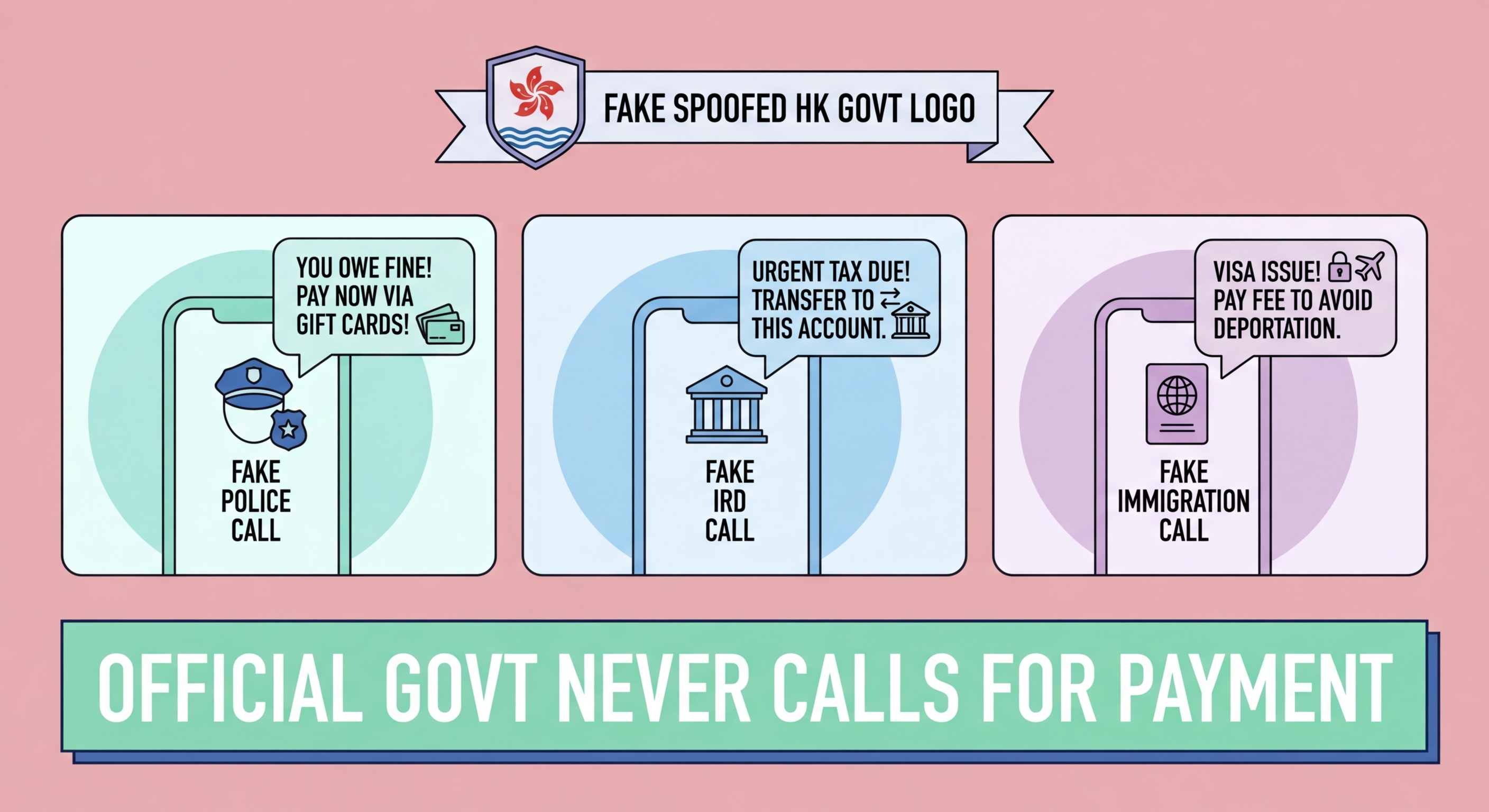
Scammers impersonating the Hong Kong Police Force, mainland Chinese authorities, the ICAC, IRD, and Immigration Department have caused some of the largest individual fraud losses ever recorded in Hong Kong. Understanding how these scams work is essential protection.
The mainland police impersonation scam is one of the most financially devastating fraud types documented in Hong Kong, with individual losses reaching tens of millions of Hong Kong dollars in some cases. The operation begins with an automated phone call — sometimes initially presented as a courier company notification about a detained package — that transfers the victim to a "mainland police officer" or "prosecutor". The caller explains that the victim's identity has been involved in a serious crime (money laundering, drug trafficking, financial fraud), that a warrant for their arrest has been issued or is imminent, and that their bank accounts are under investigation. The victim is given a "case number" and the name of an official investigation unit to establish procedural credibility.
The manipulation escalates through a series of scripted elements designed to maximise fear and compliance. The victim is instructed not to disclose the investigation to family, employers, or their bank (isolation preventing external verification). They are transferred between apparent departments and officials, each reinforcing the seriousness of the situation. In some variants, the victim is shown a fabricated warrant document or shown a video call with an apparent uniformed police officer. The "resolution" offered — to clear their name and prove their innocence — involves either providing bank account details for a "fund verification freeze", transferring funds to a "safe account" controlled by the scammers, or paying a "security deposit" that will be returned after investigation completion.
The HKPF has issued repeated public advisories stating categorically: the genuine Hong Kong Police Force, the People's Public Security Bureau, or any mainland Chinese law enforcement agency does not conduct investigations by phone calls requesting payment, account details, or asset transfers. Genuine investigations involve formal written notifications, in-person interviews conducted at police stations, and legal representation. A phone call from any person claiming to be a law enforcement officer who requests immediate financial action is a scam. The HKPF has established a dedicated "Call 18222 First" advisory for anyone who receives such a call — the ADCC can confirm in real time whether the call is consistent with any genuine investigation or matches a known scam pattern.
Inland Revenue Department (IRD) impersonation scams typically take two forms: telephone calls claiming unpaid taxes requiring immediate payment Hong Kong: Types and How to Avoid">to avoid prosecution, and phishing emails or SMS messages directing recipients to fraudulent IRD websites to "verify" tax refund details. The telephone variant uses the same fear-and-urgency methodology as the mainland police scam but with a tax delinquency pretext — the victim is told they owe back taxes, that a warrant will be issued unless payment is made immediately, and that the call must be kept confidential. The phishing variant is sometimes seasonally timed to coincide with the Hong Kong tax assessment and refund period, when many residents are genuinely expecting communications from IRD.
ICAC (Independent Commission Against Corruption) impersonation exploits the extraordinary institutional authority the ICAC holds in Hong Kong and the profound reputational and professional consequences of being investigated for corruption. Scammers claiming to be ICAC officers contact victims — particularly those working in government, financial services, or other regulated sectors — with fabricated allegations of corruption or bribery. The psychological impact of a call from the apparent ICAC is severe: the threat of career destruction, public exposure, and criminal prosecution can cause rational individuals to comply with payment demands before consulting legal representation. Genuine ICAC investigations do not begin with phone calls requesting payment or account details — they involve formal notices, search warrants, and legal representation rights.
Immigration Department impersonation scams typically target foreign domestic workers, non-permanent residents, and new arrivals — those most likely to feel vulnerable regarding their immigration status. Calls claim that the victim's visa is being cancelled, that there is an irregularity with their entry record, or that they are being investigated for immigration violations. The "resolution" involves an immediate payment or the provision of personal documents. These scams exploit the genuine anxiety many non-permanent residents feel about immigration matters and the potentially severe consequences of genuine immigration issues. The real Immigration Department contacts people through official mail, does not demand payment by phone, and any genuine immigration matter can be verified by calling the Immigration Department's published hotline at 2824 6111.
Understanding what genuine government department communications look like is as important as recognising the fraud patterns. The Hong Kong Police Force does not conduct investigations by asking suspects to transfer money by phone. If HKPF wishes to speak to someone in connection with an investigation, they make contact through official channels — a letter to the person's registered address, attendance at their residence with appropriate documentation, or a request to attend a police station for an interview. Police officers present warrant cards with verifiable identification numbers that can be checked through the HKPF's published verification resources. Phone calls from people claiming to be police officers that involve financial demands are not consistent with genuine police procedure at any stage of any investigation.
The IRD communicates through official letters sent to registered addresses, electronic notices through the MyGovHK platform, and (for some matters) through published notices in the Gazette. The IRD does not send SMS messages containing links to login or verify tax refund details, does not call taxpayers to demand immediate payment outside normal tax assessment procedures, and does not accept payment via cryptocurrency, gift cards, or FPS transfers to individual accounts. Genuine tax demands from IRD arrive through formal written assessment notices with a defined response period and an official payment reference. Any electronic communication claiming to be from IRD that requests credential entry, financial details, or immediate payment via unconventional methods is fraudulent.
When in doubt about any communication that claims to be from a Hong Kong government department, use the government's published contact information — accessible through gov.hk — to call the department directly and verify whether the communication is genuine. Do not use any contact number or website link provided in the suspicious communication. Most Hong Kong government departments have dedicated fraud alert pages and accept public calls about suspected impersonation — using these resources is the correct response to any uncertain official communication, and genuine government officers will not object to or penalise you for taking time to verify their identity through official channels.
If you receive a call claiming to be from mainland police, ICAC, IRD, Immigration, or any other government authority that involves any of the warning signs described — financial demands, isolation instructions, threats of arrest, demands not to hang up — end the call immediately. Do not be influenced by the caller's insistence that hanging up constitutes non-cooperation or will worsen your legal situation. No genuine law enforcement procedure requires you to remain on a phone call against your will, and ending a call with a scammer does not create any legal obligation or adverse consequence. After ending the call, call a trusted family member or friend and describe what happened before taking any other action.
Call the Anti-Deception Coordination Centre at 18222 to report the call and to ask whether the scenario described matches any genuine ongoing investigation or known active scam pattern. The ADCC can provide immediate guidance on whether a call is consistent with any known fraud pattern and can begin fraud intelligence reporting immediately if it is. For suspected mainland law enforcement impersonation specifically, you can also check with the Hong Kong Police Force directly at 182 388. Do not attempt to return a call to a number that called you — scammers operating sophisticated phone-based fraud will often keep the line open or redirect the number to a fake "verification service".
If you have already transferred money as a result of a government impersonation call, treat this as a financial fraud emergency: contact your bank's fraud team immediately and the ADCC at 18222. If the transfer was made via FPS, the interception window is narrow but may be open for transfers that have not yet been credited. File a formal HKPF report as soon as possible — this is required for any subsequent civil recovery action and enables police to investigate the receiving account. Psychological support is available through HKPF victim support resources and organisations including the Hong Kong Family Welfare Society's counselling services, as the experience of being defrauded through an authority impersonation scam can be deeply unsettling and the financial losses significant.