Enterprise Password Management for HK Organisations
For larger Hong Kong organisations, consumer password managers are not sufficient. Privileged access management, SSO integration, and governance are the pillars of enterprise credential security.
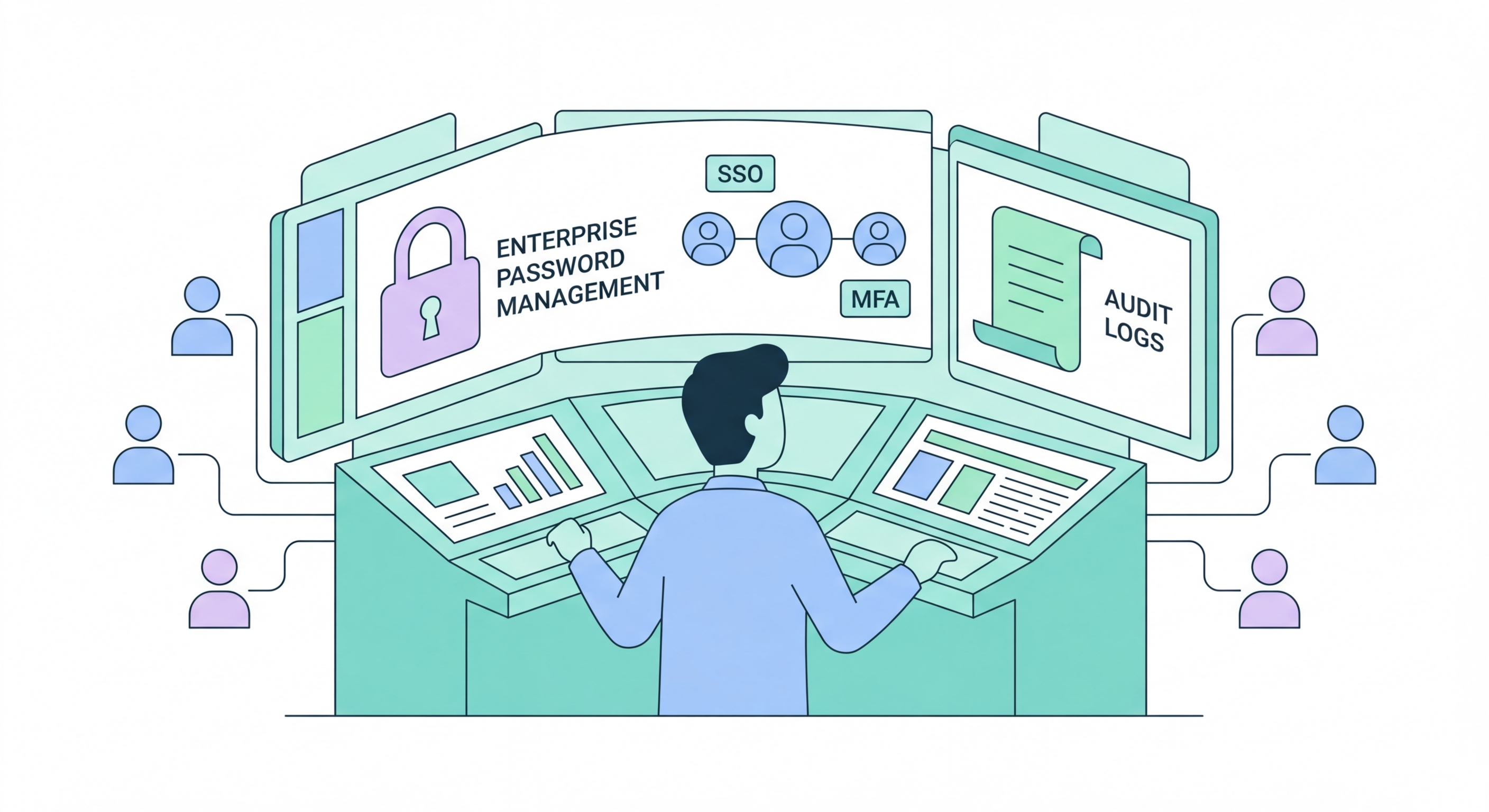
For larger Hong Kong organisations, consumer password managers are not sufficient. Privileged access management, SSO integration, and governance are the pillars of enterprise credential security.
Organisations with more than 50 employees, significant IT infrastructure, or regulatory obligations face password management challenges that exceed the capabilities of consumer and SME-focused tools. The core additional requirements are: centralised governance and policy enforcement across the entire organisation; privileged access management (PAM) for administrative and service account credentials; seamless integration with identity infrastructure like Active Directory, Azure AD, or Okta; comprehensive audit logging for compliance; and scalable onboarding and offboarding workflows.
Privileged access management is particularly critical in enterprise environments. Administrative credentials — domain administrator accounts, database root users, cloud infrastructure accounts, network device management interfaces — provide access to systems that if compromised could enable complete organisational data exfiltration or operational disruption. PAM solutions implement just-in-time access (credentials issued only when needed and automatically revoked), credential rotation (passwords changed automatically after each use or on a schedule), and session recording (complete recording of privileged sessions for audit purposes).
Hong Kong Businesses: Implementation Guide">for Hong Kong Online Banking: What You Need to Know">for Hong Kong Online Banking: A Complete Guide">for Hong Kong SMEs: Where to Start">For Hong Kong organisations subject to the Cybersecurity Law, PDPO obligations, or the Monetary Authority of Hong Kong's (HKMA) cybersecurity requirements for financial institutions, enterprise password management and PAM are not optional. The HKMA's Cybersecurity Fortification Initiative (CFI) explicitly addresses privileged access controls as a maturity requirement, and the HKPC's cybersecurity framework references credential management as a fundamental control. Larger organisations should map their password management implementation against these frameworks.

Leading PAM solutions suitable for larger Hong Kong organisations include CyberArk, BeyondTrust, Delinea (formerly Thycotic/Centrify), and HashiCorp Vault. CyberArk is the market leader for large enterprises and regulated industries — its Privileged Access Security suite provides full-lifecycle privileged credential management, session recording, threat analytics, and extensive integration with enterprise security tooling. It is widely deployed in HK financial institutions and large corporates. The implementation complexity and cost are significant, requiring dedicated infrastructure and specialised expertise.
BeyondTrust and Delinea provide strong alternatives at somewhat lower implementation complexity and cost, making them accessible to mid-market Hong Kong organisations. HashiCorp Vault is an open-source secret management solution particularly popular in DevOps and cloud-native environments, where it manages not just human-facing credentials but also machine-to-machine secrets, API keys, and database credentials used by applications. For organisations with significant cloud infrastructure on AWS, Azure, or GCP, Vault's native cloud integrations make it a compelling choice.
For organisations not yet at the scale requiring full PAM, enterprise editions of Keeper and 1Password provide a middle tier with meaningful privileged account controls, role-based access, and detailed audit logging at a fraction of the cost of dedicated PAM platforms. These tools can serve as a stepping stone toward full PAM maturity — implementing the governance and logging practices that full PAM requires, at a scale and cost appropriate for growing organisations.

Single Sign-On (SSO) allows users to authenticate once to a central identity provider and then access multiple applications without re-entering credentials. For enterprise password management, SSO integration means employees use their corporate identity (backed by the organisation's IdP — Azure AD, Okta, Google Workspace, or on-premises Active Directory) to access the password manager, rather than maintaining a separate master password. This simplifies the user experience and centralises authentication governance in the IT team's hands.
SAML 2.0 and OIDC (OpenID Connect) are the standard protocols for SSO integration. Most enterprise password managers support SAML federation with major identity providers. When an employee logs into the password manager via SSO, the authentication is handled by the IdP (with whatever MFA policies the organisation has configured there), and the IdP issues an assertion to the password manager confirming the user's identity. This means corporate MFA policies automatically apply to password manager access without additional configuration.
SCIM (System for Cross-domain Identity Management) provisioning automates user lifecycle management. When a new employee is added to Azure AD or Okta, SCIM automatically creates their password manager account and provisions their vault access based on their role or group membership. When an employee leaves, SCIM automatically deactivates their password manager account. This eliminates the manual admin work of provisioning and the security risk of delayed de-provisioning when people leave the organisation.

Governance in enterprise password management means establishing policies, ensuring they are enforced technically, and demonstrating compliance through evidence. For Hong Kong organisations, this typically means: documented password and PAM policies aligned with HKMA CFI, PDPO, and any applicable industry standards (PCI DSS for payment organisations, ISO 27001 for organisations seeking certification, or HIPAA for any healthcare-adjacent entities); technical enforcement of those policies through the password manager or IdP; and audit log collection and retention in a format suitable for regulatory review.
Audit logs for credential access should record: the identity of the user accessing each credential; the credential or vault accessed; the timestamp; the originating IP address and device; and the outcome (success or failure). These logs must be tamper-evident and retained for a period aligned with your regulatory requirements — HKMA typically requires two years of audit trail retention. Centralised log aggregation in a SIEM (Security Information and Event Management) system allows correlation of credential access logs with other security events to detect anomalous access patterns.
Periodic access reviews are an important governance control that is often neglected. Every quarter or semi-annually, privileged account owners should review who has access to which vaults and credentials, and confirm that all access is still appropriate and necessary. Former employees' residual access, inappropriate cross-team vault sharing, and accumulated over-privileged access are common issues that access reviews surface. Most enterprise password managers provide role-based access review dashboards that make this process efficient. The HKPC's CyberSec Infohub provides guidance on implementing access review processes appropriate for Hong Kong's regulatory environment.
