Wire Transfer Scams Targeting Hong Kong Businesses and Individuals

Business email compromise and wire transfer fraud cost Hong Kong organisations millions annually. Understanding the mechanics and implementing verified procedures protects both companies and individuals.

Wire transfer scams Hong Kong
1Business Email Compromise

How Business Email Compromise Enables Wire Fraud in HK

Business Email Compromise (BEC) is among the highest-loss cybercrime ↗ categories affecting Hong Kong organisations. Unlike technical hacking attacks, BEC relies primarily on social engineering — fraudsters impersonating company executives, vendors, or business partners to manipulate employees into initiating fraudulent wire transfers. The FBI's Internet Crime Complaint Center consistently ranks BEC among the top cybercrime categories by total losses globally, and Hong Kong's role as a major financial centre and trade hub makes it a prime target.

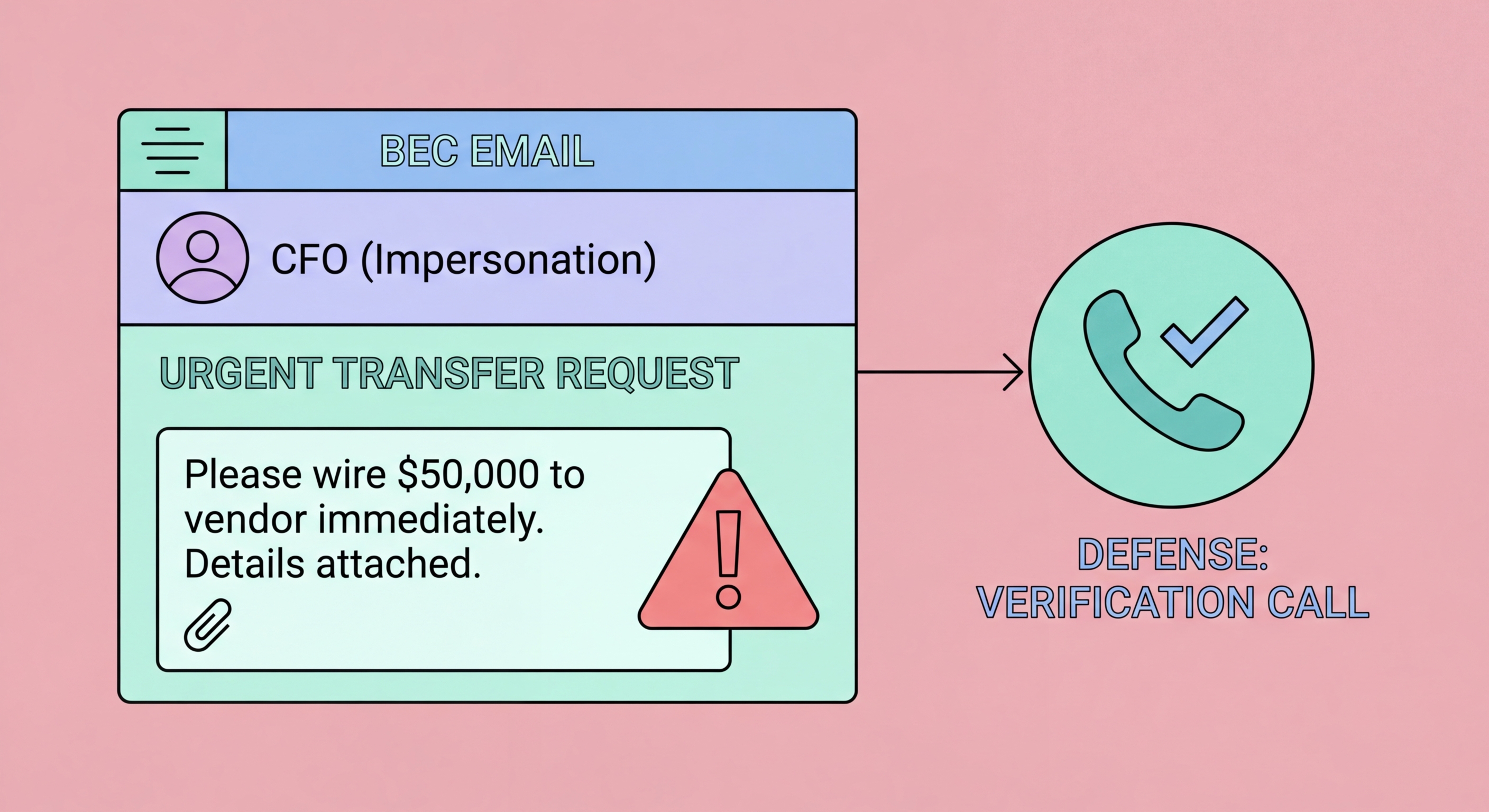
The most common BEC variant in Hong Kong involves the fraudulent impersonation of a company's CEO or CFO sending an urgent, confidential wire transfer instruction to an accounts payable employee. The email appears to come from the executive's genuine address — often through account compromise, domain spoofing, or registering a lookalike domain (e.g., companyname-hk.com vs companyname.com.hk). The message creates urgency and secrecy ("do not discuss with anyone", "this must be done today for a confidential acquisition"), bypassing normal approval processes. By the time the fraud is discovered — often when the real executive is contacted about the payment — funds have been transferred internationally.

Supplier payment diversion is a closely related variant. Fraudsters monitor business email accounts (often through a previously compromised mailbox) and insert themselves into ongoing payment discussions at the moment when payment details are being confirmed. By sending a message that appears to be from the legitimate supplier — from a compromised account or convincing lookalike domain — they redirect an expected payment to a fraudster-controlled account. The genuine supplier then follows up about the unpaid invoice, revealing the fraud after the payment is irrecoverable.

  • CEO fraud / executive impersonation: Emails appearing to be from senior executives requesting urgent confidential transfers to new accounts
  • Supplier payment diversion: Fraudsters intercepting vendor payment discussions and redirecting legitimate invoices to fraudster-controlled accounts
  • HR and payroll fraud: Impersonating employees to redirect salary payments to fraudster accounts — particularly effective before payroll runs
  • Attorney impersonation: Fraudsters posing as lawyers requesting urgent transfers related to confidential legal matters
  • Domain lookalike registration: Registering domains similar to legitimate business names to send convincing fraudulent payment requests
  • Email account compromise: Gaining access to a legitimate email account to send genuinely-authenticated fraudulent payment instructions
Business email compromise anatomy
2Prevention Procedures

Verification Procedures That Block Wire Transfer Fraud

Organisations that maintain strict payment verification procedures are dramatically more resistant to BEC fraud than those that process payment requests based on email instructions alone. The fundamental preventive control is a mandatory secondary verification requirement for all wire transfers above a defined threshold — a verbal or in-person confirmation with the payment requester through an independent channel (a known phone number, not one provided in the request email) before processing any transfer. This simple procedural control, consistently applied, defeats the vast majority of BEC attacks.

Payment procedure standardisation removes the attack surface entirely for many BEC variants. If your organisation's policy is that bank ↗ing details for vendors can only be updated through a formal supplier onboarding or change process — requiring written authorisation, management approval, and verification against independently held contact information — then a fraudulent email requesting a bank ↗ detail change has no pathway to succeed regardless of how convincing it appears. Documented, enforced procedures are the key; ad-hoc exceptions are where fraud enters.

Technical email security measures reduce the success rate of domain spoofing and email account compromise. DMARC, DKIM, and SPF configuration for your organisation's email domains prevents spoofed emails claiming to be from your domain being accepted by major mail providers. Enabling multi-factor authentication on all business email accounts removes the account compromise vector. Deploying advanced email security solutions that flag external-origin emails visually, highlight lookalike domain detections, and provide warnings for first-contact senders creates friction that prompts human review of suspicious messages.

  • Mandatory verbal verification: Require voice confirmation via a known phone number (not from the request email) for all wire transfers above a threshold
  • Four-eyes principle: Require two-person authorisation for all transfers above a defined amount — both employees must independently verify the request
  • Formal bank detail change process: Any request to change supplier banking details must go through a documented process with independent verification, never processed from email alone
  • DMARC / DKIM / SPF: Implement these email authentication standards to prevent your domain being spoofed in BEC attacks targeting your partners
  • MFA on business email: Require multi-factor authentication for all business email accounts to prevent account compromise attacks
  • External email warnings: Configure your email system to flag emails originating from outside your organisation — reducing risk of external spoofing being mistaken for internal
Wire transfer verification procedures
3Individual Wire Fraud

Wire Transfer Fraud Targeting Hong Kong Individuals

While BEC primarily targets businesses, individuals in Hong Kong are targeted by wire transfer fraud through several distinct mechanisms. Real estate transaction fraud is particularly costly — fraudsters monitor property transactions, then send conveyancing solicitors or estate agents forged instructions or impersonated communications diverting deposit payments or completion funds to fraudster accounts. Given that Hong Kong property transaction amounts are among the highest globally, a single successful fraud can result in losses of millions of HK dollars.

Impersonation of government authorities is another prevalent individual wire fraud. Fraudsters posing as HKPF officers, Customs officials, IRD representatives, or court bailiffs claim the victim is under investigation for money laundering, tax evasion, or other serious offences. They instruct victims to wire funds to a "safe government escrow account" while the investigation proceeds or to avoid asset freezing. These calls often use authentic-sounding terminology and are backed by fake warrant numbers, case references, and officer badge numbers. The genuine authorities in Hong Kong do not conduct investigations this way — any instruction to wire money to resolve a government investigation is fraud without exception.

Romance fraud leading to wire transfers is also significant in Hong Kong. After cultivating an online relationship over months, fraudsters claim a personal emergency — medical, legal, or financial — requiring an urgent wire transfer. The victim, believing they have a genuine relationship with the requester, complies. Unlike the investment variant (pig butchering), pure romance fraud focuses on extracting wire transfers for supposed personal emergencies rather than investment returns. The emotional investment created by the scam ↗mer makes victims reluctant to believe the relationship was constructed entirely for financial gain.

  • Real estate fraud awareness: Verify all wire transfer instructions for property transactions by calling your solicitor's published number — not a number provided in the instruction
  • Government agencies never demand immediate transfers: Police, IRD, Customs, and courts will never instruct you to wire money to resolve investigations — any such demand is fraud
  • Romance fraud vigilance: Any online contact requesting financial assistance via wire transfer — regardless of the relationship cultivated — requires extreme scepticism and third-party advice
  • Independent verification of instructions: Verify any wire transfer instruction involving new or changed banking details by calling the instructing party on a separately verified number
  • Cooling-off period for large transfers: Implement a personal rule: sleep on any wire transfer decision above a self-defined threshold — urgency is a fraud signal
  • Anti-Scam Helpline 18222: Call before executing any wire transfer that was prompted by unexpected contact or unusual circumstances
Wire transfer fraud targeting individuals
4Response and Recovery

Responding to a Wire Transfer Fraud in Hong Kong

Wire transfer fraud recovery is a race against time. Once a transfer reaches the beneficiary bank, it may be withdrawn in cash, transferred to another account, or converted to cryptocurrency within hours. International transfers are particularly difficult to recover because they traverse multiple correspondent banks. However, if reported within minutes or hours of discovery, banks can sometimes recall transfers that have not yet been credited to the final beneficiary — particularly for transfers to other Hong Kong banks where the HKPF can apply for court orders to freeze suspect accounts swiftly.

The immediate response sequence: call your bank's fraud hotline as soon as the fraudulent transfer is identified. Request a SWIFT recall if the transfer was international, or request the receiving bank be notified if the transfer was domestic. Simultaneously, call the HKPF Cyber Security and Technology Crime Bureau at 2527 7177 — police can liaise with the receiving bank to apply for a court-ordered account freeze, which is the most effective tool for domestic wire fraud recovery. Provide police with all available information about the fraudulent transaction: reference numbers, receiving account details, the fraudulent email or call that prompted the transfer, and the amounts.

For organisations that have suffered BEC-related wire fraud, engaging a cyber forensics firm in parallel with police reporting is advisable. Forensic investigation of the compromised email accounts can reveal the attacker's full access period, any other data accessed or exfiltrated, and the entry point — information essential both for the police investigation and for remediating the underlying security weakness to prevent recurrence. Reporting to the HKMA is also appropriate if the fraud exploited weaknesses in a bank's payment systems or processes. Reviewing and strengthening payment procedures in the aftermath is essential to prevent a repeat attack.

  • Immediate bank notification: Call your bank's fraud hotline the moment fraud is discovered — every minute increases the chance of funds clearing and becoming irrecoverable
  • SWIFT recall request: Ask your bank to initiate a SWIFT recall message for international transfers — success depends on transfer status but is always worth attempting
  • CSTCB police report: Call 2527 7177 immediately — police can apply for court-ordered account freezes at receiving HK banks that may recover funds
  • Forensic investigation for BEC: Engage cyber forensics professionals to investigate compromised email accounts and identify the full scope of the breach
  • Procedure review: After any wire fraud incident, conduct a thorough review and tighten payment verification procedures to prevent recurrence
  • Cyber insurance claim: If your organisation holds cyber insurance, notify your insurer promptly — BEC wire fraud is a covered loss under most cyber policies
Wire transfer fraud recovery options

Protect Your Organisation from Wire Transfer Fraud

Read our complete Financial Protection guide for comprehensive coverage of every financial fraud type affecting Hong Kong residents and businesses.

Related VPN Articles