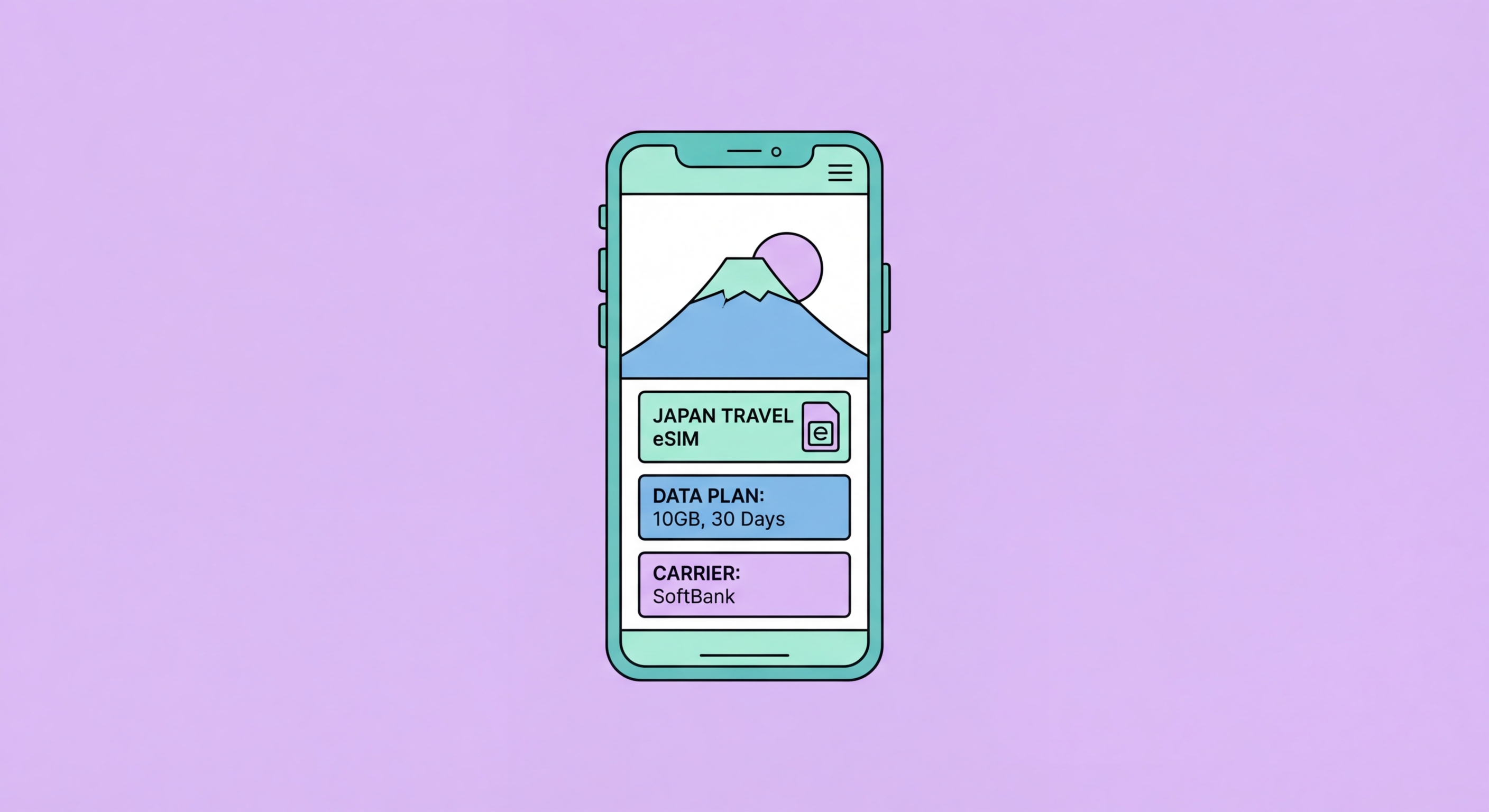
The top Japan travel eSIM plans for Hong Kong residents — comparing Airalo, Holafly, IIJmio, and other providers on network partner quality, data pricing, and coverage across Tokyo, Osaka, Kyoto, Hokkaido, and rural Japan.
Japan is consistently the most popular single international destination for Hong Kong residents, with direct flight time under 4 hours and a well-established cultural affinity driving high travel frequency. Japan is also the most competitive travel eSIM market in Asia for Hong Kong users — the combination of Japan's advanced mobile infrastructure, intense eSIM provider competition for the Asian tourist segment, and the strong yen depreciation that has kept Japan travel affordable has created a market where Japan eSIM prices are among the lowest globally relative to the quality of coverage provided. As of 2026, it is possible to purchase a Japan travel eSIM offering genuine 4G LTE coverage on Tier 1 Japanese networks for as little as USD $3–5 for 3GB of data, a price point that is extraordinarily competitive compared to HK carrier Japan roaming rates.
The Japan mobile market is served by three main national carriers: NTT Docomo, SoftBank, and au (KDDI). All three operate extensive 4G LTE networks with excellent nationwide coverage, and all three support 5G in major metropolitan areas. NTT Docomo has the most extensive rural coverage, making it the preferred network partner for travel eSIM providers targeting travellers who plan to explore outside Tokyo and Osaka — Hokkaido ski resorts, Tohoku rural areas, Okinawa island chains, and the Japanese Alps all have Docomo coverage where the other networks may have gaps. SoftBank has particularly strong urban coverage and is the preferred partner for some providers targeting city-focused tourists. When choosing a Japan eSIM, always check which network partner is used, as this is the most important determinant of the coverage you will experience.
HK carrier Japan roaming costs for comparison: 3HK charges approximately HK$78/day for Japan roaming on a standard plan, meaning a 7-day Japan trip costs approximately HK$546 in roaming charges from 3HK alone before considering the data cap. A Japan travel eSIM from Airalo offering 5GB for approximately USD $9 (approximately HK$70) covers the same 7-day trip at roughly one-eighth the cost. The savings multiply for frequent travellers to Japan — if you visit Japan 3–4 times per year (common for many Hong Kong residents), the annual saving from using travel eSIM instead of carrier roaming can easily exceed HK$2,000.
Airalo is the most widely used Japan eSIM provider among Hong Kong travellers for good reason: competitive pricing, a well-maintained app, and reliable NTT Docomo or SoftBank network partnerships. Airalo's Japan eSIM plans range from 1GB (approximately USD $4.50) to 20GB (approximately USD $33), with 5GB at approximately USD $12–14 representing the best value for a 7–10 day trip. Airalo's app allows data usage monitoring, QR code access, and in-app top-up if you run low — useful for extended Japan trips where you cannot predict exactly how much navigation, streaming, and communication data you will need. The activation process is reliable and the Docomo/SoftBank network quality in Japan is excellent across the trip types common from Hong Kong — Tokyo shopping and sightseeing, Osaka food tourism, Kyoto cultural tourism, and ski trips to Niseko and Hakuba.
Holafly's Japan unlimited plan is the preferred option for data-heavy travellers — remote workers on workcation in Japan, heavy video callers, or those streaming Japanese TV content. Pricing for Holafly's unlimited Japan plan starts at approximately USD $17 for 7 days and USD $21 for 10 days, which compares favourably to the daily roaming rates from HK carriers. The unlimited plan applies a fair-use policy after a daily high-speed threshold (typically 500MB–1GB per day at 4G speeds, then throttled) — this is adequate for most travel use cases but should be understood before purchase if you plan to use significant amounts of data for video streaming or large file uploads. Holafly's Japan eSIM uses SoftBank or NTT Docomo depending on availability, with the app showing which network is active.
IIJmio is a Japanese domestic provider that offers travel eSIM plans specifically marketed to foreign visitors, including Hong Kong tourists. IIJmio's visitor eSIM plans use NTT Docomo's network (one of the strongest options available) and are available in fixed data bundles from 3GB to 15GB at prices competitive with Airalo. The advantage of IIJmio for Japan-specific travel is that it is a Japanese domestic operator with direct network access rather than a reseller layer, potentially providing slightly more consistent performance and faster support response for Japan-specific issues. The IIJmio purchase process requires navigation of a Japanese-language dominant interface, which is less user-friendly than Airalo's international-market-focused app for HK users, but the underlying service quality is excellent.
Tokyo's eSIM coverage through NTT Docomo or SoftBank is exceptional — 5G is available throughout central Tokyo including Shinjuku, Shibuya, Ginza, Akihabara, and the airport corridors. Coverage depth in Tokyo is among the best in the world, including underground — the Tokyo Metro subway system has comprehensive in-tunnel coverage from all major networks, unlike many other major city metro systems where coverage drops in underground stations. For HK residents arriving at Narita or Haneda airports, coverage is excellent from the moment you exit the aircraft on the jet bridge, and the express train journey to central Tokyo maintains continuous coverage throughout.
Osaka, Kyoto, and the Kansai region are equally well covered by Tier 1 Japanese networks. The Shinkansen (bullet train) routes between Tokyo and Osaka maintain coverage throughout the journey, though brief signal gaps occur in some tunnel sections. For HK travellers doing a classic Tokyo-Osaka itinerary with Shinkansen connections, data works essentially seamlessly throughout. Coverage in Kyoto's temple areas, Nara's deer park, Hiroshima's Peace Memorial, and Hakone's mountain areas is all reliable on Docomo and SoftBank — coverage gaps are genuinely rare in the established tourist circuit of Japan's main islands. The Universal Studios Japan area in Osaka has strong coverage from all networks within the park.
Rural Japan and the less-visited regions require some coverage awareness. Hokkaido's major ski resorts (Niseko, Rusutsu, Furano) have reasonable coverage on Docomo but can have limited signal in some mountain lift areas and backcountry zones — download offline maps and avalanche safety apps before leaving Sapporo. Okinawa's main islands have good coverage on Docomo, but the more remote outer islands (Miyako Island, Yaeyama Islands, Ishigaki) may have gaps in less populated areas. The Japanese Alps (Kamikochi, Hakuba, Matsumoto) have adequate coverage along main routes but signal can be limited on high-altitude hiking trails. For any Japan trip that takes you significantly off the main tourist circuit, check Docomo's coverage map for your specific destinations before relying solely on mobile data for navigation.
Purchase your Japan eSIM at least 24–48 hours before your departure from Hong Kong and activate it (scan the QR code) on your home WiFi before leaving. Most Japan travel eSIMs are pre-activated in the sense that the profile is downloaded to your device, but billing does not start until your device first registers on the Japanese network — so activating at home costs you nothing and means you arrive in Japan with connectivity available from the moment your aircraft lands and your phone exits Airplane Mode at Narita or Haneda. Verify the eSIM appears in your phone's SIM settings before leaving Hong Kong, and check that it shows as a stored (not yet active) profile rather than as an error or absent.
Configure your phone's data settings before the Japan flight. On iPhone, set the Japan eSIM as your preferred data line (Settings > Cellular > Cellular Data) and disable data roaming on your HK SIM line (Settings > Cellular > [HK SIM] > Data Roaming: Off). Enable data roaming on the Japan eSIM line. This configuration ensures that when your phone connects to a Japanese network on landing, it uses the Japan eSIM for data rather than activating your HK carrier's expensive roaming. On Samsung Android, configure this through Settings > Connections > SIM Manager — set the Japan eSIM as Mobile Data SIM and disable roaming on the HK SIM. Confirm your WhatsApp or Signal settings so that your primary HK number continues to work via WiFi calling at the hotel, preserving your HK reachability for calls and messages.
Japan-specific connectivity tips for Hong Kong travellers: IC cards (Suica, Pasmo) can now be added to iPhone Wallet and Google Pay as virtual cards, eliminating the need to carry a physical transit card. Mobile payments via Apple Pay and Google Pay work at a large proportion of Japanese retail and restaurant outlets due to Japan's aggressive push for cashless payment before and after major international events. Most Japanese hotels and convenience stores (7-Eleven, FamilyMart, Lawson) have WiFi available for guests, reducing your eSIM data dependency at accommodation and when making major purchases that require stable connectivity. Google Translate's camera mode with Japanese is useful for menus and signs — download the Japanese language pack offline before your trip so it works without data.