What Are Darknet Markets? How Dark Web Marketplaces Work

Darknet markets are the infrastructure that enables large-scale trading of stolen data, credentials, and fraud tools. Understanding how they operate clarifies why data breaches have lasting consequences and how monitoring services detect exposure.

Darknet markets dark web marketplaces explained
1Market Structure

How Darknet Markets Are Structured and How They Operate

Darknet markets are .onion websites accessible only through the Tor network that function as peer-to-peer or platform-mediated marketplaces for illegal goods and services. Their structure closely mirrors legitimate e-commerce platforms: markets have a central site operated by administrators who maintain the platform infrastructure, process dispute resolution, and collect commission (typically 2-5% of transactions). Vendors — individual sellers — create listings with product descriptions, pricing, and delivery terms. Buyers browse listings, make purchases, and leave reviews. A reputation system based on accumulated reviews creates trust and accountability between anonymous parties, much like eBay or Amazon Marketplace, but for stolen data and contraband. The most significant darknet markets have supported tens of thousands of concurrent listings and processed hundreds of millions of dollars in annual transaction volume.

Payments on darknet markets are made exclusively in cryptocurrency — primarily Monero (XMR) for its stronger privacy properties, or Bitcoin (BTC) with mixing/tumbling services. Markets use escrow systems: when a buyer purchases from a vendor, the payment is held in escrow by the market until the buyer confirms receipt and satisfaction, at which point the funds are released to the vendor. This escrow model creates a functional trust mechanism that enables transactions between unknown parties. Some high-volume, trusted vendors access "finalized early" arrangements where buyers release funds faster, reducing the market's visibility into high-value transactions. The escrow system is a double-edged sword for law enforcement — it creates a centralised chokepoint that can be targeted in takedowns, but also means that significant cryptocurrency funds are held by market administrators at any time.

Market lifespan is typically short by legitimate business standards. Law enforcement agencies — including Europol's European Cybercrime Centre (EC3), the FBI, and increasingly INTERPOL with participation from the HKPF — actively target darknet markets through technical infiltration, financial tracking, and international cooperation. Major markets have been taken down in high-profile operations: Silk Road (2013), AlphaBay (2017), Hansa (2017), and more recently Genesis Market (2023). When markets are taken down, vendors and buyers typically migrate to successor markets within days — the decentralised nature of the ecosystem means that takedowns disrupt but rarely permanently eliminate market activity. For the purposes of Dark Web Monitoring Services for Hong Complete Guide for Hong Kong Users">Kong Users in 2026">dark web monitoring, what matters is not the specific market name but the data circulating across the ecosystem — your stolen data may pass through multiple market platforms over its lifetime.

  • e-Commerce structure: Central platform with administrators, vendor listings, buyer reviews, and reputation systems — functionally similar to eBay but for criminal goods.
  • Cryptocurrency payments: Primarily Monero (stronger privacy) or Bitcoin with tumbling — escrow systems hold funds until buyers confirm receipt.
  • Short market lifespans: Law enforcement takedowns are regular; vendors and buyers migrate to successor markets — the ecosystem persists despite individual market takedowns.
  • Commission and fees: Market administrators collect 2-5% commission on transactions, creating a profitable infrastructure business separate from selling stolen data.
  • Tor-only access: All major darknet markets are .onion sites accessible only through the Tor network — standard browsers cannot reach them.
  • International cooperation: HKPF CSTCB participates in international operations targeting darknet markets; HK residents' data has been recovered in several major market takedowns.
How Tor Browser enables access to darknet markets →
Darknet market structure operation
2What Gets Sold

What Personal Data and Fraud Tools Are Sold on Darknet Markets

The data market on dark web platforms is highly organised, with distinct categories, tiered pricing based on data quality, and vendor specialisations. Credential listings — email and password combinations from breach data — are the highest-volume commodity, often sold in bulk ("logs") of thousands to millions of records at low unit prices (fractions of a cent per record for old, unverified data; up to US$5 per record for recently verified, high-value account credentials). Credential listings are typically categorised by country of origin, making it easy for criminals to purchase specifically Hong Kong credentials — login data for .hk email addresses, banking credentials for HSBC or Hang Seng, or social media accounts registered with HK phone numbers.

The "fullz" category — complete identity packages — commands the highest prices. A Hong Kong fullz typically includes HKID number, full name, date of birth, residential address, mobile phone number, email address, and in premium listings, banking account numbers, recent transaction history, and security question answers. The transaction history and security question data is sourced from high-quality breaches of financial institutions or through social engineering attacks. Premium HK fullz with verified banking access are listed for US$100-500 depending on account balances and credit lines. "Partial fullz" covering only HKID plus DOB plus email are cheaper (US$20-50) and used primarily for identity document applications or synthetic identity construction. Understanding what fullz include explains why your HKID number combined with other data in a breach is so much more concerning than an email-only breach.

Beyond raw data, darknet markets sell the tools and services that enable fraud — creating an ecosystem that lowers the technical barrier to committing cybercrimes. Phishing kits — pre-built fraudulent website templates for HSBC, Hang Seng, PayMe, and government services — sell for US$50-200 and require minimal technical skill to deploy. Malware-as-a-service (MaaS) offerings provide remote access trojans (RATs), keyloggers, and banking malware for monthly subscription fees. Fraud tutorials provide step-by-step guides to specific attack types, targeting HK-specific systems. Money mule recruitment services connect criminals with local HK residents willing to transfer funds for a commission (often unwitting participants recruited through fake job advertisements). This service ecosystem means that technically unsophisticated criminals can execute sophisticated attacks using purchased tools and services.

  • Credential logs: Bulk email/password combinations; categorised by country, service type, and verification status; HK-specific credentials command price premiums.
  • Hong Kong fullz pricing: HKID + DOB + email partial: US$20-50; full identity with banking access: US$100-500 depending on account value.
  • Phishing kits: Pre-built fraudulent HSBC, Hang Seng, and government website templates; technical barrier to phishing campaigns is extremely low with these kits.
  • Malware-as-a-service: Keyloggers, RATs, and banking trojans available for monthly subscription fees from specialised vendors.
  • Money mule services: Local HK accounts for receiving and forwarding criminal funds; often recruited through fake employment advertisements.
  • Corporate credentials: VPN access, Microsoft 365 logins, and corporate email accounts for initial access; premium listings for HK financial services sector firms.
How criminals exploit the data and tools purchased on these markets →
What is sold on darknet markets stolen data
3Law Enforcement

Law Enforcement Takedowns and What Happens to Data After Markets Close

Law enforcement operations against darknet markets are among the most complex cross-border cybercrime investigations. Successful operations require technical penetration of Tor hidden services (identifying server locations despite anonymisation), financial tracking of cryptocurrency payments (using blockchain analysis tools), and international coordination between police forces, prosecutors, and courts across multiple jurisdictions. Europol's EC3, the FBI, DEA, IRS-CI, and HSI have collaborated on the largest takedowns, with intelligence shared through INTERPOL channels that include the HKPF. The Genesis Market takedown in April 2023, involving 17 countries and over 200 arrests, demonstrated the scale of modern darknet law enforcement operations — but also highlighted the data recovery challenge: Genesis held accounts for 1.5 million individuals worldwide, and post-takedown analysis revealed data pertaining to HK residents.

When a darknet market is taken down, three outcomes are possible for the market's data. First, in the best case, law enforcement seizes the market's databases and uses them to identify victims and criminals — in some operations (like AlphaBay and Hansa), law enforcement operated the market covertly for weeks before taking it down, gathering evidence. Second, if administrators received advance warning of the takedown, they may have exited the market ("exit scam") taking all escrowed funds and deleting data — leaving victims and buyers without recourse. Third, and most commonly for larger markets, the data survives the takedown and is distributed among the vendor community, recycled to successor markets, or simply remains in criminal hands. For victims of data exposure, a darknet market being taken down does not mean their stolen data has been destroyed — it means the primary distribution channel was disrupted, but the underlying data likely persists elsewhere.

The HKPF CSTCB participates in international darknet investigations and has its own operations targeting locally relevant cybercrime infrastructure. Following major international takedowns, CSTCB has issued public advisories warning HK residents about specific breach datasets affecting local users. The CSTCB also operates a cybercrime reporting mechanism (18222) and coordinates with INTERPOL and regional police forces in Singapore, Taiwan, and Mainland China on cross-border darknet investigations. For HK residents who discover their data has been exposed in a darknet market listing, filing a report with CSTCB creates an official record and may contribute to ongoing investigations — particularly if the listing specifies the source breach or vendor, which can assist law enforcement in tracing the data's origin.

  • Major takedowns in recent years: AlphaBay (2017), Hansa (2017), DarkMarket (2021), Genesis Market (2023) — each removed significant HK-relevant data from active circulation.
  • Data survives takedowns: Market closure disrupts distribution but rarely destroys underlying breach data — it typically moves to successor markets or remains in criminal hands.
  • Covert law enforcement operations: Some takedowns follow weeks of covert operation during which evidence is gathered; victim data recovered this way assists in remediation.
  • HKPF CSTCB involvement: CSTCB participates in INTERPOL and bilateral darknet investigations; issues public advisories when HK-resident data is identified in seized markets.
  • Post-takedown advisories: Follow CSTCB announcements (cstcb.police.gov.hk) for notifications about HK-specific data identified in international market seizures.
  • Report to CSTCB: 18222 — reporting exposure in a darknet market listing contributes to ongoing investigations and creates an official record for your dispute resolution.
How stolen data travels from breach to dark web market →
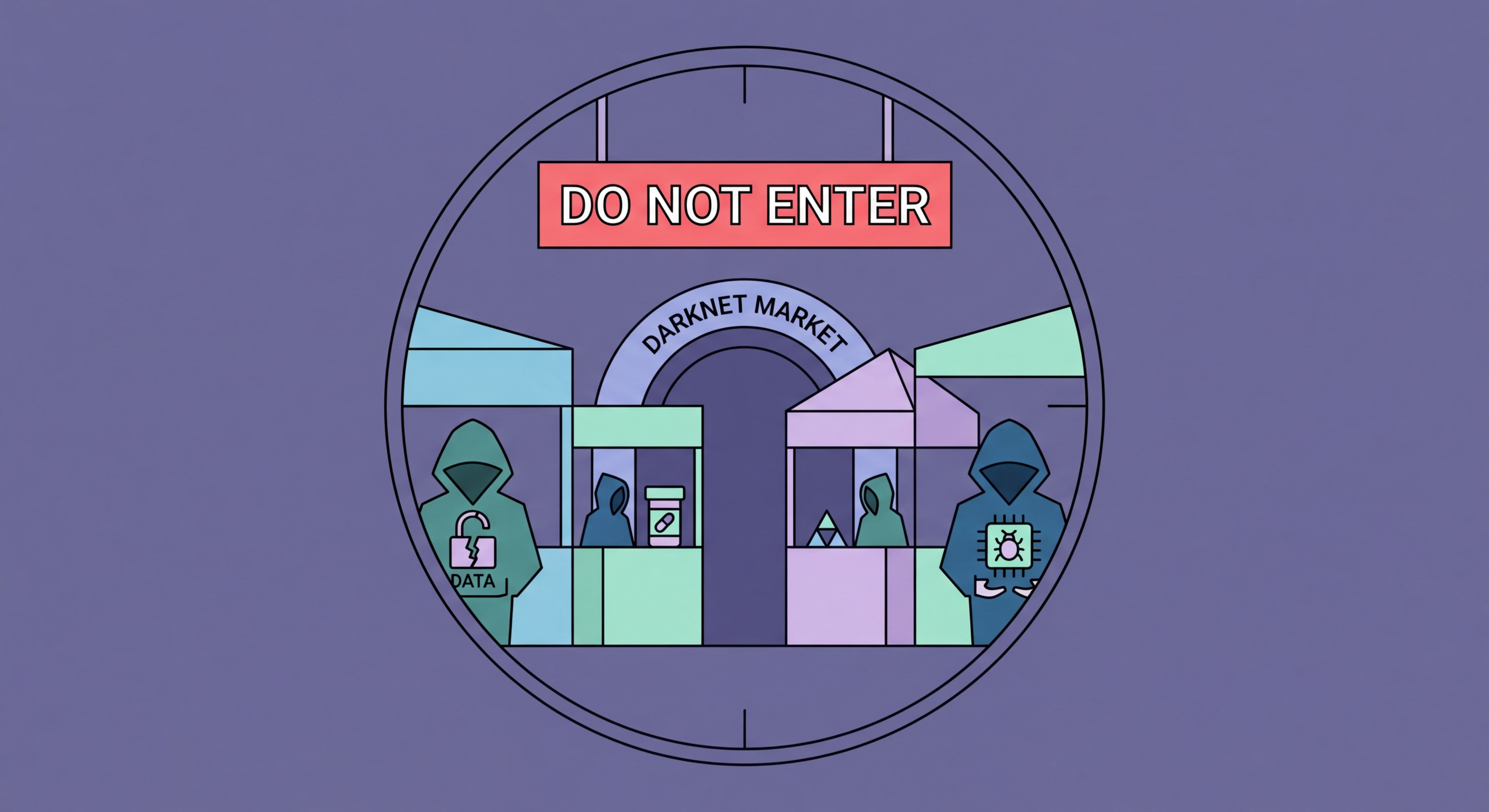
Darknet market takedown law enforcement
4Implications for Monitoring

What Darknet Market Structure Means for Your Dark Web Monitoring Strategy

Understanding darknet market structure clarifies both the value and the limitations of commercial dark web monitoring services. Paid monitoring services deploy crawlers to actively index darknet market listings, forum posts, and paste sites — searching for your registered data (email addresses, phone numbers, HKID numbers) within the vast volume of material circulating across these platforms. The sophistication of the market ecosystem means that effective monitoring requires more than just checking HIBP's breach database: it requires ongoing surveillance of active markets, newly emerging forums, and the paste sites where fresh breach data is often first distributed. This is why the coverage gap between free (HIBP email-only) and paid monitoring is significant for individuals with elevated risk profiles.

The tiered market structure also explains why some data exposures are detected quickly by monitoring services while others take months or years to surface. High-profile breach data from large, well-known services is distributed widely and rapidly — appearing in paste sites, public forums, and multiple market listings within days, making it highly likely to be detected by monitoring services. Small, targeted breaches — particularly those involving premium "fullz" listings for high-net-worth individuals or specific corporate credentials — are traded more quietly in private channels or high-reputation vendor-to-buyer direct communications. This private, quiet trading is the hardest to detect with automated monitoring. The practical implication: monitoring provides a coverage floor — catching the majority of commodity data exposure — but cannot guarantee detection of all targeted, high-value trades involving your specific data.

For businesses, the darknet market ecosystem creates specific corporate monitoring requirements. The regular appearance of corporate credential listings — VPN credentials, corporate email accounts, internal application logins — on darknet markets is a primary driver of the enterprise dark web monitoring market. HIBP's domain monitoring, supplemented by enterprise services like Recorded Future, Flashpoint, or Digital Shadows (Reliaquest), provides visibility into when employee credentials from specific corporate domains appear in market listings. This intelligence enables IT security teams to force password resets and revoke compromised credentials before criminals use them for initial network access. For Hong Kong businesses in financial services, professional services, and technology, investing in enterprise dark web monitoring that covers the specific forums and markets most relevant to their threat profile is an important defensive measure.

  • Why paid monitoring adds value: Free HIBP covers breach databases; paid services actively crawl market listings, forums, and paste sites where fresh breach data first appears.
  • Detection speed varies: High-profile breach data surfaces within days; quietly traded premium fullz or corporate credentials may take months to appear in monitored sources.
  • Private trades remain hardest to detect: Direct vendor-to-buyer transactions for high-value data are essentially invisible to automated monitoring services.
  • Corporate monitoring focus: Enterprise services monitor for domain-specific credential listings on markets most relevant to corporate threat profiles — essential for financial services firms.
  • Monitoring is ongoing: Market data persists and recirculates — monitoring must continue for years after any confirmed exposure, not just in the immediate aftermath.
  • Combine monitoring with response readiness: Monitoring is only valuable if you have a clear action plan when alerts fire — know your steps before you need them.
Compare monitoring services that scan darknet markets for your data →
Dark web monitoring darknet markets
Find Out If Your Data Is on a Dark Web Market

Find Out If Your Data Is on a Dark Web Market

Dark web monitoring services scan darknet market listings for your email, phone number, and identity data. Compare services to find the right level of coverage for your risk profile.

Related VPN Articles