Dark Web vs Deep Web: Understanding the Difference

The terms "dark web" and "deep web" are frequently confused. Here's the definitive breakdown of what each term means, with concrete examples relevant to Hong Kong internet users.

Dark web vs deep web comparison
1The Deep Web

The Deep Web: The Vast, Boring, Entirely Normal Part of the Internet

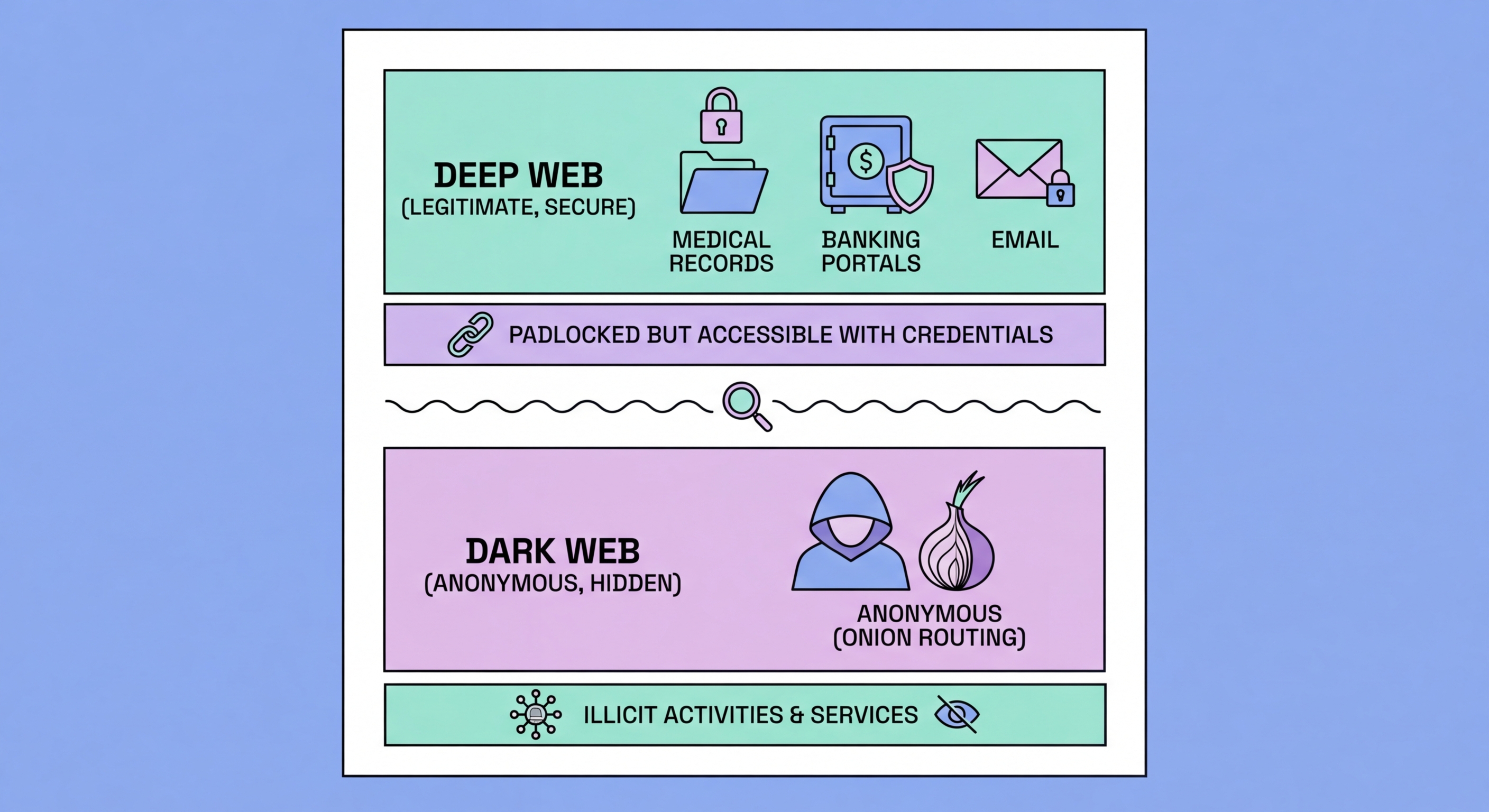
The deep web refers to all internet content that is not indexed by standard search engines like Google, Bing, or Yahoo. This includes anything behind a login screen, any content generated dynamically in response to a database query, any private communication, and any web content intentionally excluded from search engine indexing via robots.txt or similar mechanisms. The deep web is vast — estimates suggest it is 400-500 times larger than the surface web — and the overwhelming majority of it is entirely benign and legal.

If you've ever logged into online banking at HSBC or Hang Seng, checked your MPF account balance, read a private email in Gmail, accessed a company intranet, used a hospital patient portal, or searched an academic database like JSTOR, you've been in the deep web. Your medical records, financial statements, private messages, and subscription content are all part of the deep web. The defining characteristic is simply that this content is not publicly indexed and cannot be found via a web search.

The deep web is not a place you navigate to — it's a category that describes content inaccessible without authentication or specific access rights. There's no single gateway or browser required; your normal browser accesses deep web content the moment you log into any authenticated service. The deep web is where most sensitive and valuable information on the internet resides precisely because it requires authentication to access — your bank statement is deep web content not because it's hidden for nefarious reasons, but because it requires you to prove your identity to access it.

  • HK banking portals: HSBC online banking, Hang Seng eBanking, and all other banking interfaces are deep web — not indexed, require login.
  • Email inboxes: All private email content is deep web — Gmail, Outlook, Apple Mail, and any other email service requires authentication.
  • MPF and ORSO accounts: Your MPF account balance and transaction history, accessible only with your account credentials.
  • Academic databases: JSTOR, PubMed, LexisNexis, and subscription research databases are deep web — not publicly indexed.
  • Company intranets: Corporate internal systems, SharePoint, and employee portals require authentication — all deep web.
  • Healthcare systems: Hospital patient portals, HA/ClinCard systems, and medical record access are deep web content.
See the complete dark web explainer →
Deep web examples explanation
2The Dark Web

The Dark Web: A Subset Designed Specifically for Anonymity

The to Check If Your Data Is on the Dark Web">dark web is a small subset of the deep web that is specifically designed for anonymity and requires special software — predominantly the Tor Browser — to access. Unlike the broader deep web, which is simply content not indexed by search engines, the Data Breach? From Hack to Dark Web">dark web uses technical mechanisms to obscure both the identity of users and the location of servers. Dark web sites use .onion domains — generated cryptographically and resolvable only through the Tor network — rather than standard DNS-registered domains.

The key distinction from the broader deep web is intent and mechanism. The deep web is not indexed because it contains private authenticated content; the dark web is designed from the ground up to resist identification of both parties in any communication. Tor's onion routing — bouncing traffic through multiple encrypted relays — makes it very difficult to trace the origin of either a request or a server. This design makes the dark web suitable for legitimate activities that require strong anonymity (journalism, whistleblowing, political activism in repressive environments) but also attractive for criminal activities that benefit from the same anonymity.

The dark web does not require special knowledge to access — the Tor Browser, available free from torproject.org, works similarly to a regular browser and can be downloaded by anyone. However, navigating to dark web sites requires knowing their .onion addresses, as there is no Google equivalent for the dark web. Dark web directories and link aggregators exist but are themselves unofficial and not reliably comprehensive. Most people who are concerned about the dark web don't need to access it directly — they need to know if their data has ended up there, which can be checked through dark web monitoring services without accessing the dark web yourself.

  • Requires Tor Browser: The standard tool for accessing .onion sites — download only from the official torproject.org website.
  • .onion domains: Cryptographically generated addresses only resolvable through the Tor network — not standard DNS.
  • Server anonymity: Dark web server operators can conceal their physical location via Tor hidden services, making takedowns difficult.
  • Subset of the deep web: All dark web content is technically deep web (not indexed by search engines), but the reverse is not true.
  • You don't need to visit it: Dark web monitoring services scan the dark web on your behalf — you don't need to access it yourself to know if your data is there.
  • Legal to access in HK: Using Tor and accessing the dark web is not illegal in Hong Kong — what matters is what you do while there, not the access itself.
How Tor Browser works and when to use it →
Dark web technical explanation
3Side-by-Side Comparison

Deep Web vs Dark Web: A Clear Comparison

The fundamental distinction is one of design intent. The deep web exists because not all content should be publicly searchable — authenticated, private, and proprietary content naturally resides here. The dark web was specifically engineered to provide strong anonymity. You don't choose to put content on the deep web — it's automatically deep web if it's not publicly indexed. Dark web content is deliberately placed there by operators who chose to use .onion hosting for its anonymity properties.

From a security and privacy perspective, the deep web holds the most valuable data for most individuals and organisations: banking credentials, personal data, medical records, business information, and communications. This is why deep web content is such a valuable target for cybercriminals — breaching a company's internal systems and accessing its deep web databases is far more lucrative than scraping its public website. The dark web, meanwhile, is where stolen deep web data ends up for sale after a breach.

For Hong Kong residents monitoring their digital security, the relevant question is not "what is on the deep web" (answer: your private data) but "has any of my deep web data leaked to the dark web" (answer: possibly, if any service you use has experienced a breach). Dark web monitoring services bridge this gap by scanning dark web markets and forums for your specific data — effectively checking whether your private authenticated information has been stolen and listed for sale by criminals.

  • Deep web = private but normal: Your banking, email, medical records, and business data — valuable, heavily targeted, entirely legal.
  • Dark web = anonymity by design: Requires Tor, uses .onion addresses, designed to obscure user and server identity.
  • Size difference: The deep web is hundreds of times larger than the surface web; the dark web is a tiny fraction of the deep web.
  • Access difference: Deep web requires login/authentication; dark web requires Tor or equivalent anonymisation software.
  • Data flow: Your deep web data (from breached services) ends up on the dark web for sale — this is the breach-to-dark-web pipeline that monitoring services detect.
  • Practical implication: Monitor the dark web for your deep web data — use HIBP, password managers, and monitoring services to detect breaches early.
How data travels from breach to dark web market →
Dark web vs deep web comparison
4What This Means for You

What the Dark Web vs Deep Web Distinction Means for HK Users

Understanding this distinction clarifies the actual threat model for Hong Kong internet users. The threat is not that you personally visit the dark web (most people never do or need to) — the threat is that criminal actors use the dark web to trade data that was stolen from legitimate services you use. Your HKBC online banking is deep web content; if HKBC experienced a breach and your credentials were stolen, those credentials might then appear on a dark web marketplace. The dark web is the destination; your deep web data is the target.

This understanding also clarifies the limitations of "deep web" as a scare term used in some media reporting. When journalists write about content "found on the deep web," they usually mean the dark web or simply non-indexed content — deep web content that is legitimately private (your banking, email, etc.) is not concerning. The concerning category is specifically data that has leaked from private (deep web) systems to public criminal markets (dark web).

For a practical response: your deep web data is protected by the authentication systems and security practices of the services that hold it. You can improve this protection by using unique strong passwords (so a breach of one service doesn't expose others) and enabling 2FA (so stolen credentials alone can't be used). Your dark web exposure is monitored through services like HIBP. The combination of good credential hygiene and active dark web monitoring covers the two most important bases.

  • You interact with the deep web constantly: Every login to any authenticated service puts you in the deep web — this is normal and not dangerous in itself.
  • The risk is in the transition: When deep web data (your credentials) is stolen and listed on the dark web, that's when the risk materialises.
  • Monitoring bridges the gap: Dark web monitoring services watch for your deep web data (credentials, personal info) appearing on dark web markets.
  • Password hygiene is the key defence: Unique passwords ensure that a breach of one service's deep web database doesn't cascade to compromise your accounts elsewhere.
  • 2FA adds a second layer: Even if credentials appear on dark web markets, 2FA prevents them from being used for account takeover without your physical authentication device.
  • No need to visit the dark web yourself: Use monitoring services — you can protect yourself from dark web threats without ever accessing it.
Check if your data has leaked to the dark web →
Dark web deep web implications for Hong Kong users
Now You Know the Difference — Check Your Exposure

Now You Know the Difference — Check Your Exposure

Your deep web data may already be on the dark web without you knowing. Take the free check now to find out.

Related VPN Articles