Rotating Proxies Explained: What They Are and How They Work

Rotating proxies automatically cycle through a pool of IP addresses with each request or at set intervals — the essential technology behind scalable web data collection.

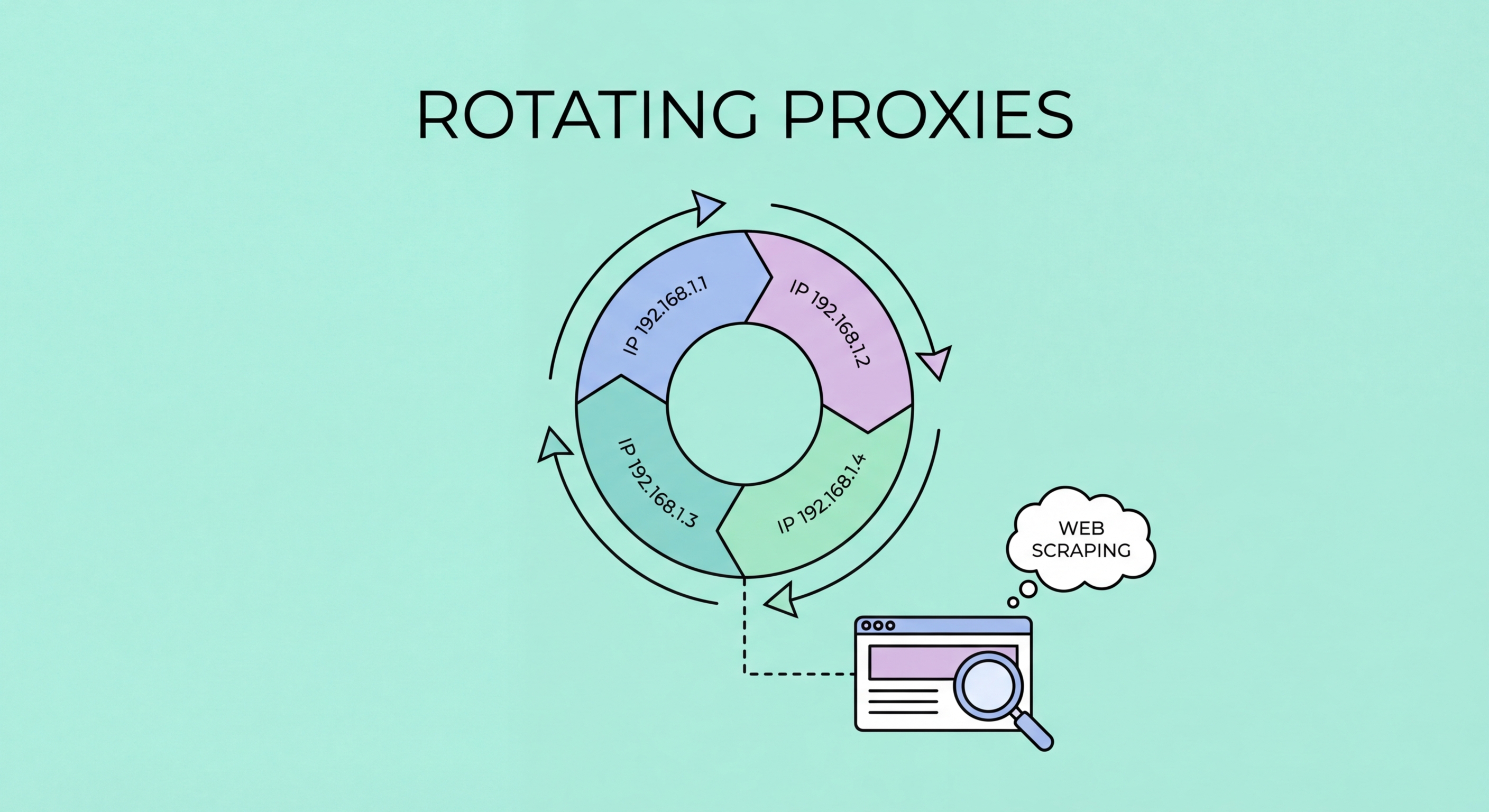
Rotating proxy pool diagram
1What Are Rotating Proxies

How Rotating Proxy Pools Work

A rotating proxy (or rotating proxy pool) is a service where each outbound request is sent through a different IP address from a large pool. Instead of connecting to a single static proxy server — where all your requests would appear to originate from the same IP — a rotating proxy gateway automatically assigns a new IP from its pool for each request, or rotates IPs on a time-based schedule. To any target website, each request appears to come from a different, independent user.

The mechanics vary by provider and use case. In the simplest configuration — per-request rotation — every HTTP request you make through the gateway gets a fresh IP. This is ideal for web scraping where you're collecting individual data points from thousands of URLs: even if a website rate-limits IP addresses, no single IP sends enough requests to trigger a ban. Some providers also offer sticky sessions, where the same IP is maintained for a defined period (30 seconds to 30 minutes), which is necessary for tasks that require maintaining a session — logging into a website, adding items to a cart, or navigating multi-step flows.

The gateway architecture of most rotating proxy services is transparent to the client: you configure a single proxy address and port in your scraping tool or browser. The provider's backend gateway handles the actual IP rotation, drawing from its pool of thousands or millions of IPs and load-balancing requests across them. Premium providers offer additional controls: targeting IPs from specific countries, cities, or ASNs; specifying minimum session duration; and filtering out recently flagged IPs. These controls are typically accessed through the provider's API or via specific request headers.

  • Per-Request Rotation: A new IP is assigned from the pool for every outbound request — ideal for high-volume scraping.
  • Sticky Sessions: The same IP is maintained for a configurable duration — required for session-based workflows.
  • Gateway Architecture: Clients connect to one address; the backend silently rotates through the IP pool.
  • Pool Size Impact: Larger pools reduce IP reuse frequency, lowering detection risk for high-volume operations.
  • Geo-Targeting: Advanced providers allow specifying the country, city, or ASN for rotated IPs.
  • IP Health Filtering: Premium services filter out recently flagged or banned IPs before adding them to rotation.
Rotating proxy pool architecture
2Why Rotation Prevents Bans

The Rate-Limiting Problem and How IP Rotation Solves It

Websites use IP-based rate limiting as a primary anti-bot defense: when a single IP address sends more than a defined number of requests within a time window, the website blocks that IP, returns a 429 Too Many Requests response, or serves a CAPTCHA challenge. For a scraping operation sending thousands of requests per minute, a static proxy IP would be blocked almost immediately — often within tens or hundreds of requests. IP rotation solves this by distributing the request volume across many IPs, so no single IP ever reaches the rate limit threshold.

The mathematics are straightforward: if a website rate-limits IPs at 100 requests per hour, and your scraping job needs to send 100,000 requests per hour, you need at least 1,000 IPs receiving no more than 100 requests each. A rotating proxy pool with 100,000 available IPs allows you to send 10 million requests per hour while keeping each individual IP well below any reasonable rate limit. This is why large-scale data collection operations routinely use rotating residential proxy pools with tens of millions of IPs — the arithmetic demands it.

IP rotation is necessary but not always sufficient. Sophisticated websites use multi-signal detection that goes beyond IP reputation: browser fingerprinting, cookie patterns, JavaScript execution, HTTP/2 settings, TLS fingerprints, and behavioral analysis. A rotating proxy that changes IPs but uses identical browser headers and behaves with robotic request timing will still be detected. Professional scraping infrastructure pairs IP rotation with request header randomisation, realistic timing delays, browser automation tools (Playwright, Puppeteer) that produce natural browser fingerprints, and CAPTCHA solving services.

  • Rate Limiting: Websites block IPs exceeding defined request thresholds — rotation keeps each IP below the threshold.
  • Request Distribution Math: Scale your IP pool proportionate to your request volume and target site limits.
  • 429 Response Handling: When you receive a 429, implement backoff and request the same URL with a fresh IP.
  • Multi-Signal Detection: IP rotation alone doesn't defeat fingerprinting — pair with header randomisation and human-like timing.
  • Browser Automation: Tools like Playwright produce realistic browser fingerprints that pass JavaScript-based bot detection.
  • CAPTCHA Services: Services like 2Captcha and CapMonster solve CAPTCHA challenges programmatically for blocked IPs.
Why websites ban IPs and how rotation helps
3Types of Rotating Proxies

Datacenter Rotating vs Residential Rotating Proxies

Rotating proxies are available in both datacenter and residential variants, and the choice between them involves the same cost-vs-detectability tradeoff as static proxies. Rotating datacenter proxies draw from pools of commercial server IPs. They're fast, inexpensive, and available in quantities suitable for very high-volume operations. However, datacenter IP ranges are well-known to anti-bot systems, and the more sophisticated detection platforms will recognise and challenge or block requests even if they come from different datacenter IPs on every request.

Rotating residential proxies cycle through real home broadband IPs. Because each IP in the rotation appears as a different consumer household to the destination website, the probability of any single IP being flagged decreases further. Residential rotating proxies are considerably more expensive than datacenter rotating proxies — expect to pay $5–15 per gigabyte versus $0.50–2 per gigabyte for datacenter IPs — but they achieve dramatically higher success rates against websites with advanced bot detection, making them cost-effective for use cases where datacenter IPs fail entirely.

Mobile rotating proxies represent a third tier: pools of IPs from mobile carriers (4G/5G networks). Mobile IPs are the most trusted category for website anti-bot systems because mobile carrier IP space is legitimately shared among thousands of users through carrier-grade NAT — a single mobile IP may genuinely represent hundreds of real users. This makes blocking a mobile IP extremely costly for websites in terms of collateral damage, and detection systems accordingly treat mobile IPs with high trust. Mobile proxies are the most expensive type but achieve the highest bypass rates for the most defensively fortified websites.

  • Rotating Datacenter: Fast, cheap ($0.50–2/GB), suitable for less-defended sites and high-volume basic scraping.
  • Rotating Residential: Trusted consumer IPs ($5–15/GB), appropriate for sites with moderate to advanced bot detection.
  • Rotating Mobile: 4G/5G carrier IPs (most expensive), highest success rates on sophisticated anti-bot platforms.
  • Cost vs Success Rate: Match proxy type to target site's detection sophistication — don't overpay for sites that don't need it.
  • Geographic Rotation: Some providers support rotating through IPs of the same country or city to maintain geo-consistency.
  • Session Rotation: Per-request or timed rotation options — choose based on whether your workflow requires session persistence.
Types of rotating proxies
4Integration Guide

Integrating Rotating Proxies Into Your Scraping Stack

Most rotating proxy providers expose their service through a gateway endpoint: a single proxy address and port that handles all the rotation internally. In Python using the requests library, configure the gateway as your proxy in the proxies parameter. For Scrapy, set DOWNLOADER_MIDDLEWARES and ROTATING_PROXY_LIST or use a rotating proxy middleware package. Many providers also offer direct API integration that allows requesting a specific IP, checking IP status, and managing session IDs programmatically.

Error handling is critical in rotating proxy integrations. Your scraping code must handle failed requests gracefully: detect 407 (Proxy Authentication Required), 429 (Too Many Requests), 403 (Forbidden), and CAPTCHA response pages, then retry with a fresh IP rotation rather than continuing to hammer the same IP. Implement exponential backoff for repeated failures on the same target URL. Maintain a request log that tracks success rates by target domain so you can identify when a target site is blocking your IP pool type and needs an upgrade to residential or mobile proxies.

Concurrency management is equally important. Rotating proxies are most effective when paired with appropriate concurrency — too many simultaneous requests even from different IPs can trigger velocity-based detection (many requests to the same domain within a short window from different IPs can still look bot-like). A human user makes requests sequentially. Professional scraping operations tune concurrency per target domain based on observed detection thresholds, typically starting with low concurrency and scaling up while monitoring success rates. This calibration process is as important as proxy selection for sustainable, high-success scraping operations.

  • Gateway Endpoint: Connect to one proxy address — the provider handles rotation internally.
  • Error Detection: Monitor for 407, 429, 403, and CAPTCHA responses and trigger IP rotation on failure.
  • Retry Logic: Implement exponential backoff and retry failed URLs with fresh IPs rather than abandoning them.
  • Concurrency Tuning: Calibrate simultaneous requests per domain to avoid velocity detection — start low and test.
  • Request Logging: Track success rates by domain to identify when a proxy tier upgrade is needed.
  • Scrapy Integration: Use scrapy-rotating-proxies middleware or direct proxy middleware for Scrapy projects.
Complete guide to proxies for web scraping →
Integrating rotating proxies in code

Ready to Scale With Rotating Proxies?

Compare the leading rotating proxy providers — datacenter, residential, and mobile — and find the right solution for your data collection needs.

Related VPN Articles