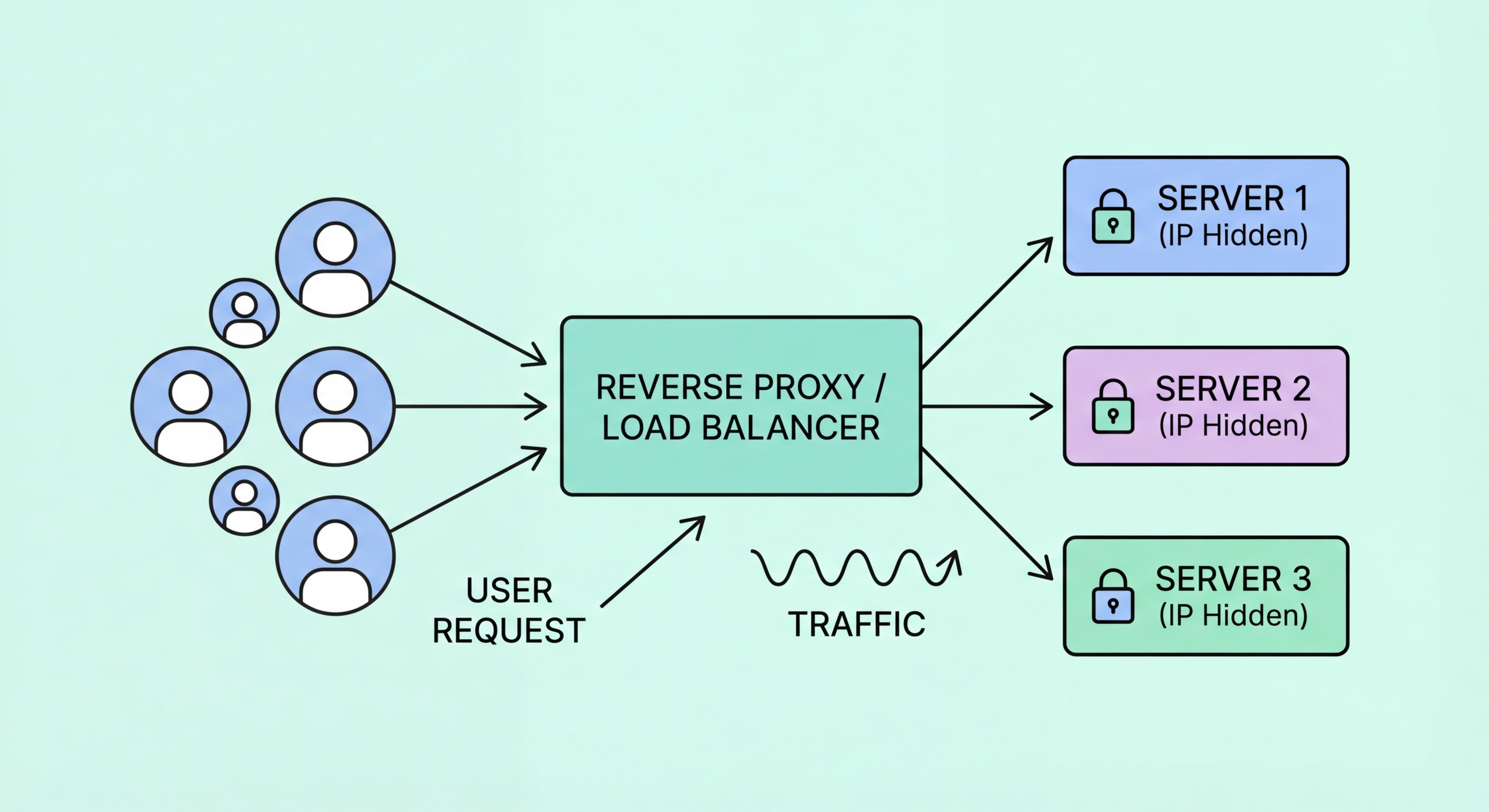
A reverse proxy sits in front of web servers, handling incoming requests on their behalf. It protects server identity, balances traffic load, accelerates delivery, and adds security layers — an essential component of modern web architecture.
The terminology can be confusing: a forward proxy acts on behalf of clients (your device) to access servers on the internet, while a reverse proxy acts on behalf of servers to receive requests from clients on the internet. In a forward proxy setup, the proxy is configured on or near the client side, and clients explicitly or transparently route their requests through it. In a reverse proxy setup, the proxy is deployed on or near the server side, and clients have no idea — they think they're talking directly to the backend server.
When you visit a popular website like any major e-commerce or news platform, your browser connects to an IP address that is almost certainly a reverse proxy (often a CDN node) rather than the actual web server. The reverse proxy receives your request, determines which backend server should handle it, forwards the request, receives the response, and returns it to your browser. The backend server's real IP address never appears in your browser — only the reverse proxy's IP is publicly exposed, protecting the origin server from direct internet exposure.
This architecture difference has profound implications. Forward proxies are typically deployed for the benefit of client-side privacy, access control, and traffic management. Reverse proxies are deployed for server-side benefits: protecting origin server identity, distributing traffic across multiple servers, caching content to reduce origin load, terminating TLS to offload encryption processing, and adding security layers like DDoS protection and WAF (Web Application Firewall) capabilities. The two technologies serve completely different purposes despite sharing the name "proxy."
Load balancing is one of the most valuable capabilities of reverse proxies. When a website receives more traffic than a single server can handle, multiple identical or complementary backend servers are deployed to share the load. The reverse proxy sits in front of all these backend servers and distributes incoming requests among them according to a configured algorithm. Clients see a single IP address and domain — they have no awareness that their request might be handled by any of dozens of backend servers.
Common load balancing algorithms include round-robin (requests are distributed sequentially to each server in turn), least-connections (requests go to the server with the fewest active connections), IP hash (the same client IP always routes to the same server, useful for session persistence), and weighted distribution (servers with more capacity receive a proportionally larger share of traffic). More sophisticated reverse proxies support health checking — automatically removing unhealthy or unresponsive backend servers from the rotation until they recover, providing automatic failover without manual intervention.
For Hong Kong businesses with variable or seasonal traffic patterns — retail sites with sales events, financial platforms during market volatility, or media sites during breaking news — load balancing via reverse proxy is the foundation of horizontal scaling. By adding additional backend servers behind the reverse proxy during peak periods and removing them when traffic normalises, organisations can scale capacity dynamically without changing DNS records, SSL certificates, or client-visible infrastructure. Cloud platforms including Alibaba Cloud Hong Kong, AWS ap-east-1, and Google Cloud's Hong Kong region all provide managed load balancer services built on reverse proxy technology.
Reverse proxies are a critical security layer for web-facing infrastructure. By placing a reverse proxy between the public internet and origin servers, organisations ensure that the origin servers' real IP addresses are never directly exposed. Even if an attacker discovers the origin server's IP through other means and attempts a direct DDoS attack, the reverse proxy absorbs the traffic and can implement rate limiting, IP blocking, and traffic scrubbing before any request reaches the origin. The origin servers can also be protected by firewall rules that only allow connections from the reverse proxy's IP addresses.
Web Application Firewalls (WAFs) are frequently implemented as a layer within reverse proxy infrastructure. A WAF inspects the HTTP content of requests — checking for SQL injection payloads, cross-site scripting (XSS) attempts, malformed input, directory traversal attacks, and other application-layer attack patterns — and blocks malicious requests before they reach the backend application. Cloudflare, AWS WAF, and Imperva all implement WAF capabilities within their reverse proxy platforms. For Hong for Hong Kong Businesses">Kong businesses operating e-commerce, financial services, or any application handling sensitive user data, WAF protection via a reverse proxy is considered security baseline practice.
TLS termination at the reverse proxy is another security benefit with performance implications. The reverse proxy handles the computationally intensive SSL/TLS handshake with each client, decrypts the traffic, and communicates with backend servers over the internal network using either plain HTTP (on trusted private network segments) or a new TLS connection. This offloads TLS processing from application servers, allows centralised certificate management (renewing one certificate at the reverse proxy rather than across dozens of backend servers), and enables the reverse proxy to inspect decrypted traffic for WAF purposes before forwarding to backends.
Organisations deploying reverse proxy infrastructure have a range of options from self-hosted open-source software to fully managed cloud services. Nginx is the most widely used self-hosted reverse proxy and web server software globally — its event-driven architecture handles high concurrency efficiently and its configuration language is flexible enough to support complex routing, load balancing, and caching rules. HAProxy is the preferred choice in environments where load balancing performance and sophisticated health-checking are the primary requirements. Both are open-source, battle-tested, and free to use.
For organisations that prefer managed services, Cloudflare is the dominant choice for internet-facing reverse proxy with integrated DDoS protection, WAF, and CDN. Cloudflare operates data centers in Hong Kong and throughout Asia, providing excellent latency for local users. AWS Application Load Balancer and API Gateway provide managed reverse proxy functionality within AWS infrastructure. Google Cloud's Cloud Armor and Load Balancing provide similar capabilities for GCP deployments. These managed services eliminate the operational burden of running and maintaining reverse proxy infrastructure but involve ongoing subscription costs.
For development environments and smaller deployments, Caddy is worth considering: an open-source web server and reverse proxy that automatically handles TLS certificate provisioning via Let's Encrypt, dramatically simplifying HTTPS setup. Traefik is popular in containerised environments (Docker and Kubernetes), automatically detecting new services and configuring reverse proxy routes without manual configuration changes. These modern tools lower the barrier to deploying reverse proxy infrastructure for smaller development teams who can't justify the operational overhead of a full Nginx or HAProxy configuration.