Anonymous Proxy Servers: How Much Privacy Do They Provide?

Not all proxies marketed as "anonymous" actually protect your identity. Understanding the three levels of proxy anonymity — transparent, anonymous, and elite — is essential for making informed privacy decisions.

Anonymous proxy servers explained
1Three Anonymity Levels

The Three Levels of Proxy Anonymity Explained

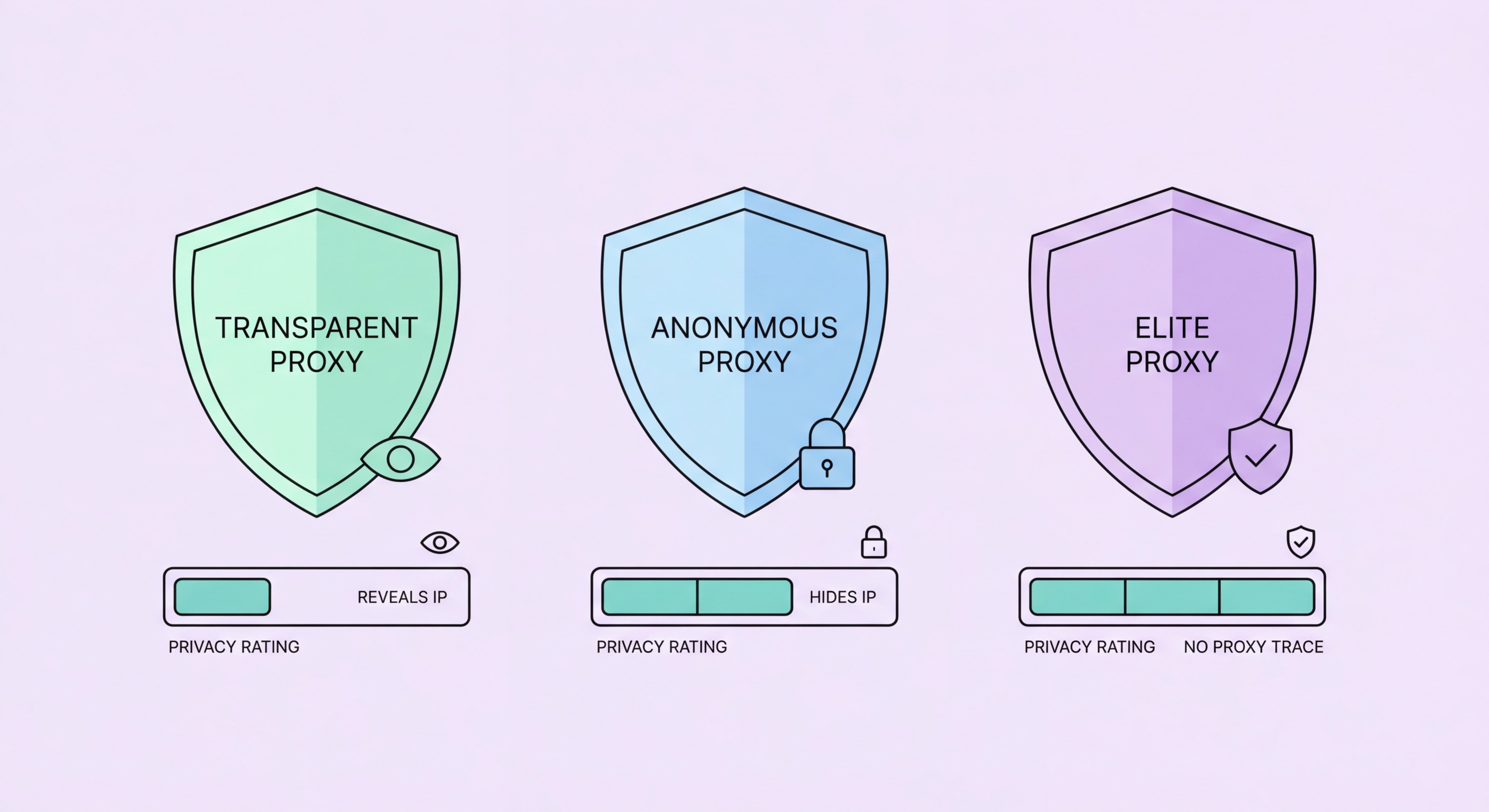
Proxy servers are classified into three anonymity levels based on what information they reveal to destination servers. These levels are defined by which HTTP headers the proxy includes when forwarding your requests. Transparent proxies pass your real IP address to the destination server in the X-Forwarded-For header and also identify themselves as proxy servers — they provide zero privacy. Anonymous proxies remove your real IP from the packet header but still include a Via or X-Forwarded-For header revealing that the request was proxied. Elite proxies (also called high-anonymity proxies) remove all identifying headers, making the request appear as though it came directly from a regular non-proxy internet user.

The distinction matters practically because the information revealed determines what the destination server knows about you. With a transparent proxy, the website receives your real IP, your location, your ISP, and knows you're using a proxy — you've gained nothing in terms of privacy. With an anonymous proxy, the website doesn't know your real IP but does know you're using a proxy — it may treat your request with additional suspicion or challenge it. With an elite proxy, the website sees the proxy's IP as if it were a direct user connection and has no indication of proxy use.

Confusingly, many commercial services market themselves as "anonymous proxies" without specifying which tier they provide. A proxy listed as "anonymous" on a free proxy list may be a low-quality anonymous proxy that still reveals proxy use via headers, or it may be an elite proxy — the label is not standardised. When purchasing or evaluating proxy services, test the actual headers sent by connecting to a header-inspection service like httpbin.org/headers through the proxy and examining what headers the destination server receives. Only elite (high-anonymity) proxies are appropriate for privacy-sensitive use cases.

  • Transparent Proxy: Passes your real IP in X-Forwarded-For and identifies as a proxy — zero privacy benefit.
  • Anonymous Proxy: Hides your real IP but includes headers revealing that a proxy is in use.
  • Elite (High-Anonymity) Proxy: Removes all proxy-indicating headers — appears as direct user traffic.
  • Label Warning: "Anonymous proxy" labels are not standardised — verify actual header behavior by testing.
  • Testing Method: Connect to httpbin.org/headers through the proxy to see exactly what headers the destination receives.
  • Privacy Use Case: Only elite/high-anonymity proxies provide meaningful anonymity against destination server logging.
Three levels of proxy anonymity
2What Proxies Don't Hide

What Even Elite Proxies Cannot Conceal

Even elite proxies have significant privacy limitations that are important to understand before relying on them for sensitive purposes. First, your ISP still sees that you are connecting to the proxy server's IP address. While the ISP cannot see what you're doing through the proxy (assuming you're using HTTPS connections to the destination), they can see the volume of traffic to the proxy, the timing, and the proxy's IP. This connection record may be logged and is not protected by the proxy's anonymity properties — those apply only to the destination server's perspective.

Browser fingerprinting is a powerful identification technique that proxies cannot address. Your browser reveals identifying information through JavaScript: screen resolution, installed fonts, browser plugins, Canvas rendering, WebGL capabilities, time zone, language settings, and dozens of other attributes. A website using advanced fingerprinting can identify you as the same user across multiple sessions even if you use a different IP address each time. Proxies change your IP but do nothing about browser fingerprint — only browser privacy tools, Tor Browser, or headless browser configurations can address fingerprinting.

The proxy provider itself represents a privacy risk that many users overlook. When you connect to an elite proxy, the proxy provider's server processes every one of your requests. The provider knows your real IP (from the client connection), what websites you visit, what data you send, and when. Elite proxy anonymity hides your identity from destination websites — it does not hide your activity from the proxy operator. A proxy provider with weak privacy practices, a logging policy, or a willingness to respond to legal data requests can compromise your anonymity even if the proxy is technically elite-grade.

  • ISP Visibility: Your ISP sees connections to the proxy's IP — timing and volume metadata is still logged.
  • Browser Fingerprinting: JavaScript-based fingerprinting identifies users across IPs — proxies cannot prevent this.
  • Proxy Provider Logs: The proxy operator knows your real IP and your browsing activity — choose providers with verified no-logs policies.
  • Cookie Tracking: Cookies set before using the proxy may identify you to websites regardless of IP change.
  • Account Login: Logging into accounts while using a proxy reveals your identity to that service regardless of proxy use.
  • DNS Leaks: If your application resolves DNS locally, DNS queries reveal visited domains to your ISP even through a proxy.
What proxies don't hide
3Proxy vs VPN Anonymity

Anonymous Proxy vs VPN: Which Is More Private?

For anonymity purposes, a VPN generally provides stronger protection than even an elite proxy for individual users because of the encryption layer. A VPN encrypts all traffic between your device and the VPN server, hiding both the content and metadata of your communications from your ISP and any network observer. Your ISP sees only an encrypted stream to the VPN server's IP — they cannot determine which websites you're visiting or what data you're sending. An elite proxy provides IP concealment at the destination but leaves your traffic content and destination metadata visible to your ISP if connections aren't HTTPS.

The Tor network goes further still, routing traffic through three relay nodes operated by independent volunteers, with each node knowing only the previous and next hop in the chain. Tor provides substantially stronger anonymity than either proxies or VPNs by separating knowledge of who you are from knowledge of what you're accessing — no single node knows both your real IP and the destination. The trade-off is significant performance degradation: Tor browsing is typically 5–10x slower than a direct connection, making it impractical for bandwidth-intensive use cases.

The appropriate tool depends on your threat model. For casual privacy — hiding your IP from websites and avoiding basic tracking — an elite proxy is adequate and convenient. For stronger privacy protection against ISP surveillance and correlation attacks — where someone might combine ISP logs with destination server logs to unmask you — a no-logs VPN is more appropriate. For high-risk anonymity requirements where exposure could have serious consequences — whistleblowing, reporting from dangerous environments, communications that must be resistant to state-level adversaries — Tor is the appropriate tool.

  • Elite Proxy: Hides your IP from destination websites — appropriate for basic IP masking and casual privacy.
  • VPN: Encrypts all traffic and hides destinations from ISP — stronger privacy for most personal use cases.
  • Tor: Routes through three independent relays — strongest anonymity, significantly slower, for high-risk situations.
  • Threat Model: Match the privacy tool to your actual adversary — proxy for websites, VPN for ISP, Tor for state actors.
  • No-Logs Providers: Regardless of tool, a provider that doesn't log your activity is essential for meaningful privacy.
  • Combination Use: Using a proxy within a VPN tunnel provides layered protection — IP hidden from both site and proxy provider.
Anonymous proxy vs VPN comparison
4Evaluating Providers

Evaluating Proxy Providers for True Anonymity

If your use case genuinely requires anonymity (rather than simply IP masking for access purposes), evaluating proxy providers requires going beyond their marketing claims. The key questions are: Does the provider maintain logs of user activity and real IP connections? What is their legal jurisdiction and who can compel them to disclose data? Have they ever received and complied with law enforcement data requests? For privacy-focused use, these questions are as important as technical specifications.

Payment method also matters for strong anonymity. If you pay for a proxy service with a credit card or through a payment processor like PayPal, there's a linkage between your real identity (in the payment record) and your proxy account. Privacy-focused users can reduce this exposure by paying with cryptocurrency (preferably privacy-focused coins), though this is only relevant for high-stakes anonymity scenarios. For most everyday privacy uses, standard payment methods are adequate.

Consider combining technologies for layered protection. Running a proxy over a VPN — connecting to a VPN first, then using a proxy — means the proxy provider sees a VPN IP rather than your real IP, and the VPN provider sees only encrypted traffic to the proxy. This layered approach provides meaningful protection even if either the VPN or the proxy provider has weak data practices. For most users, this level of complexity is unnecessary, but it's a viable option for those with genuine privacy requirements that exceed what either technology provides alone.

  • Logging Policy: Verify whether the provider logs connection metadata, request history, or real user IPs.
  • Legal Jurisdiction: Understand which country's laws govern the provider and who can compel disclosure.
  • Warrant Canary: Look for providers that publish warrant canaries or transparency reports about government data requests.
  • Payment Privacy: Cryptocurrency payment reduces the linkage between your real identity and proxy account.
  • VPN over Proxy Layering: Connect through a VPN before using a proxy so the proxy sees a VPN IP, not your real IP.
  • Independent Audit: Prefer providers whose no-logs claims have been independently verified through third-party security audits.
Compare Tor vs Proxy vs VPN for anonymity →
Choosing an anonymous proxy provider

Find a Truly Anonymous Proxy Solution

Compare the best paid proxy providers with genuine privacy practices — and understand the full spectrum from proxy to VPN to Tor.

Related VPN Articles