Credit monitoring is a critical but underused layer of identity protection for Hong Kong residents. Learn how to use TransUnion reports, bank alerts, and dark web monitoring together to catch identity fraud before it causes lasting damage.
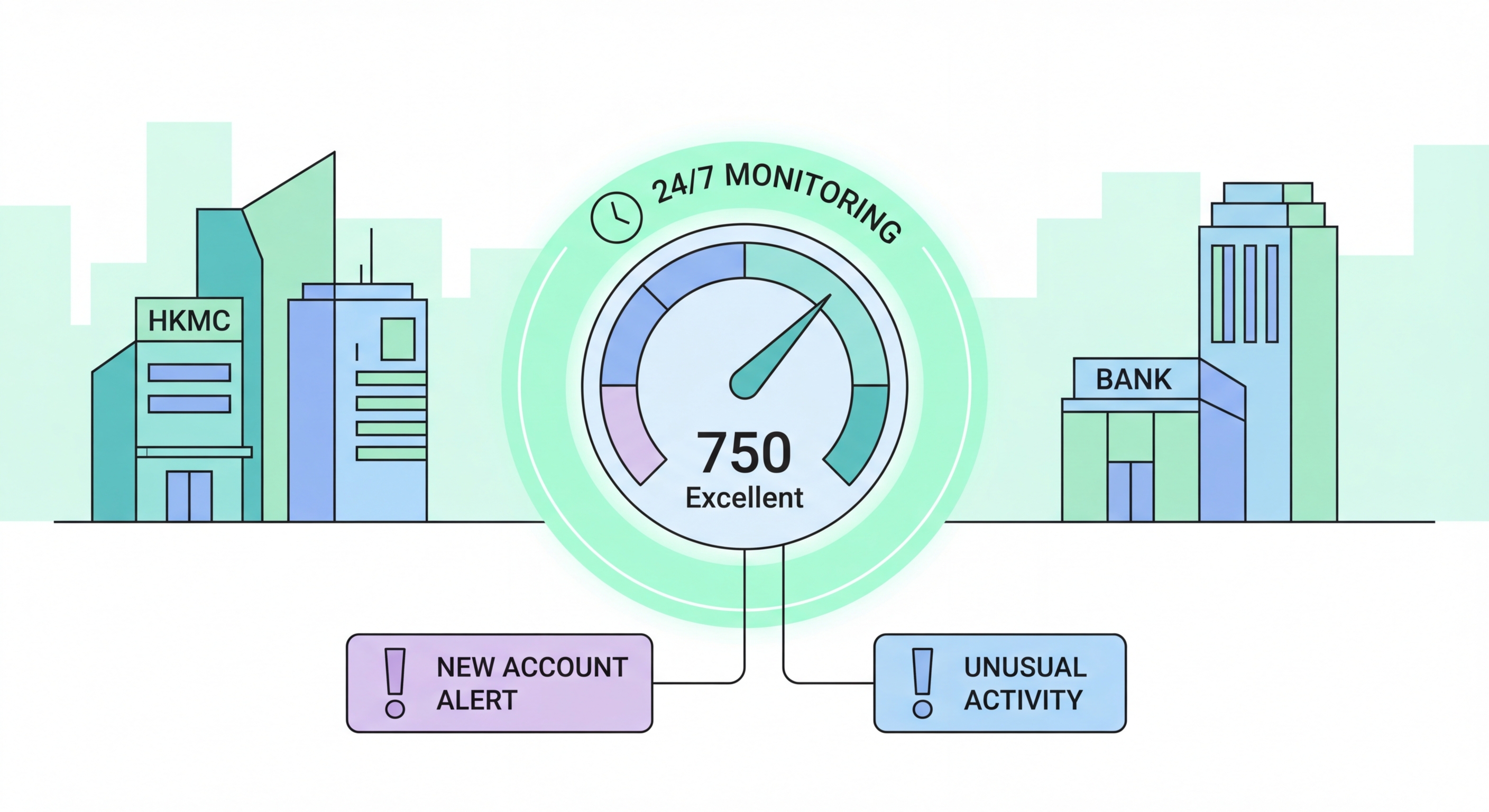
Credit monitoring in Hong Kong operates through TransUnion, the primary credit reference agency (CRA) serving individual consumers in the territory. TransUnion maintains credit files for millions of Guide for Hong Kong">Hong Kong residents, aggregating data from banks, licensed money lenders, telecommunications companies, and other credit-granting institutions. Your credit file contains a record of all credit applications made in your name, existing credit facilities (credit cards, personal loans, mortgages), repayment history, and any defaults or court judgments. When a criminal uses your identity to apply for credit, that fraudulent application appears on your TransUnion file — credit monitoring catches this by alerting you when new enquiries or account changes are recorded.
Hong Kong residents have the right to obtain their credit report from TransUnion under the Code of Practice on Consumer Credit Data (issued under the PDPO). The current process allows you to request a full credit report online or by mail at a modest fee, with the report delivered within a few business days. Unlike some countries, Hong Kong does not currently have a legally mandated free annual credit report, though some banks provide credit score monitoring as a customer benefit. For active identity protection, the recommended approach is to obtain your TransUnion report at minimum twice per year, with quarterly checks if you have elevated risk exposure (travel, recent data breaches affecting your accounts, or high-value assets).
Credit monitoring services offer a more real-time alternative to periodic self-checks. These services receive alerts from credit reference agencies when new enquiries, account openings, or changes are made to your file, then relay these alerts to you — typically within 24-48 hours. In the US and UK, standalone credit monitoring is a mature market with many free options; in Hong Kong, credit monitoring is primarily available as part of comprehensive identity protection packages offered by banks (some premium banking tiers include this), insurers, and services like LifeLock (available to HK residents internationally, though tailored to US credit data). The practical Hong Kong approach combines TransUnion self-monitoring with bank-provided account alerts.
Your TransUnion credit report in Hong Kong is divided into several sections, each of which can reveal different types of identity theft. The enquiries section shows every time a lender or institution has requested your credit file — each search is date-stamped and attributed to the requesting institution. An unfamiliar enquiry is the earliest possible indication of identity fraud: a criminal has applied for credit in your name, and the prospective lender has pulled your file to assess the application. Not every unfamiliar enquiry indicates fraud — soft checks by insurance companies or employers don't always appear, and some bank internal checks may use a different legal entity name — but any hard enquiry from an institution you didn't apply to should be investigated immediately.
The accounts and facilities section lists all credit cards, loans, and overdraft facilities in your name. Each entry shows the institution, account type, credit limit, outstanding balance, and repayment history. Fraudulent accounts opened in your name will appear here with an institution you didn't choose and (typically) with a payment history showing arrears, since criminals rarely make repayments on fraudulently obtained credit. Some fraudulent accounts may be current if the criminal is servicing the debt while building credit for a larger fraud — this is less common but occurs with sophisticated synthetic identity fraud operations.
The defaults and legal judgments section is the most serious — entries here indicate that a creditor has registered a formal default against you or obtained a court judgment for unpaid debt. If you discover an unfamiliar default, this is a significant identity theft indicator requiring immediate action: the fraudulent debt has reached a stage where formal legal processes have been initiated in your name. Defaults remain on your TransUnion file for a period defined by the PDPO's Code of Practice on Consumer Credit Data (generally 5 years for defaults), so prompt dispute and correction is essential to prevent long-term credit score damage from fraud you didn't commit.
Credit monitoring and dark web monitoring serve complementary roles in an identity protection strategy. Dark web monitoring operates upstream — it detects when your credentials or personal data appear on criminal markets, giving you a warning before the data is actively exploited. Credit monitoring operates downstream — it detects when a criminal has already used your identity to apply for or obtain credit. Together, they cover the full timeline of identity theft: dark web monitoring provides the earliest possible warning of data exposure; credit monitoring provides the last line of defence if that exposure has already been used for financial fraud. Neither alone provides complete protection; both together create overlapping coverage that maximises detection speed.
The practical free monitoring stack for Hong Kong residents combines three complementary systems. First, Have I Been Pwned (haveibeenpwned.com) — register all your email addresses for free breach notifications; this is the primary early warning for credential exposure. Second, your password manager's breach report (1Password Watchtower, Bitwarden Reports, iOS Security Recommendations) — this checks stored passwords against the HIBP pwned passwords database and identifies vulnerable accounts for immediate remediation. Third, manual TransUnion credit report checks twice per year — this catches any fraudulent credit applications that slipped through the dark web monitoring net. This zero-cost stack provides a solid baseline that most Hong Kong residents should implement immediately.
For elevated-risk individuals — those with high-value assets, public profiles, businesses, or who have already experienced identity incidents — a paid monitoring tier adds meaningful coverage. Paid services like Norton 360 with LifeLock, Experian IdentityWorks (available to HK residents), or the identity protection components of comprehensive cybersecurity suites add dark web scanning beyond HIBP's email-only coverage (monitoring HKID numbers, phone numbers, passport details), real-time credit monitoring where available, and in some cases resolution support services that assist with the administrative burden of identity theft recovery. The value of these paid services is strongest for those who have already had data exposed in breaches affecting non-email data types.
When credit monitoring reveals a suspicious enquiry, unfamiliar account, or unexpected default, time is critical. The first step is to contact the institution that made the enquiry or opened the account — identify them from your TransUnion report and call their fraud line directly. Major Hong Kong banks have dedicated fraud teams: HSBC (2233 3000), Hang Seng (2198 7111), Standard Chartered (2886 8868), Bank of China (3988 2388), and Citibank (2860 0333). Explain that you did not authorise the application or account and that you believe you are a victim of identity fraud. Request that the application be withdrawn, the account frozen, and any associated enquiry be removed from your credit file pending investigation.
Simultaneously, obtain a police report from the HKPF CSTCB. Call 18222 or visit your nearest police station to file a report of identity fraud — specify the fraudulent credit accounts or applications as evidence. The police report number is essential for all subsequent dispute resolution: TransUnion requires it to process fraud-related credit file corrections, lenders require it to escalate disputes beyond standard customer service channels, and the PCPD requires it if you are filing a complaint about a data user's role in the breach. File the police report on the same day you discover the fraud, documenting every detail including dates, institution names, and amounts involved.
After immediate containment, focus on credit file remediation. Submit a written dispute to TransUnion referencing your police report number, PCPD complaint reference (if applicable), and providing your HKID copy for verification. TransUnion is required to investigate and respond within 40 days under the PDPO framework. For each fraudulent account, also submit disputes directly to the respective lenders — they have independent obligations to correct fraudulent accounts separate from TransUnion's process. Follow up persistently: institutions receive many dispute submissions and may not prioritise without repeated contact. Keep records of all communications including dates, times, and names of staff spoken to. Most Hong Kong identity fraud disputes are successfully resolved within 3-6 months with consistent follow-through.