My Credit Card Is on the Dark Web: What to Do Now

Discovering your credit card data on the dark web requires immediate, specific action. This guide walks Hong Kong residents through the exact steps to take — from contacting your bank to disputing charges and preventing future exposure.

Credit card on dark web what to do
1Immediate Steps

Immediate Steps: Contact Your Bank Now

If you discover your credit card data on the to Check If Your Data Is on the Dark Web">dark web — whether through a monitoring service alert, a bank notification, or your own research — the single most important first step is to contact your issuing bank's fraud line immediately. In Hong Kong, each major card issuer has a 24-hour fraud hotline: HSBC (2233 3000), Hang Seng Bank (2198 7111), Standard Chartered (2886 8868), Bank of China (3988 2388), Citibank (2860 0333), American Express HK (2277 1388), and DBS (2290 8888). Tell the fraud team that you have reason to believe your card number has been exposed on the Data Breach? From Hack to Dark Web">dark web and request that the current card be suspended and a replacement issued with a new card number. Most HK banks process emergency card replacements within 1-5 business days; some offer expedited replacements.

While on the call, request a review of recent transactions. Ask the fraud team to walk through all transactions in the past 30-90 days and confirm which are authorised. Fraudulent card use often begins with small test charges (HK$1-50 at vague merchants) before escalating to larger fraudulent purchases — these test charges are easy to miss if you only check recent balances rather than full transaction histories. If any transactions are suspicious, dispute them immediately on the call and request chargeback initiation. Under Hong Kong's consumer protection framework and international card network rules (Visa, Mastercard, American Express zero liability policies), you are generally not liable for unauthorised card transactions if reported promptly — but the timeline for reporting affects your dispute rights.

After speaking with the bank, document your call: note the date and time, the name of the staff member you spoke with, and the reference number for the fraud report. Request a written confirmation of the card suspension and fraud report by email. This documentation creates a paper trail that protects you in the event of any dispute about what was reported or when. Banks process thousands of fraud contacts and mistakes in documentation are possible — having your own records ensures you can escalate effectively if the bank's records are incomplete or if unauthorised charges continue appearing after the card was supposedly suspended. The documentation is also valuable if you later need to file a HKPF report or a credit card dispute in writing.

  • Call your bank's fraud line immediately: HSBC: 2233 3000, Hang Seng: 2198 7111, Standard Chartered: 2886 8868, Bank of China: 3988 2388 — all 24 hours.
  • Request card suspension and replacement: A new card number eliminates risk from the exposed data — do not just "put a watch" on the account.
  • Review 30-90 days of transactions: Small test charges are easy to miss — review comprehensively, not just recent transactions.
  • Dispute suspicious charges immediately: International card network zero liability policies protect you from unauthorised transactions if reported promptly.
  • Document everything: Date, time, staff name, reference number — request email confirmation of your fraud report and card suspension.
  • Check all linked services: If your card was used for subscriptions or auto-pay, contact those providers to update payment details with your new card number after replacement.
How criminals use stolen card data on dark web markets →
Credit card fraud immediate steps contact bank
2Understanding the Exposure

What Credit Card Data Is on the Dark Web and What It Enables

Understanding precisely what credit card data is circulating about you helps calibrate the appropriate response. Credit card data on the dark web ranges from minimal (card number only) to comprehensive ("fullz" — full card details with cardholder name, billing address, CVV, expiry date, and sometimes PIN). A card number alone (without CVV and expiry) has limited utility for fraud; full card details including CVV and billing address are significantly more valuable and enable online fraud where card-not-present transactions are processed. The source of the breach determines what was exposed: e-commerce site breaches typically capture full card details entered during checkout; physical skimming at ATMs or POS terminals typically captures magnetic stripe data (sufficient for card cloning); and large payment processor breaches can expose card data at scale.

Dark web marketplaces categorise stolen card data into tiers based on quality and value. "Classic" card data (basic credit card number, expiry, CVV) sells for US$5-15 per card. "Premium" listings with verified balance information, accurate billing address, and recent CVV sell for US$20-50. "Platinum" or "Black" tier listings for high-limit cards from premium banks (Citi PremierMiles, HSBC Premier, Standard Chartered Visa Infinite) with verified high credit limits may sell for US$50-100+. For HK-issued cards, listings sometimes include the issuing bank name and approximate credit limit — making them more valuable to fraudsters who know exactly which cards have room for large fraudulent purchases. This tiering also explains why premium credit cards sometimes see more fraud than standard cards — they attract more sophisticated criminal attention.

The exposure level also determines how urgently you need to act beyond the immediate card cancellation. If only basic card data was exposed (number, expiry, CVV) without personal details, the fraud risk is primarily financial and is substantially contained by cancelling the card. If the exposure included your full billing address, phone number, or email address in addition to card data, criminals may use this information for social engineering attacks — calling you or your bank pretending to be the other party, or using the personal details to create more convincing phishing attempts. If the dark web listing includes your name, address, card details, and HKID number (a "financial fullz"), the risk extends to identity theft beyond just credit card fraud and the response needs to include the identity theft steps described in the credit monitoring guide.

  • What data matters: Card number + expiry + CVV = online fraud risk; with billing address = higher-confidence fraud; with HKID/personal data = identity theft risk.
  • Source determines exposure scope: E-commerce breach captures checkout data; skimming captures magnetic stripe; processor breach can be large-scale.
  • Premium cards attract more fraud: High-limit HK cards (HSBC Premier, Citi Prestige) are specifically targeted on dark web markets for their available credit.
  • Social engineering risk: If personal details (phone, address) are combined with card data, expect targeted phishing/vishing attempts — be suspicious of incoming contact.
  • Financial fullz requires identity theft response: Card data + HKID = check credit file, monitor for fraudulent applications, file HKPF report.
  • After cancellation, card data is useless: Cancelling and replacing the card with a new number fully eliminates the payment fraud risk from the exposed data.
If personal data was also exposed, see the full identity theft response guide →
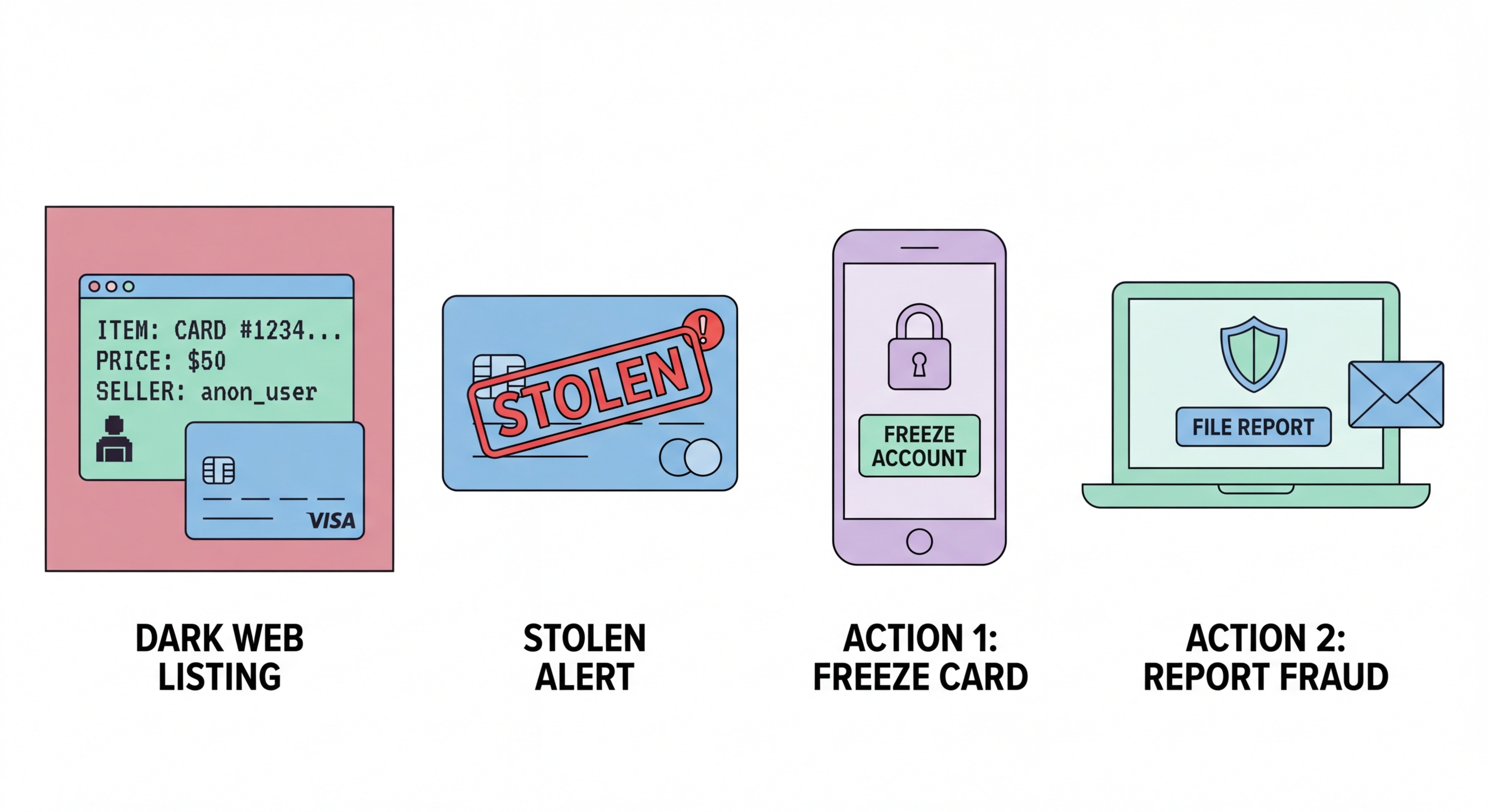
Credit card data exposed dark web what was stolen
3Dispute Process

Disputing Fraudulent Charges and the HK Chargeback Process

If fraudulent charges have already appeared on your card, the formal dispute and chargeback process is your path to recovery. Hong Kong card issuers are bound by international card network rules (Visa, Mastercard, American Express) that provide strong consumer protections for unauthorised transactions. Under Visa and Mastercard zero liability policies, you are not responsible for unauthorised transactions made on your account, provided you report them promptly and have not acted negligently (for example, sharing your card details in response to a phishing message). In practice, "promptly" for Hong Kong banks typically means within 60 days of the statement date showing the fraudulent transaction — report immediately, not when the next statement arrives.

The dispute process begins with your phone call to the bank's fraud line (as described in Section 1). Follow up the phone call with a written dispute submission — the bank will provide a dispute form, or you can submit via the bank's app or secure message service. Your written dispute should include: the specific transaction(s) you are disputing, the date and amount, the reason for dispute (unauthorised transaction), and confirmation that you did not authorise the transaction or provide your card details to the merchant. The bank will initiate a chargeback claim with the card network, which may request supporting documentation including your fraud report confirmation and any evidence you have of the dark web exposure (for example, a screenshot of the monitoring service alert, with your card's last four digits visible). Keep copies of all submissions.

Timeline expectations for dispute resolution in Hong Kong: initial acknowledgement within 7-10 business days; provisional credit for the disputed amount is typically provided while the investigation is underway (this is not a guarantee and depends on your bank's policies and the circumstances); final resolution within 45-90 days in most cases, though complex disputes involving merchants challenging chargebacks can take longer. If your bank denies a chargeback request or delays unreasonably, you have escalation options: the HKMA handles complaints about banks and financial institutions ([email protected] or 2878 8196); the Consumer Council (2929 2222) handles general consumer disputes; and for Visa and Mastercard disputes specifically, the international card network's arbitration process provides a final avenue if the bank's dispute resolution fails.

  • Zero liability protects you: Visa and Mastercard policies mean you are not liable for unauthorised transactions if reported promptly — don't assume you will have to absorb the loss.
  • Report within 60 days: HK banks typically require dispute within 60 days of the statement date — report immediately, not at month end.
  • Follow up in writing: A phone call initiates the dispute; a written submission (bank app, secure message, or dispute form) creates the formal record.
  • Provisional credit: Many HK banks provide provisional credit for disputed amounts while investigation is underway — ask about this when reporting.
  • Escalation options: HKMA (2878 8196), Consumer Council (2929 2222), international card network arbitration — use if bank dispute resolution is unsatisfactory.
  • Resolution timeline: 45-90 days for most disputes; document all communications and follow up at 30-day intervals if no resolution.
Your PDPO rights if a company breach exposed your card data →
Credit card dispute chargeback process Hong Kong
4Prevention

Preventing Future Credit Card Exposure and Fraud

After resolving the immediate incident, implement preventive measures that reduce your future exposure to credit card fraud. Virtual card numbers are one of the most effective tools available to HK consumers — several services and banks offer single-use or merchant-specific virtual card numbers that limit exposure when shopping online. If a virtual card number is stolen, only that specific number is compromised; cancelling it doesn't affect your physical card or other virtual cards. In Hong Kong, some banks offer virtual card generation in their banking apps — HSBC's Virtual Card feature for online transactions, for example, generates temporary card numbers for specific merchants. Apple Pay and Google Pay generate transaction-specific tokens that are never the actual card number, providing a similar protection for contactless payments.

Enable every available notification on your banking app — per-transaction push notifications for all card transactions are the most valuable early warning system for ongoing fraud. Set the threshold as low as possible (ideally HK$1) so even test charges trigger an alert. Review your bank's available transaction controls: many HK banks now offer the ability to set geographic restrictions (blocking transactions from outside Hong Kong), merchant category restrictions (blocking gambling or adult content merchants), or daily spending limits directly from the banking app. These controls, if briefly suspicious activity occurs, allow you to temporarily restrict card functionality without cancellation — useful if you suspect your card details may be at risk but haven't confirmed fraud yet.

Longer-term, reduce the surface area for card data theft by minimising where you store card details online. Audit the services that have your card number stored — subscription services, e-commerce platforms, food delivery apps, parking systems, etc. Remove stored card details from services you rarely use or don't fully trust. For regular online purchases, use PayPal, Apple Pay, Google Pay, or your bank's own payment gateway rather than entering card details directly — these intermediaries handle card data storage and provide an additional layer of protection. For high-value purchases from new or unfamiliar merchants, use a prepaid card or virtual card number rather than your primary credit card. Physical skimming risk at HK ATMs is reduced by using contactless (tap) payments where possible, checking for card reader tampering before inserting, and covering the PIN pad when entering your PIN.

  • Virtual card numbers: Use bank-issued virtual card numbers or Apple/Google Pay tokens for online purchases — a compromised virtual number affects only that number, not your physical card.
  • Per-transaction alerts at HK$1: Set the lowest possible threshold for transaction notifications — even small test charges should trigger an immediate push notification.
  • Transaction controls: Many HK banks offer geographic, merchant category, and spending limit controls in the banking app — use these to restrict risk.
  • Remove stored card details: Audit which services store your card; remove from low-use, low-trust merchants; use PayPal/Apple Pay as intermediaries for regular online shopping.
  • Contactless reduces ATM skimming risk: Tap payments eliminate card insertion and reduce physical skimming exposure at HK ATMs and POS terminals.
  • Regular monitoring: Review card statements monthly; run dark web monitoring on your email addresses to receive early warning of future breach events involving payment data.
Build your complete identity and financial protection strategy →
Credit card fraud prevention Hong Kong
Know Your Bank's Fraud Line Before You Need It

Know Your Bank's Fraud Line Before You Need It

Save your bank's 24-hour fraud line number now. Quick reporting is the single most important factor in limiting credit card fraud losses — don't look for the number when you're already in crisis.

Related VPN Articles