Proxy Server Glossary: 30 Key Terms Explained
A complete reference guide to proxy server terminology — from fundamental concepts like SOCKS5 and residential IPs to advanced techniques like IP rotation and sticky sessions.
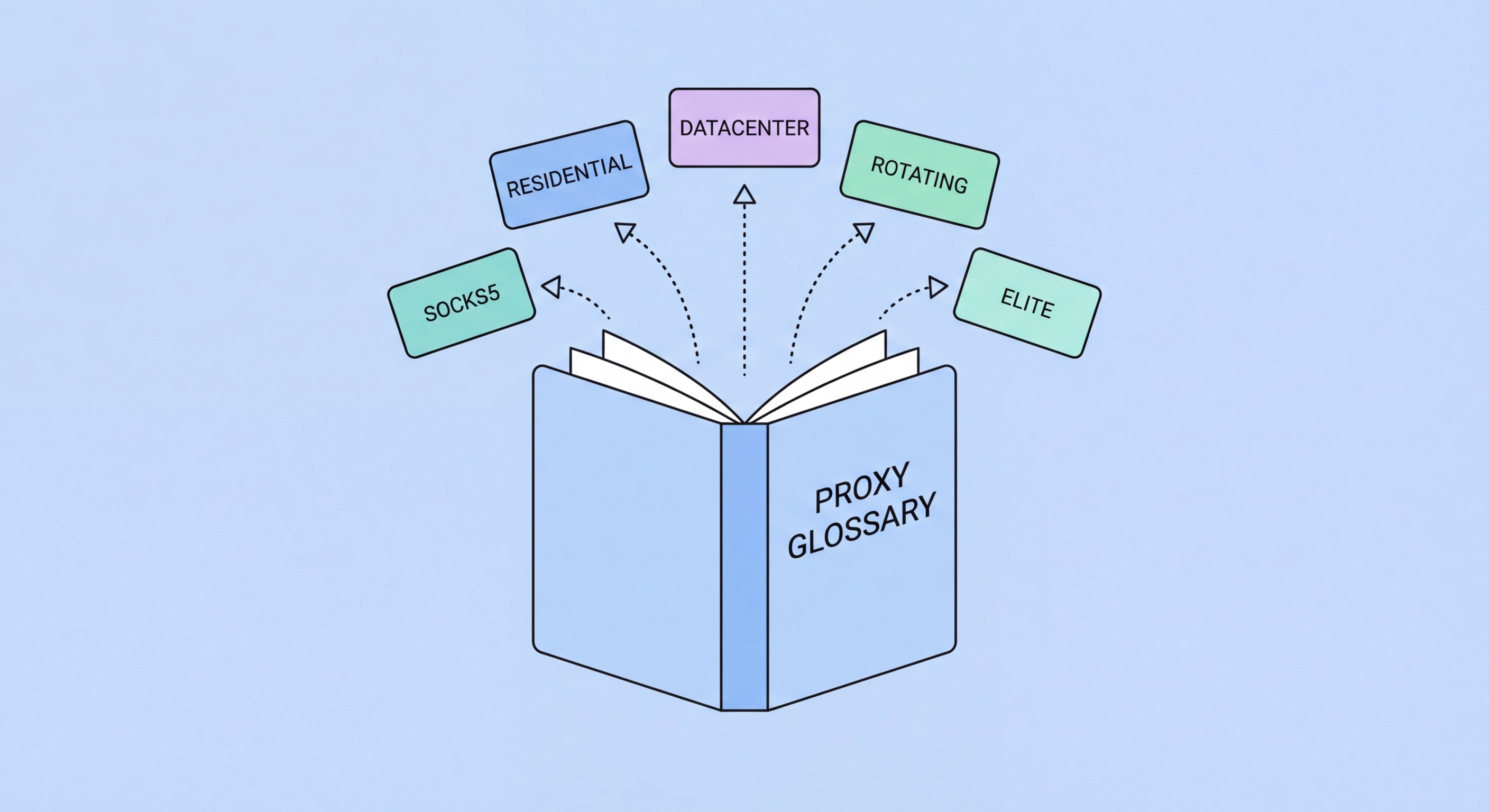
A complete reference guide to proxy server terminology — from fundamental concepts like SOCKS5 and residential IPs to advanced techniques like IP rotation and sticky sessions.
Understanding proxy server technology requires familiarity with a specific vocabulary. This glossary covers the 30 most important terms you'll encounter when evaluating, configuring, or using proxy services — from the most basic definitions through to advanced technical concepts used by developers and data professionals.
Anonymous Proxy: A proxy that hides your real IP address from destination servers but includes HTTP headers (Via or X-Forwarded-For) that indicate a proxy is being used. Provides partial privacy — destination knows you're using a proxy but not who you are. ASN (Autonomous System Number): A unique identifier assigned to networks operated by ISPs, corporations, and hosting providers. Anti-bot systems use ASN lookup to classify IPs as datacenter (commercial hosting ASNs) or residential (consumer ISP ASNs). Bandwidth: The amount of data transferred through a proxy connection, typically measured in gigabytes. Commercial proxy services usually price by bandwidth consumed rather than by number of requests.
CAPTCHA: A challenge-response test used by websites to distinguish human users from automated bots. Proxies and scrapers frequently encounter CAPTCHAs as an anti-bot measure; CAPTCHA solving services handle these programmatically. Datacenter Proxy: A proxy using an IP address assigned to commercial cloud or hosting infrastructure (AWS, Google Cloud, etc.). Fast and cheap but more detectable than residential proxies. DNS Leak: A privacy failure where DNS queries are resolved outside the proxy tunnel, revealing visited domain names to your ISP or DNS provider despite proxy use. Elite Proxy (High-Anonymity Proxy): A proxy that removes all identifying headers including X-Forwarded-For — requests appear to destination servers as direct, non-proxied connections. Forward Proxy: A proxy deployed on the client side that routes client requests to the internet, as distinguished from a reverse proxy which routes internet requests to servers.

IP Address: A numerical label assigned to each device on a network. Every internet-connected device has an IP address; proxies substitute their own IP for yours when making requests on your behalf. IP Geolocation: The process of determining the geographic location of an IP address using commercial databases that map IP ranges to countries, regions, and cities. Used by websites to implement geographic content restrictions. IP Pool: The collection of IP addresses managed by a proxy provider. Larger pools enable more frequent IP rotation without reuse. IP Rotation: The practice of assigning a different IP address from the provider's pool for each request or on a timed schedule. Essential for avoiding rate limiting in high-volume scraping operations.
ISP (Internet Service Provider): The company that provides internet access to consumers and businesses. Residential proxy IPs are assigned to ISP customers. Mobile Proxy: A proxy using an IP address from a mobile network carrier (4G/5G). The most trusted and hardest to detect proxy type, as mobile carrier IP space is legitimately shared by many real users. PAC File (Proxy Auto-Configuration): A JavaScript file that defines which requests should be proxied and through which proxy — used for dynamic, rule-based proxy routing in enterprise environments. Per-Request Rotation: A proxy configuration where a new IP address is assigned from the pool for every individual outbound request. Ideal for scraping jobs where IP identity must vary continuously.
Port: A numeric identifier (0–65535) that identifies a specific service on a server. Common proxy ports include 3128 (HTTP), 8080 (HTTP alternate), 1080 (SOCKS), and many others. You configure both IP and port when setting up a proxy connection. Proxy Authentication: The mechanism by which proxy servers verify that connecting clients are authorised to use the proxy. SOCKS5 and HTTPS proxies support username/password authentication; some proxies use IP whitelisting instead.

Rate Limiting: A website's anti-bot measure that limits the number of requests from a single IP address within a time window. Triggers 429 Too Many Requests responses and is the primary challenge addressed by IP rotation. Residential Proxy: A proxy using an IP address assigned by an ISP to a real home broadband subscriber. Treated as legitimate consumer traffic by websites and significantly harder to block than datacenter proxies. Reverse Proxy: A proxy deployed on the server side that handles incoming requests on behalf of backend servers. Provides load balancing, DDoS protection, TLS termination, and origin server anonymisation.
Rotating Proxy: A proxy pool service that automatically cycles through different IP addresses for each request or on a scheduled interval. Session: A series of related requests that maintain continuity — for example, browsing a multi-page checkout flow. Proxy session management ensures the same IP is used throughout a session where continuity matters. SOCKS4: The predecessor to SOCKS5, supporting TCP proxying and DNS-at-proxy but not UDP or authentication. Largely superseded by SOCKS5. SOCKS5: The current standard for application-layer socket proxying, supporting TCP, UDP, IPv6, and built-in username/password authentication. The preferred proxy protocol for non-HTTP applications including torrent clients and custom scripts.
Sticky Session: A proxy configuration that maintains the same IP address for a defined duration (e.g., 30 seconds, 10 minutes) rather than rotating per-request. Required for tasks that need session persistence like logging into websites. Transparent Proxy: A proxy that intercepts traffic at the network level without requiring client configuration, and passes the client's real IP to destination servers in X-Forwarded-For headers. Provides zero privacy benefit. X-Forwarded-For: An HTTP header added by anonymous proxies that contains the client's original IP address. Elite proxies strip this header entirely to prevent destination servers from identifying the proxy user. Zero-Day: In proxy context, a newly discovered IP address that hasn't yet been added to blocklists — fresh IPs command premium pricing from some providers.

Anti-Bot System: Technology deployed by websites to detect and block automated traffic. Examples include Cloudflare Bot Management, Akamai Bot Manager, Imperva, and PerimeterX. These systems analyse dozens of signals beyond IP reputation — browser fingerprint, JavaScript execution, mouse movement, TLS fingerprint, and behavioral patterns. BGP (Border Gateway Protocol): The routing protocol that governs how traffic is directed across the internet between autonomous systems. BGP announcements determine which ASN "owns" an IP address range, enabling ASN-based IP classification.
Browser Fingerprinting: The technique of identifying users by the unique combination of browser and device characteristics — screen resolution, installed fonts, Canvas rendering, WebGL, timezone, language — that are exposed via JavaScript. Proxies change IP but don't address fingerprinting. CGNAT (Carrier-Grade NAT): A technique used by mobile carriers where many real users share a single public IP address. Makes mobile IPs especially trusted — blocking a mobile IP risks blocking many legitimate users. Geo-Targeting: The ability to request proxy IPs from a specific geographic location — at country, region, city, or ASN level. Essential for geographic market research and ad verification.
HTTP CONNECT Method: The HTTP request method used to create a TCP tunnel through an HTTP proxy to a HTTPS destination. The proxy forwards encrypted bytes without inspecting them after the CONNECT handshake. Managed Scraping API: A proxy service that handles not just IP rotation but also browser fingerprint management, CAPTCHA solving, and JavaScript rendering — returning clean HTML to the requester. Examples include Bright Data's Web Unlocker and Smartproxy's Site Unblocker. SNI (Server Name Indication): A TLS extension that reveals the target domain name during the TLS handshake, even in HTTPS connections — observable by network monitors even when content is encrypted. Web Application Firewall (WAF): Security software, often integrated into reverse proxy platforms, that inspects HTTP requests for attack patterns like SQL injection and XSS before they reach backend application servers.
