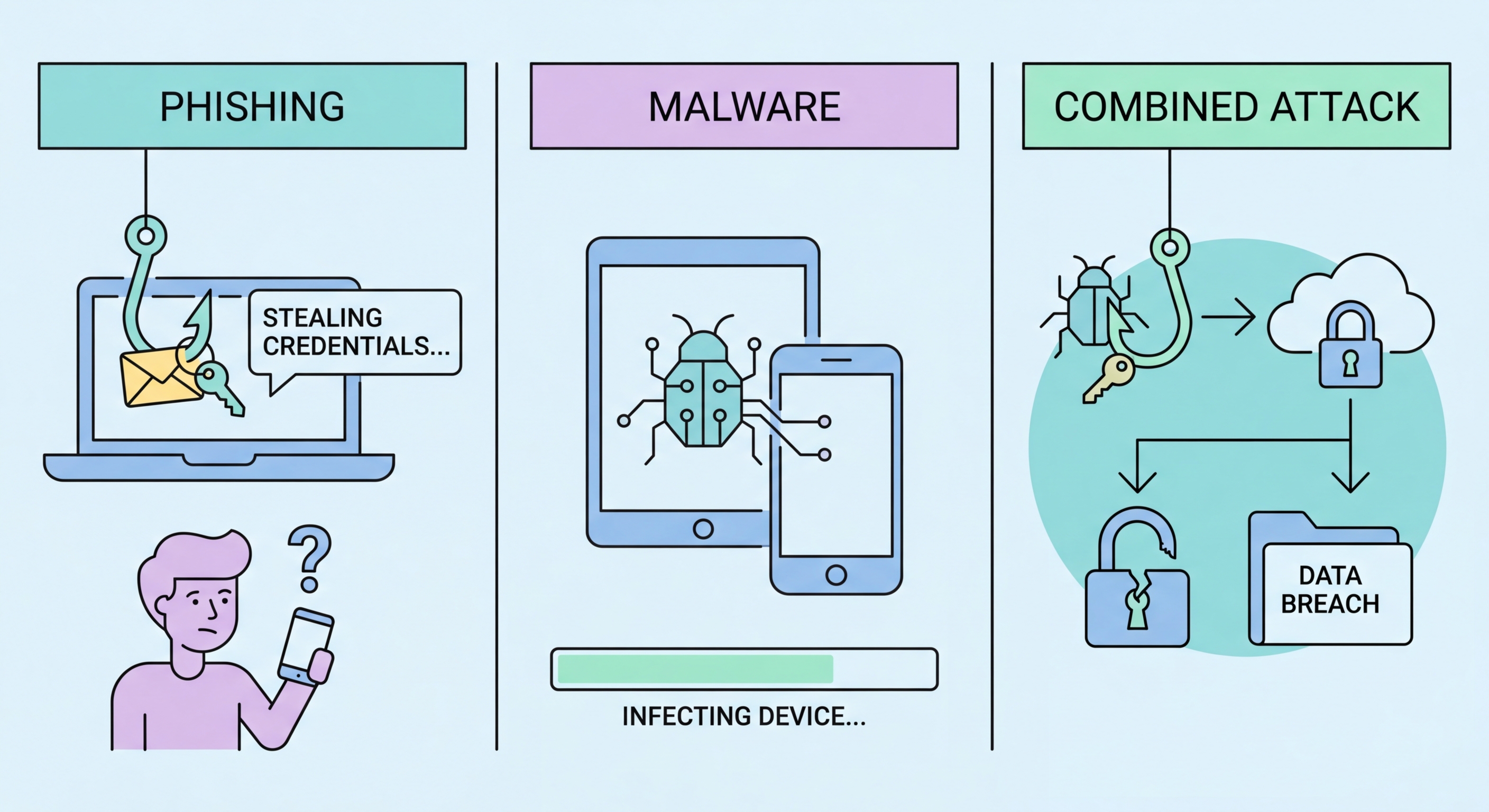
Phishing tricks you into doing something harmful; malware does the harm autonomously after getting onto your device. Understanding both — and how they work together — shapes a more effective protection strategy for Hong Kong users.
Phishing is a social engineering attack: it succeeds by deceiving a human into taking an action — clicking a link, entering credentials, transferring money, downloading a file. The attack mechanism is manipulation of the person rather than exploitation of technical vulnerabilities. If the intended victim recognises the deception and does not comply, the phishing attack fails. This human dependency is both phishing's greatest strength (because humans are reliably manipulable) and its point of failure (because an informed, vigilant person can defeat it entirely by simply not complying).
Malware is a technical attack: software designed to perform harmful actions on a device without the owner's consent. Once installed, malware operates autonomously — it does not require ongoing human interaction to do its damage. Types of malware include ransomware (encrypts files and demands payment), keyloggers (record keystrokes to capture passwords and sensitive information), trojans (appear legitimate while providing attacker access), spyware (monitor and exfiltrate data), and botnets (use infected devices for coordinated attacks or cryptocurrency mining). The critical distinction from phishing is that once malware is installed, human vigilance is no longer sufficient to prevent harm — technical removal and remediation is required.
Despite this fundamental distinction, phishing and malware are not separate threat categories in practice — they are frequently combined in layered attacks. Phishing is the most common initial delivery mechanism for malware: a phishing email with a malicious attachment, a smishing link that downloads an APK, or a phishing website that silently exploits browser vulnerabilities to install a dropper. The human element (phishing) gets the malicious software past the human's guard; the technical element (malware) then operates independently. This combination means that effective protection requires both human vigilance (to prevent the initial phishing delivery) and technical defences (to detect and block malware if the phishing delivery succeeds).
Email attachment-based malware delivery is the most established phishing-to-malware attack vector. A phishing email contains an attachment — typically a PDF, Word document, Excel spreadsheet, or compressed archive — that the social engineering component of the email motivates the victim to open. The attachment contains malicious code: a macro-embedded Office document that installs a dropper when macros are enabled, a PDF exploiting a renderer vulnerability, or an archive containing an executable disguised with a document icon and file name. Enterprise email security tools including Microsoft Defender and Proofpoint specifically target attachment sandboxing — detonating attachments in an isolated environment before delivery to detect malware — but no technical control catches all variants.
In Hong Kong, smishing campaigns targeting Android users frequently include links that trigger the download of malicious APK files — Android application packages that, when installed, grant broad device permissions including access to SMS messages (enabling OTP interception), contact lists (for further smishing propagation), and device storage. These malicious apps often impersonate genuine banking apps or utility apps from the same bank or service provider being spoofed in the smishing message. Android's more permissive installation model (allowing sideloading of APKs from outside the Play Store) creates this additional attack surface compared to iOS. Google Play Protect scans installed apps for malware and is a primary defence, but it is less effective against novel malware not yet in its detection signatures.
Drive-by malware delivery through phishing websites is a more passive infection vector. When a victim navigates to a phishing website — whether through a phishing link, a malicious QR code, or a redirected search result — the site may attempt to exploit browser or operating system vulnerabilities to silently install malware without any further user interaction beyond the page visit. This is sometimes called a "drive-by download" attack. Modern browsers with up-to-date patch levels significantly reduce but do not eliminate this risk. The combination of browser updates, anti-phishing browser extensions, and DNS filtering (blocking access to known malware distribution domains) provides layered protection against drive-by delivery.
Ransomware is the most financially damaging category of malware-based attack and is almost universally delivered through phishing. A ransomware attack encrypts the victim's files and demands a cryptocurrency payment in exchange for the decryption key. For individuals, this means loss of personal files, photos, and documents. For businesses, it can mean complete operational paralysis — loss of access to all business systems, customer data, financial records, and operational infrastructure. Ransomware attacks on Hong Kong businesses have been documented across healthcare, logistics, professional services, and other sectors, with ransom demands typically in the tens of thousands to millions of US dollars and recovery periods of weeks to months.
The phishing component of a ransomware attack typically delivers an initial "dropper" — a small piece of malware that, once executed, downloads and installs the ransomware payload. The dropper may also install additional malware that exfiltrates data before encryption, enabling the attacker to threaten public release of sensitive data as additional leverage ("double extortion"). In some sophisticated ransomware operations, the dropper includes a remote access trojan that gives the attacker extended time to map the organisation's network, identify and compromise backup systems (to prevent recovery without paying the ransom), and identify the most valuable data before triggering the encryption. This reconnaissance phase may last weeks or months after the initial phishing delivery before the ransomware is deployed.
For Hong Kong businesses, ransomware preparedness involves both preventing the initial phishing delivery and implementing recovery controls that function even when ransomware successfully deploys. The latter includes: maintaining offline or cloud-backup copies of critical data that ransomware cannot reach (attackers specifically target and destroy online and network backups), testing restoration from backups regularly, maintaining an incident response plan that includes ransomware scenarios, and having relationships with cybersecurity incident response firms before an incident occurs. The HKCERT provides incident response guidance for Hong Kong organisations, and HKPF can provide law enforcement support including intelligence on the threat actor group behind specific ransomware attacks.
Effective defence against the combined phishing-malware threat requires a layered approach that addresses both the human and technical dimensions. The human layer — phishing awareness, verification habits, and scepticism about unexpected requests — prevents the initial delivery of malware by making users resistant to the social engineering that delivers it. This layer is addressed through training, habit development, and the application of the verification practices described throughout this guide. Even well-trained individuals are occasionally deceived, particularly by sophisticated targeted attacks, which is why the technical layer is not optional.
The technical layer includes: maintaining all software and operating systems with current patches (reducing the vulnerability surface that drive-by malware exploits); using reputable endpoint protection software that includes behavioural malware detection (not just signature-based antivirus) on all devices; enabling DNS filtering (through services like CyberDefender.hk, Cloudflare 1.1.1.1 for Families, or Quad9) to block connections to known malware distribution and command-and-control domains; and for businesses, deploying Endpoint Detection and Response (EDR) tools that can identify and contain malware activity even after initial infection. Email security tools with attachment sandboxing and URL rewriting address the primary delivery vector at the network perimeter.
Incident response preparation is the final layer — accepting that even with excellent prevention, some attacks will succeed, and having a plan for rapid containment and recovery. For individuals, this means maintaining current backups of important files to an external drive or cloud service, and knowing how to perform a device reset if malware is confirmed. For businesses, a written incident response plan covering ransomware scenarios, regular recovery testing, and relationships with cybersecurity incident response firms are the key preparedness elements. The HKCERT provides a 24-hour hotline (8105 6060) for cyber incident reporting and initial response guidance for Hong Kong organisations.