Investment Scam Protection for Hong Kong Residents
How to identify and avoid the investment frauds costing Hong Kong residents billions annually — from pig butchering to fake trading platforms and unlicensed brokers.
How to identify and avoid the investment frauds costing Hong Kong residents billions annually — from pig butchering to fake trading platforms and unlicensed brokers.
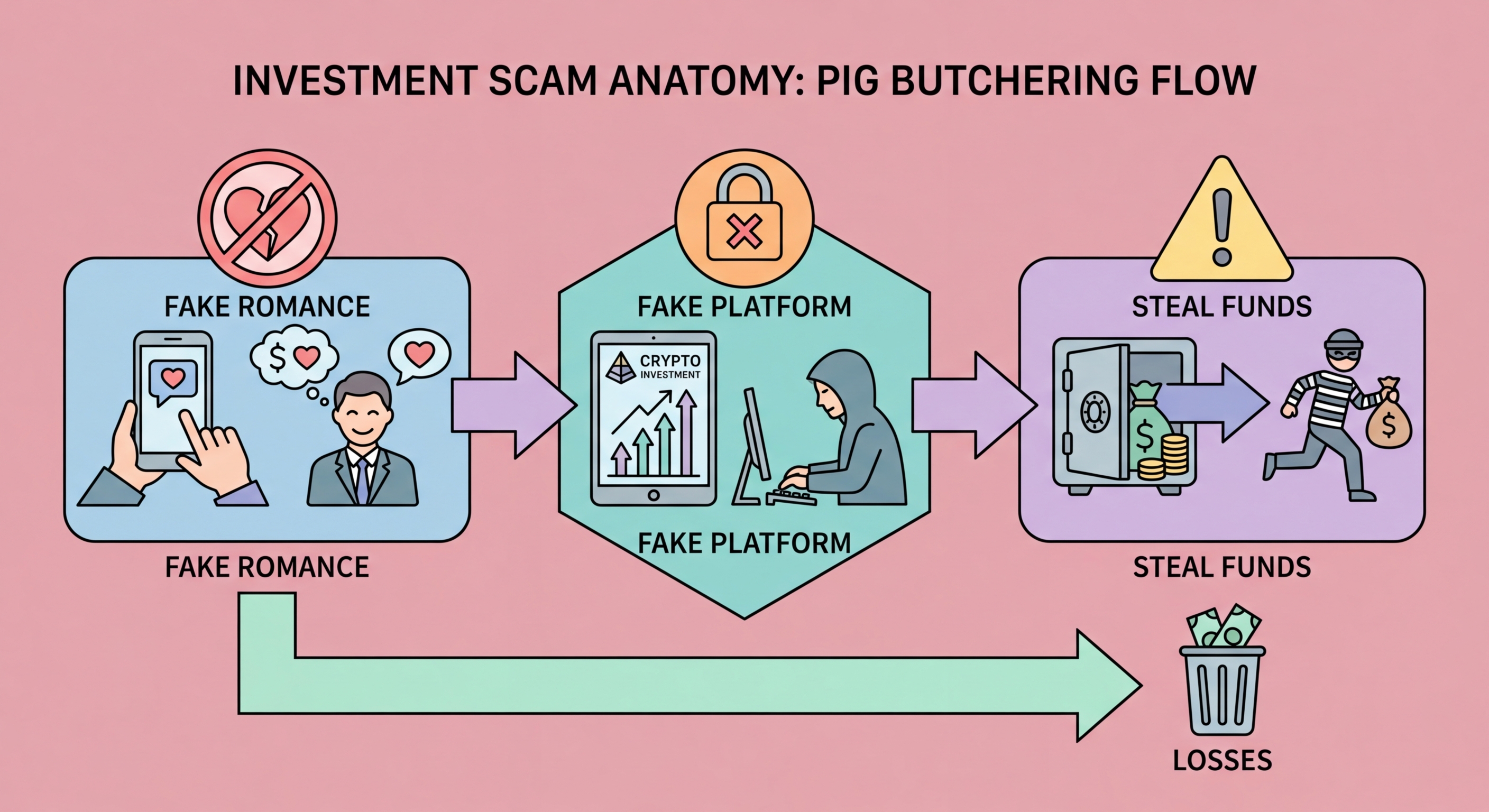
Pig butchering scams — known in Cantonese as 殺豬盤 or "sha zhu pan" — are the most financially devastating fraud typology in Hong Kong and across Asia. The name refers to the process of "fattening the pig before slaughter": fraudsters invest weeks or months cultivating a relationship with victims — through romantic attention, friendship, or professional networking — before gradually introducing investment opportunities on platforms they control. By the time the deception is revealed, victims have transferred life-changing sums of money that are never recovered.
The mechanics are consistent across cases. Initial contact typically comes via a wrong-number WhatsApp message, a connection request on LinkedIn from an attractive profile, or a match on a dating app. The scammer — often operating as part of an organised criminal group from compounds in Myanmar, Cambodia, or the Philippines — establishes rapport over weeks, sharing personal details, photos, voice notes, and video calls. When the victim's trust is established, the scammer casually mentions cryptocurrency investment returns, introduces them to a "platform" used by their family or employer, and guides them through making a first small deposit that shows immediate paper profits.
The fake trading platform displays fabricated returns that are always positive and growing. The victim is encouraged to invest more, often borrowing from family or taking out loans to capitalise on the "opportunity". When they eventually attempt to withdraw — usually after their balance has grown to a substantial figure — they encounter taxes, compliance fees, or platform minimums that must be paid before withdrawal can proceed. These fees are also stolen. When victims can no longer pay, the scammer and platform disappear. The HKPF's total reported pig butchering losses in 2023 exceeded HK$4.9 billion — and the true figure is estimated to be many times higher due to underreporting.

Beyond pig butchering, Hong Kong residents are targeted by a variety of investment fraud schemes involving fake trading platforms for stocks, forex, commodities, and cryptocurrencies. These platforms are built to look professional — featuring real-time charts, account dashboards, customer service chat, and even call centre support. The technology is convincing enough to fool sophisticated investors, particularly when combined with initial small withdrawals allowed to build confidence before larger deposits are requested.
The Securities and Futures Commission (SFC) regulates all investment platforms dealing in securities and futures products in Hong Kong under the Securities and Futures Ordinance (SFO). Any platform providing investment services to HK residents — regardless of where it is incorporated — must hold an appropriate SFC license. The SFC publishes a comprehensive public register at apps.sfc.hk where any member of the public can search for a platform or broker's licensing status in seconds. The SFC also maintains an alert list of unlicensed platforms actively targeting HK investors — checking this list before depositing money is non-negotiable.
Telltale signs of fake platforms include unrealistically consistent returns (legitimate investments fluctuate with markets), pressure to upgrade to a higher account tier requiring a larger deposit to unlock withdrawal functionality, customer service that becomes unresponsive or obstructive when withdrawal is requested, and platform terms and conditions that are vague, poorly written, or located in jurisdictions with no financial regulation. Platforms with no verifiable physical office address, no regulatory registration in any jurisdiction, and no third-party audited track record are fraudulent until proven otherwise.

Across all investment fraud typologies, a consistent set of warning signs appears regardless of whether the scam involves cryptocurrency, forex, stocks, or real estate. Recognising these signals — and treating them as absolute disqualifiers rather than factors to weigh against potential returns — is the most reliable defence against investment fraud. The difficulty is that fraudsters deliberately create scenarios where the promised returns appear to justify overlooking warning signs that would otherwise be obvious.
The promise of unusually high, consistent returns with minimal or no risk is the foundational fraud signal. Legitimate investments involve real risk — markets fluctuate, businesses fail, and diversified portfolios still experience losses. Any investment that claims to deliver 30%, 50%, or 100% annual returns with certainty is exploiting basic financial ignorance or greed. The returns shown on pig butchering platforms and fake trading apps are entirely fabricated — there is no underlying investment, just a convincing number on a screen.
Pressure tactics — urgency, exclusivity, and social proof — are deliberately deployed to override rational decision-making. "This opportunity closes tomorrow", "we only accept 10 more investors", "everyone in our group has made HK$300,000" are manipulation techniques designed to create fear of missing out and eliminate the pause needed for due diligence. Legitimate investment opportunities from regulated advisors will still exist next week, next month, and next year. The artificial urgency exists because fraudsters know that time and opportunity for verification are their enemies.

Reporting investment fraud in Hong Kong serves multiple purposes: it creates an official record that may support civil recovery, contributes intelligence to ongoing police investigations of organised crime networks, protects other potential victims by triggering SFC alerts, and is psychologically important for victims in acknowledging what has occurred. Shame and embarrassment prevent many victims from reporting — fraudsters exploit this stigma, knowing unreported crimes rarely draw regulatory attention. Reporting is not a sign of weakness but a critical protective act.
Report investment fraud to three agencies simultaneously. First, the Hong Kong Police Force Cyber Security and Technology Crime Bureau at 2527 7177 or via the Crime Reporting Hotline 999. Second, the Securities and Futures Commission at sfc.hk or [email protected] — the SFC investigates unlicensed investment activity and has enforcement powers including asset freezing. Third, the HKMA at hkma.gov.hk if the fraud involved a licensed bank or regulated payment service. If money was transferred internationally, INTERPOL's Financial Crime Unit and the relevant foreign financial intelligence unit may also be appropriate contacts.
Recovery of lost funds is difficult but not always impossible. If funds were transferred via Hong Kong banks to local accounts, the police can apply for court orders to freeze those accounts if acted upon quickly. Internationally transferred funds are harder to recover but cross-border police cooperation under existing MLATs (Mutual Legal Assistance Treaties) with Mainland China, the US, UK, and EU countries has resulted in some successful asset recoveries. Be highly sceptical of any "recovery service" that contacts scam victims offering to recover lost funds for an upfront fee — these are secondary scams that target people who have already been defrauded and are desperate to recover money.
