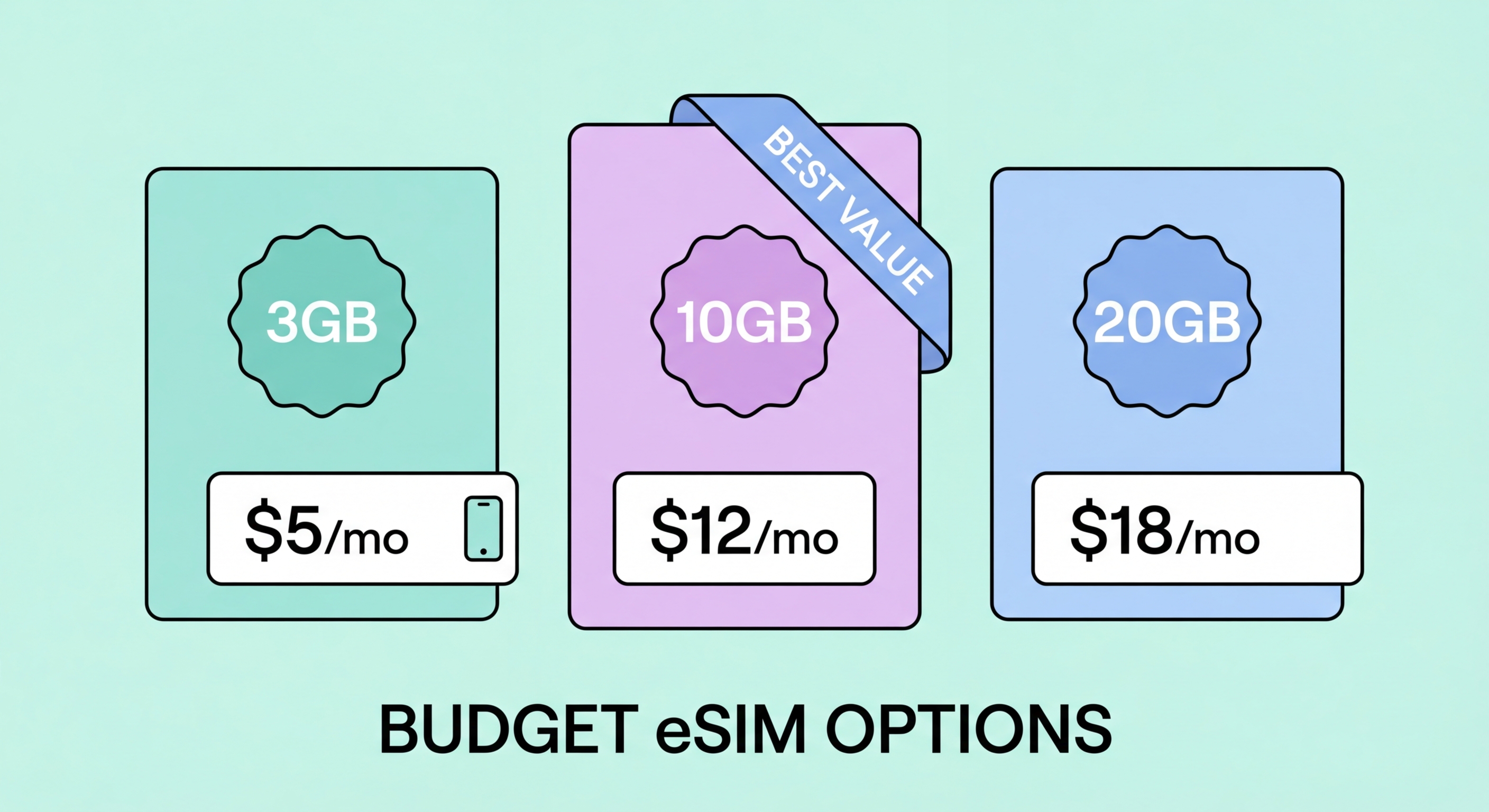
A guide to the most affordable eSIM plans in Hong Kong — budget local carrier plans, cheapest travel eSIM options, promotional offers, and what to watch out for with unusually cheap eSIM deals.
Hong Kong's mobile market is highly competitive, and local eSIM plans from major carriers are priced competitively by international standards. The cheapest entry-level eSIM plans from the four major HK carriers start from approximately HK$68–88 per month for basic data plans with fixed monthly data allowances (typically 10–20GB) and local HK calling. These entry-level plans suit users with moderate data needs who make most of their calls and send messages over WhatsApp or FaceTime rather than traditional voice calls. All four carriers — 3HK, CMHK, SmarTone, and csl — regularly run promotional offers, particularly during back-to-school seasons, year-end promotional periods, and competitive price-matching campaigns, which can temporarily reduce monthly plan costs significantly below standard pricing.
For users who want a cheap secondary eSIM for a specific purpose — a mainland China data line, a dedicated data-only eSIM for a tablet, or a secondary number for work purposes — prepaid eSIM options provide the most flexible low-cost entry. CMHK and 3HK both offer prepaid data eSIM plans that can be activated without a monthly commitment. A prepaid CMHK data eSIM with mainland China data capability can be purchased and topped up as needed, providing cross-border data access without committing to a monthly postpaid plan. The activation process for prepaid eSIM is the same as for postpaid — scan the QR code, download the profile — but without requiring a credit card or bank account linkage for recurring billing.
MVNOs (Mobile Virtual Network Operators) operating in Hong Kong offer another source of budget eSIM options. Several MVNOs lease network capacity from the major HK carriers and resell it under their own brands at competitive prices. While MVNO eSIM plans are not always marketed prominently, some offer very competitive monthly rates for data-heavy users. The trade-off with MVNO plans compared to the major carriers' own plans is typically in customer service responsiveness, retail store presence, and potentially lower data priority during network congestion. For users who primarily need affordable data and are comfortable with digital-only support, MVNOs can provide meaningful cost savings over the major carrier plans for equivalent data allowances.
Japan is the cheapest travel eSIM destination for Hong Kong residents in terms of absolute price per GB — providers like Airalo regularly offer Japan eSIM plans at USD $3–5 for 3GB, reflecting the intense competition in the Japan travel eSIM market driven by high demand from Asian tourists. South Korea and Taiwan similarly have competitive travel eSIM pricing, with 3GB plans available for USD $4–7. For popular Asia-Pacific destinations that HK residents visit frequently, the travel eSIM market is highly competitive and prices are as low as the technology class supports — the cost of provisioning infrastructure means truly free commercial travel eSIMs are not a realistic offering, but the USD $3–5 price point for 3–5 days of basic data connectivity is accessible to essentially all travellers.
Airalo offers the lowest prices among the major reputable travel Hong Kong in 2026">eSIM providers for most destinations, particularly in the Asia-Pacific market where competition is highest. For users comfortable with the Airalo interface and activation process, Airalo consistently undercuts Holafly and Saily on per-GB pricing. The trade-off is that Airalo's plans are fixed-bundle rather than unlimited — you get what you pay for and cannot exceed it without purchasing additional data. For very budget-conscious travellers who carefully monitor data consumption, Airalo's starter plans (1GB for under USD $4 for popular Asian destinations) can cover basic travel needs (navigation, messaging, email) without streaming or data-heavy social media use.
Roamless's pay-per-use model can be the cheapest option for short trips or light data users who cannot predict exactly how much data they will use. Rather than purchasing a bundle that may include unused data, Roamless charges by the megabyte from a pre-funded credit balance — you pay only for what you actually use. For a 2-day business trip where you primarily use hotel WiFi and only need mobile data for transport navigation and occasional emails, the actual data consumed may be well under 500MB, making a pay-per-use model significantly cheaper than a 1GB or 3GB fixed bundle. The per-MB pricing on Roamless is higher than the effective per-MB rate of a fully consumed Airalo bundle, so users who consistently use most of their bundle will find Airalo cheaper — Roamless benefits users with genuinely minimal and unpredictable data usage.
True free commercial eSIM service is rare — the costs of network infrastructure, carrier provisioning, and customer support prevent indefinite free offerings. However, several types of free or near-free eSIM experiences exist that are legitimate and useful for HK residents. Major HK carriers occasionally offer free eSIM trial periods for customers converting from physical SIM, particularly when running campaigns to accelerate eSIM adoption — a common offer is waiving any conversion fee (if applicable) and providing a month at no additional charge when switching from physical SIM to eSIM on an existing plan. Check the current promotions on 3HK, CMHK, SmarTone, and csl websites to see if conversion incentives are available at the time you are considering the switch.
Some travel eSIM providers offer free data trials or promotional first-time user credits. Airalo periodically offers first-time user promotions providing a small free data credit toward a purchase — typically USD $3–5 of credit that can be applied to any destination plan. These promotions are shared through referral programs and promotional campaigns, so following Airalo's official social media channels or checking the app's promotions section can surface current offers. Saily and Roamless similarly have referral credit programs where existing users and new users both receive account credits — a small but meaningful cost reduction for first-time users. These credits do not provide entirely free eSIM service but reduce the effective cost of a first travel eSIM purchase.
Free regional eSIM offers are sometimes bundled with travel bookings, credit card benefits, or loyalty programs. Some Hong Kong banks — HSBC, Hang Seng, Standard Chartered — include travel eSIM data credits as benefits in their premium credit card travel packages. Cathay Pacific's Marco Polo Club and Asia Miles programme periodically partners with eSIM providers for member offers. These credit card and loyalty programme benefits are worth checking before purchasing travel eSIM through a standard provider channel, as they may provide equivalent plans at lower effective cost when applied to card spending rewards or redemption points. Hong Kong's American Express Platinum and Citi Prestige cards have both offered eSIM data benefits in some programme years.
The travel eSIM market includes a large number of small and less established providers offering significantly below-market pricing. Understanding why some eSIM deals are unusually cheap helps you evaluate the risk. The most common reason is use of secondary or tertiary partner networks in each destination country — while a premium provider uses NTT Docomo for Japan, a budget provider may use a less established MVNO or regional network with lower data speeds, less complete geographic coverage, and potentially unreliable connectivity in some areas. For trips where reliable connectivity is important — business travel, navigating unfamiliar territory, or medical travel — saving USD $3–5 on a cheaper eSIM that fails in the moment you need it is a poor trade-off.
Privacy risks are another concern with ultra-cheap eSIM providers. Business models that offer data at below-cost pricing typically rely on monetising user data — collecting connection metadata, browsing behaviour at the IP level, and in some cases inserting advertising into unencrypted traffic. While HTTPS traffic cannot be intercepted, a carrier with an incentive to monetise user data may use connection metadata analysis to target advertising or sell anonymised usage data to third parties. Reputable providers like Airalo and Holafly have transparent privacy policies and generate revenue through subscription and plan pricing alone. Providers without transparent privacy policies and ownership disclosure, particularly those registered in jurisdictions with weak data protection frameworks, warrant caution.
Activation reliability is the most immediate practical risk of cheap eSIM providers. Reports of failed activations, QR codes that don't work, and customer support that is unresponsive or slow are disproportionately common among budget providers. When you are at an airport or arrived at a destination and need connectivity, an eSIM that fails to activate is a significant problem. For first-time eSIM users especially, the confidence that a provider will quickly resolve activation issues is worth the modest premium that reputable providers charge over the cheapest alternatives. A general guideline: if the provider does not have substantial user reviews on major app stores and a publicly visible customer support channel, the activation risk is elevated relative to established providers.