Understanding eSIM roaming options from Hong Kong — how carrier roaming differs from travel eSIM, when each is the right choice, how to prevent bill shock, and best practices for staying connected abroad at the lowest cost.
When your HK carrier eSIM is active and your device travels to a foreign country, the eSIM automatically searches for available networks in that country. If your HK carrier has a roaming agreement with a local carrier in that country — called an international roaming agreement — your device connects to that local carrier's network and your HK carrier is billed for the usage, which is then passed on to you as a roaming charge. This carrier roaming process happens automatically and transparently — you may not even notice when your device switches from your HK carrier's network to the roaming partner network, except that your signal strength indicator may show the partner carrier's name instead of your HK carrier's name.
All four major HK carriers have international roaming agreements with carriers in hundreds of countries. When your device roams using your HK carrier's eSIM, you are using the physical infrastructure of the local partner carrier but billing through your HK carrier's account. This arrangement means you receive a single HK-dollar bill for your roaming usage rather than needing to manage separate accounts with local carriers in each country you visit. The convenience of this single-bill roaming is the primary advantage of using carrier roaming over travel eSIM — there is zero setup required, and you can use your HK number and existing data plan across borders without any additional action beyond ensuring roaming is enabled.
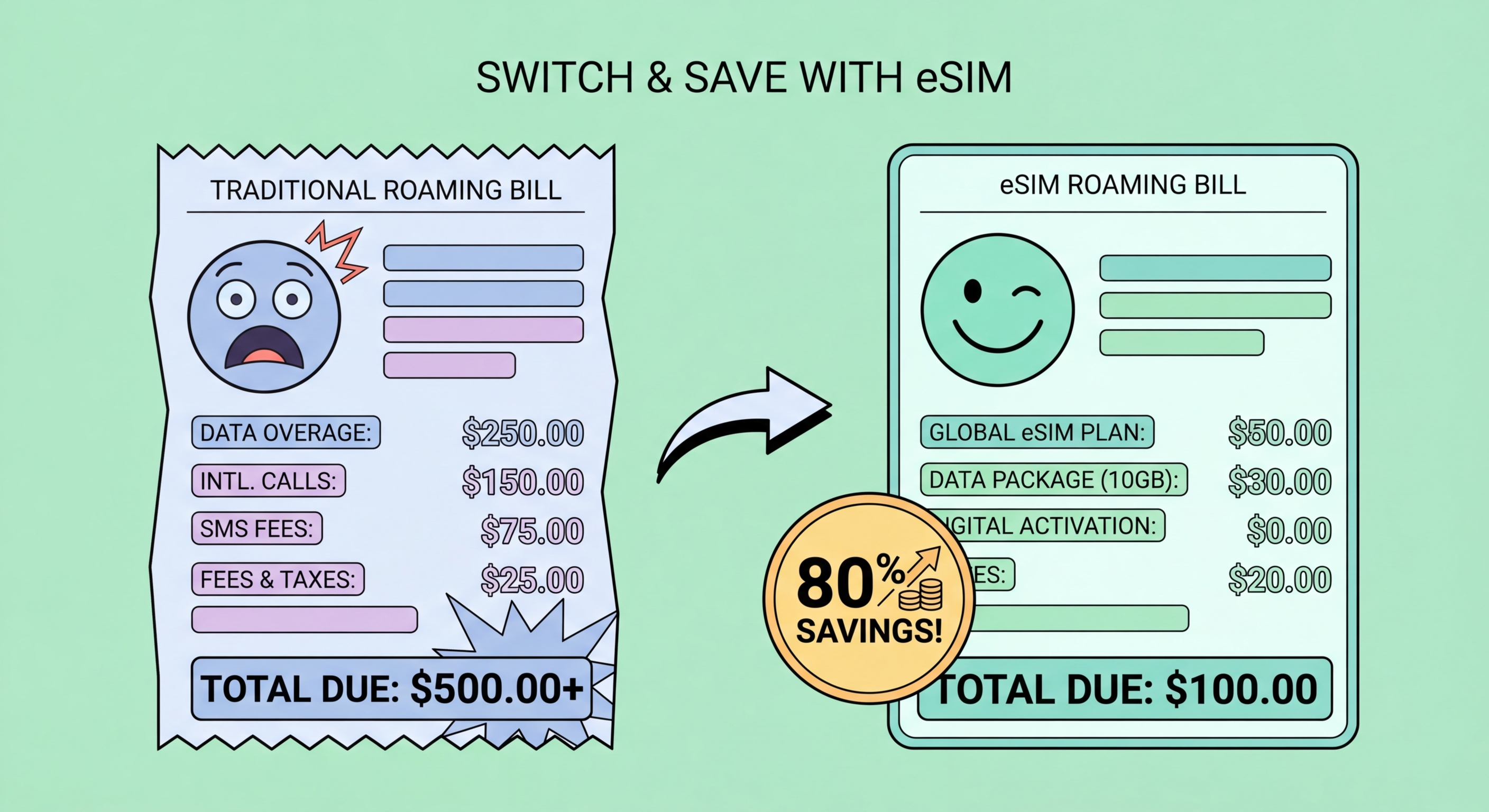
The major disadvantage of carrier roaming is the cost. HK carriers charge roaming data rates that are substantially higher than local rates in destination countries — typically structured as daily roaming add-on packages (HK$78–120/day for major Asia-Pacific destinations, HK$100–150/day for Europe and the US) or per-MB rates that can create significant bill shock if no daily package is in place. The daily package rates, while better than per-MB billing, are still significantly more expensive than equivalent data from a travel eSIM provider. For any trip exceeding 2–3 days, the cost comparison almost always favours a travel eSIM over HK carrier roaming. The break-even point where carrier roaming is genuinely competitive with travel eSIM is for very short visits (1 day or less) where the carrier roaming day-pass provides adequate data without the need to purchase and activate a separate travel eSIM.
The decision between HK carrier roaming and a dedicated travel eSIM is primarily a function of trip length and how much data you need. For a 1-day business trip to Shenzhen or Macau where you need intermittent data for navigation and messaging, activating a CMHK or 3HK daily roaming add-on may be the most convenient and reasonably priced option — the cost is low for one day, and there is no setup overhead compared to purchasing and managing a separate eSIM. For any trip of 3 or more days to any destination, the cost calculation almost always favours a travel eSIM — even accounting for the time to purchase and activate the travel eSIM, the savings typically justify the effort within the first day of travel.
The type of data usage also affects the calculation. If your travel data needs are primarily for messaging and light email (WhatsApp, SMS, email checking) with minimal navigation or streaming, a carrier roaming day-pass may provide adequate data at a cost that, while higher per-GB than travel eSIM, is acceptable for occasional light use. If your travel data usage is heavier — active navigation all day, frequent video calls, social media sharing with photos and videos — the higher data consumption makes the per-GB cost differential between carrier roaming and travel eSIM more significant. Heavy data users on a 5-day Japan trip, for example, might use 5–10GB — at HK carrier roaming rates, this could cost HK$390–780 in day-pass charges versus USD $10–20 (HK$78–156) from a travel eSIM.
A practical middle ground for infrequent travellers who do not want the overhead of managing travel eSIM purchases is to use carrier roaming for very short trips (1–2 days) and switch to travel eSIM for longer trips. This hybrid approach minimises the time investment in travel eSIM management for occasional short-trip travellers while still capturing the substantial cost savings for longer international travel. For frequent travellers (monthly or more), the overhead of managing travel eSIM purchases is minimal — using an established provider like Airalo with stored payment details allows a new destination eSIM to be purchased and activated in under 2 minutes, making the carrier roaming convenience advantage essentially negligible.
Roaming bill shock occurs when a user unknowingly incurs large roaming charges, typically through data roaming at per-MB rates without a day-pass, or through accidental roaming when the device connects to a foreign network at a border area or in the event of unusual network behaviour. The most effective prevention is disabling data roaming on your HK carrier eSIM line before travelling — if data roaming is off, your HK SIM cannot use data on a foreign network, eliminating any risk of unexpected charges. This is the safest configuration when using a travel eSIM for data, as described in the dual SIM configuration guides — your HK SIM handles calls and SMS (which may still have roaming rates but are typically per-minute or per-message rather than the catastrophic per-MB data rates), while your travel eSIM handles all data.
All four major HK carriers provide data roaming notification services — SMS alerts sent when your device starts roaming on a foreign network, when a daily roaming add-on is activated, and sometimes when you approach a spending limit. Ensure these notifications are enabled on your account. Additionally, most HK carrier apps allow you to set a spending limit or data limit for roaming — configure this as a backstop protection even if you primarily plan to use a travel eSIM. A roaming spending limit of HK$50–100 provides a safety net against accidental roaming charges without requiring active monitoring throughout the trip. These limits can typically be set or adjusted through the carrier app without a store visit.
Be aware of specific roaming risk scenarios beyond simple data usage. Calls received while roaming on your HK carrier network are typically charged at a "received call while roaming" rate — even if you do not answer the call. This is because the calling party dials your HK number and the call is routed through the HK carrier to wherever you are — the carrier incurs network costs for this international routing and charges accordingly. Using WiFi calling (enabling Wi-Fi Calling in phone settings and having a WiFi connection) allows your HK number to receive calls over the internet rather than the cellular network while abroad, avoiding this received-call roaming charge entirely. All four major HK carriers support WiFi calling on eSIM, and it works seamlessly when connected to hotel or office WiFi.
The optimal roaming configuration for most HK travellers using a dual SIM setup (HK carrier + travel eSIM) is a simple checklist to complete before every trip: (1) Purchase and activate travel eSIM profile for the destination on HK WiFi; (2) Set travel eSIM as the mobile data line in phone settings; (3) Disable data roaming on the HK carrier eSIM line; (4) Enable WiFi Calling on the HK carrier eSIM line for receiving HK calls over WiFi; (5) Verify the configuration by checking which line is set as data in the Cellular settings. This five-step pre-trip checklist takes under two minutes and ensures that once you board the flight, your connectivity configuration is correct and no accidental roaming charges can occur.
On arrival at your destination, verify that your travel eSIM has connected to a local network by checking the signal bar area — it should show the destination carrier's name (e.g., "NTT Docomo" in Japan or "T-Mobile" in the US) and signal bars. If the travel eSIM is not connecting, toggle Airplane Mode on and off to force a network search. If the HK carrier name appears instead of the destination carrier, to Spot and Avoid Attacks on Your Phone">your phone has connected to the HK carrier's roaming partner rather than your travel eSIM — re-check the data SIM assignment in settings and ensure data roaming on the HK SIM is disabled. Most connection issues resolve with an Airplane Mode cycle or device restart.
On return to Hong Kong, reverse the configuration: set the HK carrier eSIM back as the active data line, re-enable data roaming on the HK SIM (it needs to be enabled for normal use of 4G and 5G in Hong Kong itself), and deactivate the travel eSIM (set it to inactive/stored rather than deleting it if you plan to return to that destination). Keeping stored travel eSIM profiles means you can re-activate them on your next trip to the same destination without purchasing a new plan — provided the plan is still within its validity period. Many travel eSIM plans have 30-day or longer validity from the first use, allowing the plan to be used across multiple short trips to the same destination within the validity window.