What Is Penetration Testing and Does Your HK Business Need It?

A plain-language guide to penetration testing for Hong Kong businesses — what pentesting is, the different types of tests, what they cost, when they are worthwhile, and how to commission a pentest that delivers genuine security value.

Penetration testing Hong Kong businesses
1What Is a Pentest

What Penetration Testing Actually Is (and Isn't)

Penetration testing (pentest) is a structured, authorised attack simulation conducted by security professionals to identify exploitable vulnerabilities in your systems, networks, or applications before real attackers find them. A penetration tester uses the same techniques, tools, and thought processes as a malicious attacker, but within a defined scope and with your explicit authorisation. The outcome is a report documenting discovered vulnerabilities, the potential impact of their exploitation, how the vulnerabilities were found and exploited in the test, and recommended remediation actions. Penetration testing provides evidence-based assurance that your security controls work — or reveals that they don't — through actual exploitation rather than theoretical assessment.

Penetration testing differs fundamentally from vulnerability scanning, which is an important distinction for Hong Kong businesses evaluating security services. A vulnerability scan is an automated tool scan that identifies known vulnerabilities in software versions, misconfigured services, and exposed ports — it produces a list of potential issues without verifying which are actually exploitable. Penetration testing goes further: a skilled tester takes vulnerabilities identified through scanning (and many not found by automated tools) and attempts to actually exploit them, chain multiple vulnerabilities together to achieve a greater impact than any individual vulnerability suggests, and demonstrate real-world attack scenarios including how an attacker would pivot through your network after initial access. The result is a qualitatively different understanding of your actual security posture.

Penetration testing is not a silver bullet or a one-time certification that your systems are secure. A pentest reflects the security posture of your systems at a point in time, under the specific conditions of the test, against the specific scope and threat scenarios tested. Systems change, new vulnerabilities emerge, and new attack techniques develop continuously. A pentest that confirmed your network was secure in January may not reflect the vulnerability introduced by a new server deployed in February or the critical patch not applied in March. Penetration testing is most valuable as a periodic validation activity — typically annual for most HK businesses — that complements continuous security controls rather than replacing them.

  • Pentest vs vulnerability scan: A pentest is an authorised attack simulation by skilled testers — fundamentally different from automated vulnerability scanning in depth and business value
  • Exploitation verification: Penetration testers verify which vulnerabilities are actually exploitable and demonstrate the real impact — not just listing potential issues
  • Attack chaining: Skilled testers combine multiple low-severity vulnerabilities into high-impact attack chains — demonstrating risks that individual vulnerability scanners miss
  • Point-in-time assessment: A pentest reflects security posture at one moment — it does not guarantee ongoing security as systems and threats evolve
  • Annual cadence: Most HK businesses should conduct annual penetration tests — more frequently for high-risk systems, payment platforms, and after significant changes
  • Complement to security controls: Penetration testing validates that your security controls work as intended — it is most valuable when a mature security programme exists to remediate findings
What is penetration testing
2Types of Penetration Tests

Types of Penetration Tests Available to HK Businesses

External network penetration testing assesses what attackers can access from the internet without any prior knowledge of or access to your systems. The tester begins with only your organisation's name and internet-visible infrastructure — IP ranges, domain names, internet-facing services — and attempts to compromise your systems from the outside, simulating an opportunistic or targeted external attacker. This is the most commonly commissioned pentest type and is appropriate for any HK business with internet-facing systems. External network pentests reveal vulnerable internet-facing services, misconfigured firewalls, and authentication weaknesses in public-facing systems including remote access gateways, web applications, and email servers.

Internal network penetration testing simulates an attacker who has already achieved initial access to your internal network — either through a compromised employee account, a phishing attack, or an insider. Starting from a workstation or server on the internal network, the tester attempts to escalate privileges, move laterally, and reach high-value targets including domain controllers, financial systems, and backup infrastructure. Internal network pentests are particularly relevant for assessing ransomware resistance — since ransomware operators spend significant time laterally moving through internal networks after initial access, an internal pentest can reveal how far a compromised workstation can travel and what it can reach. For HK businesses with on-premises infrastructure, internal network pentests should accompany external tests.

Web application penetration testing focuses specifically on web applications — customer-facing websites with login functionality, e-commerce platforms, web-based business applications, and APIs. Web application pentests follow methodology frameworks such as OWASP Testing Guide and WSTG (Web Security Testing Guide) to assess for OWASP Top 10 vulnerabilities including SQL injection, Cross-Site Scripting (XSS), authentication flaws, and broken access control. For Hong Kong businesses that operate customer-facing web applications — particularly those involving financial transactions, customer account access, or personal data processing — annual web application penetration testing is a standard security practice and may be required by PCI-DSS if card payments are processed. Social engineering and phishing simulation testing are covered in a dedicated article in this guide.

  • External network pentest: Tests what attackers can access from the internet — essential for any HK business with internet-facing systems or remote access infrastructure
  • Internal network pentest: Simulates a compromised workstation on the internal network — reveals lateral movement paths and ransomware blast radius
  • Web application pentest: OWASP methodology assessment of customer-facing web applications and APIs — required for payment card processing systems under PCI-DSS
  • Cloud security assessment: Reviews configuration of cloud environments (AWS, Azure, Google Cloud) for misconfigurations — a specialised pentest type for cloud-heavy environments
  • Physical and social engineering: Tests physical security controls and employee susceptibility to social engineering — covers attack vectors outside technical systems
  • Red team exercises: Comprehensive multi-vector attack simulations over extended periods — appropriate for larger organisations wanting realistic adversary simulation
Types of penetration testing
3When HK SMEs Need Pentesting

When Does Your Hong Kong Business Need a Penetration Test?

Not every Hong Kong SME needs a penetration test — the value of a pentest depends on having a mature enough security baseline that the test findings can be understood and remediated. An SME that has not yet implemented MFA, applied basic patching, or deployed endpoint protection is likely to receive a pentest report full of critical findings that could have been identified and remediated through basic security hygiene without the cost of a pentest. For such organisations, the security investment is better directed at implementing foundational controls first. Once basic controls are in place, a penetration test validates whether those controls actually work as intended and identifies the residual vulnerabilities that remain.

Specific trigger events that justify penetration testing for Hong Kong businesses include: significant IT infrastructure changes (new network architecture, migration to cloud, major application deployment), after a security incident (to understand the full scope of compromise and verify eradication), as a requirement of compliance frameworks (PCI-DSS for card payment processors, ISO 27001 certification, HKMA-regulated firm examination readiness), before launching customer-facing web applications or APIs that handle personal data or financial transactions, and as part of regular security assurance for businesses in high-risk sectors including financial services, legal, and healthcare. Cyber insurance underwriters increasingly ask about penetration testing frequency during policy renewals.

The cost of penetration testing in Hong Kong varies substantially by scope, methodology, and provider. External network penetration tests for a typical SME with a small number of internet-facing IPs range from HK$20,000 to HK$60,000. Web application pentests depend on application complexity — from HK$25,000 for a simple application to significantly more for complex multi-function platforms. Internal network tests are typically HK$30,000–80,000 depending on scope. HKPC operates a subsidised vulnerability assessment and penetration testing programme for Hong Kong SMEs through its Cybersecurity Professional Volunteer Programme, which may provide accessible assessment for businesses with limited budgets. When selecting a pentest provider, verify the lead testers hold relevant certifications (OSCP, CREST, CEH) and that the provider carries professional indemnity insurance for the engagement.

  • Foundational controls first: Implement MFA, patching, and endpoint protection before commissioning a pentest — basic controls must be in place for pentest findings to be useful
  • Infrastructure change trigger: Commission a pentest after significant infrastructure changes — new cloud migration, new network architecture, or major application deployment
  • Post-incident testing: Penetration testing after a security incident verifies eradication and identifies vulnerabilities the attacker exploited or could have exploited
  • PCI-DSS requirement: Card payment processors are required to undergo annual penetration testing under PCI-DSS requirements
  • HKPC SME programme: HKPC's cybersecurity programme includes subsidised vulnerability assessment and testing for HK SMEs — accessible for budget-constrained businesses
  • Tester credentials: Verify pentest providers' lead testers hold OSCP, CREST, or equivalent certifications and carry professional indemnity insurance
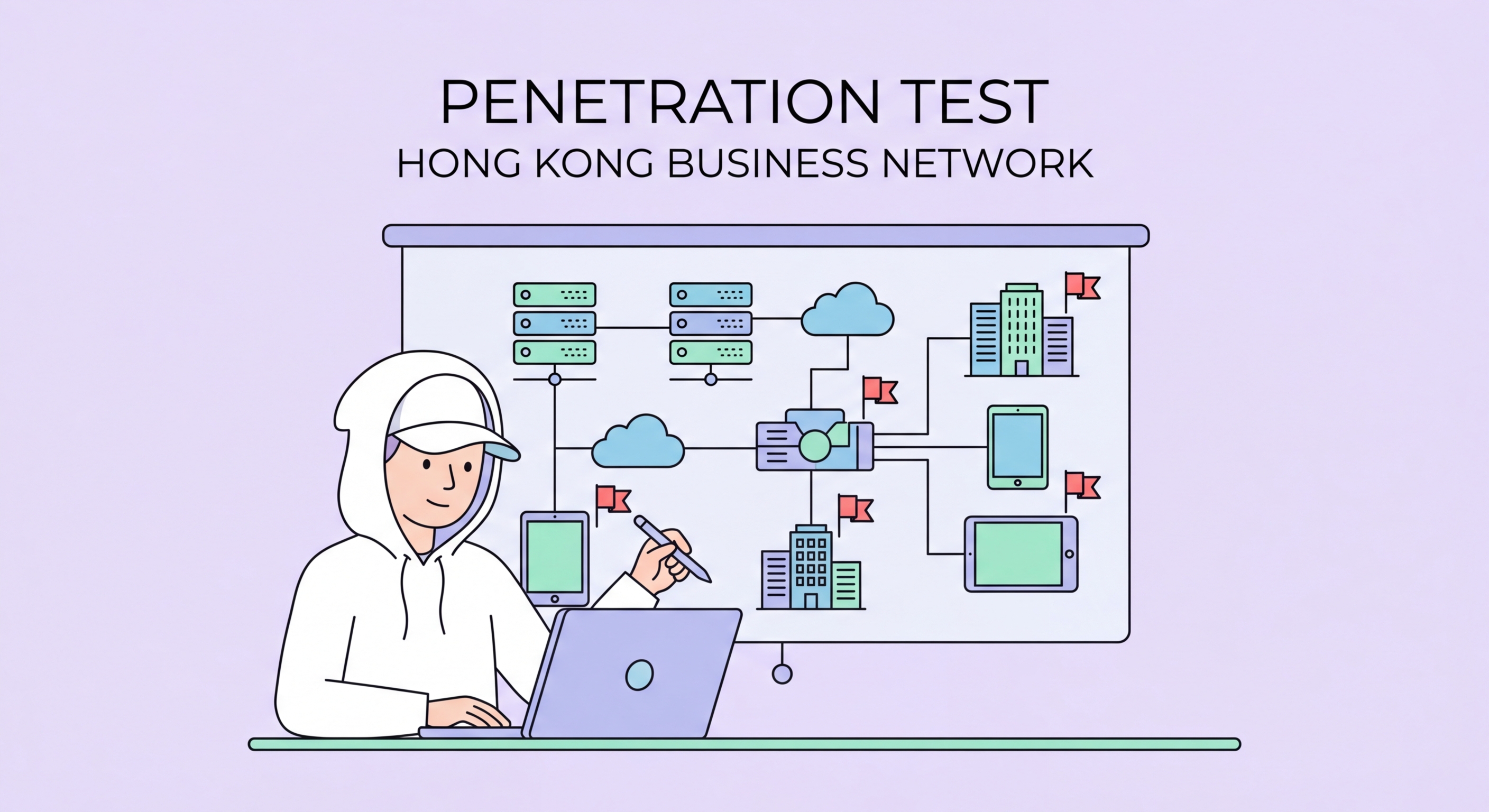
When to commission a penetration test
4Commissioning a Pentest

How to Commission a Penetration Test in Hong Kong

Effective commissioning of a penetration test requires defining clear scope, selecting a qualified provider, and establishing appropriate governance. Scope definition specifies exactly what systems, applications, and networks are in scope for testing, the testing methodology (black box — no prior information, grey box — limited information such as network diagrams, white box — full system documentation provided), the testing windows (business hours, out-of-hours, or both), and the rules of engagement (what types of exploitation are authorised and what is explicitly prohibited — for example, data exfiltration simulations may be excluded from the rules of engagement for a production environment). A well-defined scope prevents both scope creep (testers going beyond what is authorised) and scope gaps (important systems excluded from testing).

Selecting a penetration testing provider in Hong Kong requires evaluating: the technical certifications held by the actual testers who will conduct your engagement (not just company-level certifications — verify that OSCP, CREST CRT, or equivalent certifications belong to the people doing your test); previous experience with your industry and technology environment; the comprehensiveness and usability of their deliverable reports (ask for a sample report); response time and communication during the engagement; professional indemnity insurance coverage; and references from previous clients. The CREST (Council of Registered Ethical Security Testers) and CHECK (UK government scheme) certification programmes provide quality assurance frameworks used by reputable penetration testing firms. HKPC maintains a list of HKPC-recognised cybersecurity service providers including penetration testing firms.

After the penetration test, remediation and re-testing are essential to realise the security value of the investment. A pentest report that sits unactioned provides documentation of your vulnerabilities but no security improvement. Triage the findings by severity and exploitability — critical findings with high exploitability must be remediated immediately, while lower-severity findings can be addressed in a scheduled improvement programme. For each finding, develop a specific remediation action, assign ownership, and set a remediation deadline. Most penetration testing providers offer re-testing to verify that findings have been correctly remediated — this verification is important, as incorrect or partial remediation of complex vulnerabilities is common and re-testing confirms the actual security improvement. Maintaining a pentest finding remediation register that tracks all findings, their remediation status, and verification provides documentation useful for regulatory and insurance purposes.

  • Define scope precisely: Specify exactly what systems are in scope, the methodology (black/grey/white box), testing windows, and rules of engagement before engaging a provider
  • Verify individual tester credentials: Confirm OSCP, CREST, or equivalent certifications belong to the specific testers doing your engagement — not just company-level credentials
  • Sample report review: Request a sample pentest report before engagement — reports vary enormously in quality and usefulness; a good report explains exploitation steps and remediation clearly
  • HKPC recognised providers: Check HKPC's list of recognised cybersecurity service providers for vetted penetration testing firms in Hong Kong
  • Remediation register: Create a finding remediation register tracking all pentest findings, severity, owner, remediation actions, and verification status
  • Retest critical findings: Engage the provider to retest critical and high-severity findings after remediation — verification confirms the fix actually addresses the vulnerability
Commissioning a penetration test

Validate Your Business Security with Penetration Testing

Explore our complete Business Cybersecurity guide for all security assessment and assurance guidance for Hong Kong businesses.

Related VPN Articles