Major Hong Kong Data Breaches: What to Do

Data breaches affect organisations and individuals across Hong Kong regularly. Understanding how major breaches happened and what to do when your data is exposed is essential knowledge for every HK resident.

Hong Kong data breaches guide illustration
1HK Breach Landscape

The Hong Kong Data Breach Landscape

Hong Kong has experienced a significant number of data breaches affecting its residents and businesses. The city's position as a major financial and commercial hub, combined with high rates of digital adoption and dense storage of sensitive financial and identity data, makes it a high-value target for both financially motivated criminals and state-sponsored actors. The Privacy Commissioner for Personal Data (PCPD) receives hundreds of data breach notifications annually, ranging from minor accidental disclosures to major systematic compromises affecting millions of records.

Notable categories of HK data breaches include healthcare providers (patient records including HKID numbers, medical histories, and contact information), retail and e-commerce platforms (customer payment data, addresses, and purchase histories), financial services (banking customer data, though major bank system compromises are rare due to stringent HKMA controls), government and public utilities (voter registration data, utility account information), and hospitality and property management companies (resident and guest personal information). The healthcare and hospitality sectors have experienced some of the largest-scale breaches affecting HK residents.

The legal framework for data breach responses in Hong Kong is evolving. The PCPD has strengthened its enforcement capabilities and increasingly issues fines and public reprimands for organisations that fail to implement adequate data security measures or fail to notify affected individuals promptly. Organisations that experience breaches may be required to notify the PCPD and, where appropriate, affected individuals. Individuals whose data is exposed in a breach have rights under the Personal Data (Privacy) Ordinance to seek redress.

  • High-value target: HK's financial hub status and dense data storage make it a priority target for cybercriminals
  • PCPD oversight: Privacy Commissioner receives hundreds of breach notifications annually — public reprimands increasing
  • Healthcare risk: Medical providers storing HKID, medical history, and contact data have been frequent breach targets
  • Retail and e-commerce: Customer payment and address data frequently targeted in platform compromises
  • Government data: Public sector breaches affect voter registration, utility accounts, and government service data
  • PDPO rights: Affected individuals have rights to seek redress under Hong Kong's Personal Data (Privacy) Ordinance
What happens to stolen HK credentials →
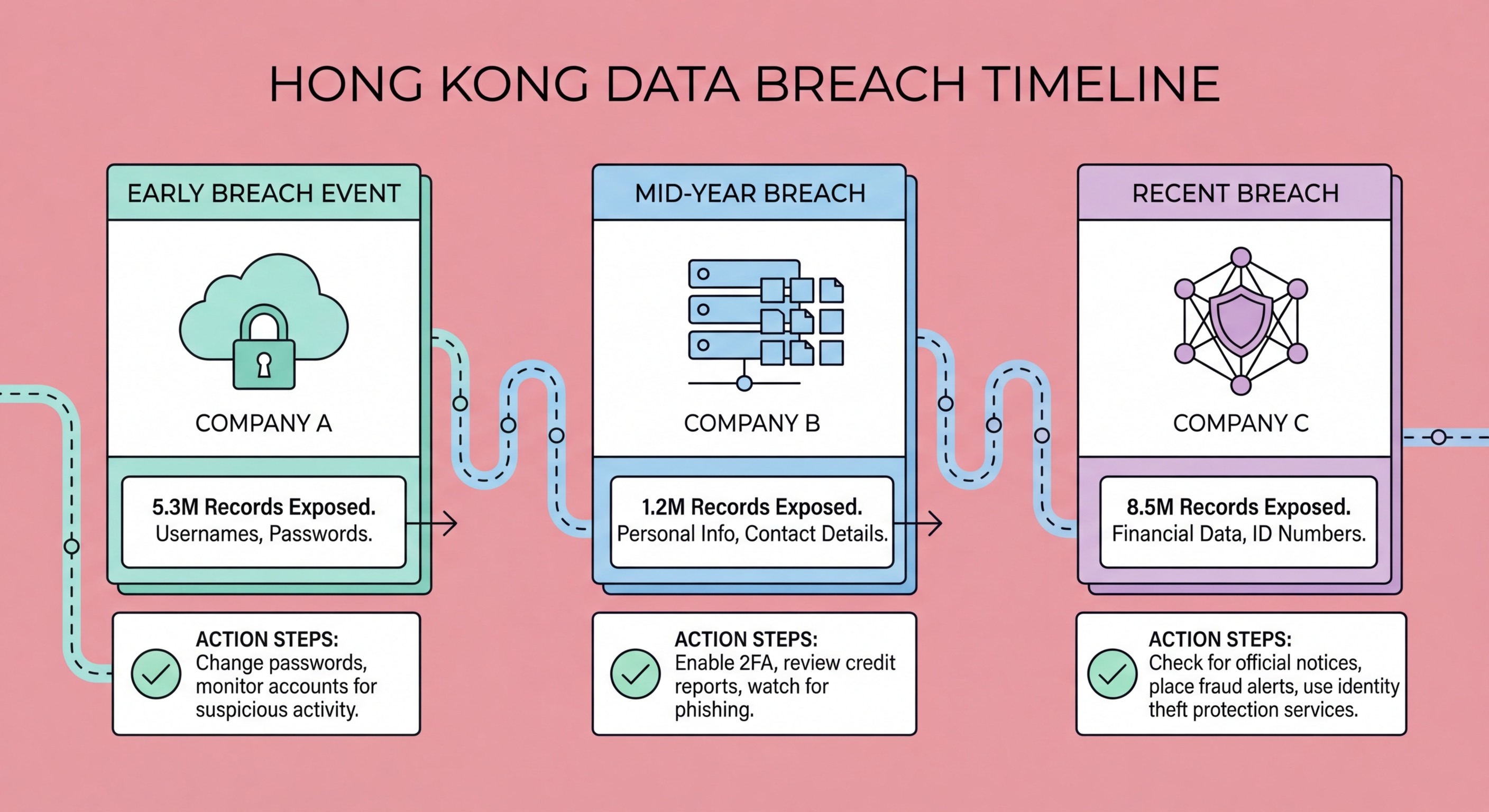
Hong Kong data breach landscape and statistics
2Immediate Response

What to Do Immediately When You Receive a Breach Notification

When you receive a notification that a Hong Kong organisation holding your data has to Check If Your Password Has Been Breached">been breached, the urgency and scope of your response should be proportional to the sensitivity of the data involved. A breach involving your email address and hashed password requires prompt but not frantic action. A breach involving your HKID number, banking information, or medical records requires urgent response across multiple channels simultaneously.

For credential breaches, the immediate actions are: change the password on the affected service immediately using your password manager to generate a unique new password; check whether you used the same password on any other service and change those immediately; enable two-factor authentication on the affected account if not already active; and monitor the account for suspicious activity over the following weeks. If the breach involved financial account credentials, contact your bank's fraud line proactively rather than waiting for suspicious transactions to appear.

For breaches involving personal identity data (HKID, date of birth, address, phone number), the priority actions are different. File a report with the PCPD if the organisation has not notified you promptly or if you believe the breach involved inadequate security. Monitor your credit record (via licensed credit reference agencies in HK such as TransUnion) for any unauthorised credit applications. Be especially vigilant for phishing attempts in the weeks following, as attackers use breach data to craft personalised scams that are much harder to detect than generic phishing.

  • Password breach — immediate: Change affected password, find and change reused passwords, enable 2FA
  • Financial data breach: Contact bank fraud line proactively, monitor for unauthorised transactions
  • HKID/identity breach: File PCPD complaint if notification delayed, monitor credit record via TransUnion
  • Contact information breach: Expect increased targeted phishing — be extra sceptical of all unsolicited communications
  • Response speed matters: Credential changes should happen within hours, not days, of breach notification
  • Document everything: Record the breach notification, date received, and actions taken — useful for any future PCPD complaint
How to check if your passwords are exposed →
Immediate response to a Hong Kong data breach notification
3PCPD and Reporting

Reporting Breaches to the PCPD and Your Rights Under PDPO

The Privacy Commissioner for Personal Data (PCPD) is Hong Kong's data protection authority, responsible for overseeing compliance with the Personal Data (Privacy) Ordinance (PDPO). If your personal data has been compromised in a breach, you have rights under the PDPO including the right to access your personal data held by the organisation, the right to request correction of inaccurate data, and potentially the right to seek compensation for damage suffered as a result of the breach.

To file a complaint with the PCPD, visit the Commissioner's website at pcpd.org.hk and download the complaint form. Complaints can be submitted by post, email, or in person at the PCPD's office. The complaint should include: the name of the data user (organisation that held your data); the nature of the breach; the personal data categories affected; the date you were notified; and any response you have already received from the organisation. The PCPD investigates complaints and can issue enforcement notices, impose fines, and publicly reprimand non-compliant organisations.

HKCERT (Hong Kong Computer Emergency Response Team Coordination Centre) at hkcert.org is the first point of contact for technical cybersecurity incidents including breaches. For individuals who discover they are victims of identity fraud following a breach, the Hong Kong Police Force's Cyber Security and Technology Crime Bureau (CSTCB) accepts reports of cybercrime including identity theft, fraudulent account applications, and SIM swap attacks. Report cyber fraud to the 24-hour cybercrime hotline at 182 388.

  • PCPD complaint: File at pcpd.org.hk — include data user name, breach nature, data categories, notification date
  • PDPO rights: Access your data, request corrections, potentially seek compensation for breach damage
  • HKCERT reporting: hkcert.org — technical cybersecurity incident reporting and advice
  • Police cyber crime hotline: 182 388 — for identity theft, fraudulent applications, and SIM swap fraud
  • TransUnion credit monitoring: HK residents can request credit reports to check for unauthorised credit applications
  • Keep records: Document all breach notifications, PCPD communications, and police reports for potential legal proceedings
Where stolen HK data ends up and what happens next →
Reporting to PCPD and Hong Kong Police after a data breach
4Staying Informed

How to Stay Informed About Hong Kong Data Breaches

Proactive breach monitoring is more effective than waiting for breach notifications from organisations, which are sometimes delayed by days or weeks. The most practical approach for Hong Kong residents is to subscribe to Have I Been Pwned notifications for all email addresses you use (free at haveibeenpwned.com), enable breach monitoring in your password manager, and subscribe to HKCERT's security advisories at hkcert.org/subscribe. Together, these provide coverage of both global breach databases and Hong Kong-specific security incidents.

The PCPD publishes enforcement notices, investigation reports, and press releases about significant data breaches affecting Hong Kong residents. Following the PCPD on their website and on social media provides awareness of major local incidents that may not immediately appear in global breach databases. The PCPD's annual privacy survey and data breach reports provide useful context on the current HK data protection landscape.

The Hong Kong Police Force's Cyber Security and Technology Crime Bureau publishes regular cybercrime statistics and alerts at the CyberDefender website (cyberdefender.hk). This includes statistics on types of cybercrime affecting HK residents, case studies of major incidents, and practical guidance on digital security. For business owners and IT managers, subscribing to HKCERT's enterprise security advisories provides advance warning of threats targeting HK organisations before they become widely exploited.

  • HIBP notifications: Subscribe at haveibeenpwned.com for all your email addresses — free, immediate breach alerts
  • HKCERT advisories: hkcert.org/subscribe — Hong Kong-specific security advisories and breach notifications
  • PCPD publications: pcpd.org.hk — enforcement notices and investigation reports on HK data breaches
  • CyberDefender: cyberdefender.hk — HKPF Cyber Security and Technology Crime Bureau cybercrime alerts
  • Password manager monitoring: Bitwarden Premium, 1Password, Dashlane all include continuous breach monitoring
  • HKMA alerts: For financial services — HKMA publishes cybersecurity circulars and threat intelligence for financial institutions
Set up breach monitoring for your credentials →
Staying informed about Hong Kong data breaches

Be Ready Before the Next HK Breach

Unique passwords, 2FA, and active breach monitoring mean you can respond effectively when the next data breach affects a service you use in Hong Kong.

Related VPN Articles