DeFi Security: What Hong Kong Investors Need to Know
Understanding the unique risks of decentralised finance — smart contract vulnerabilities, rug pulls, liquidity attacks, and safe DeFi participation principles for HK investors.
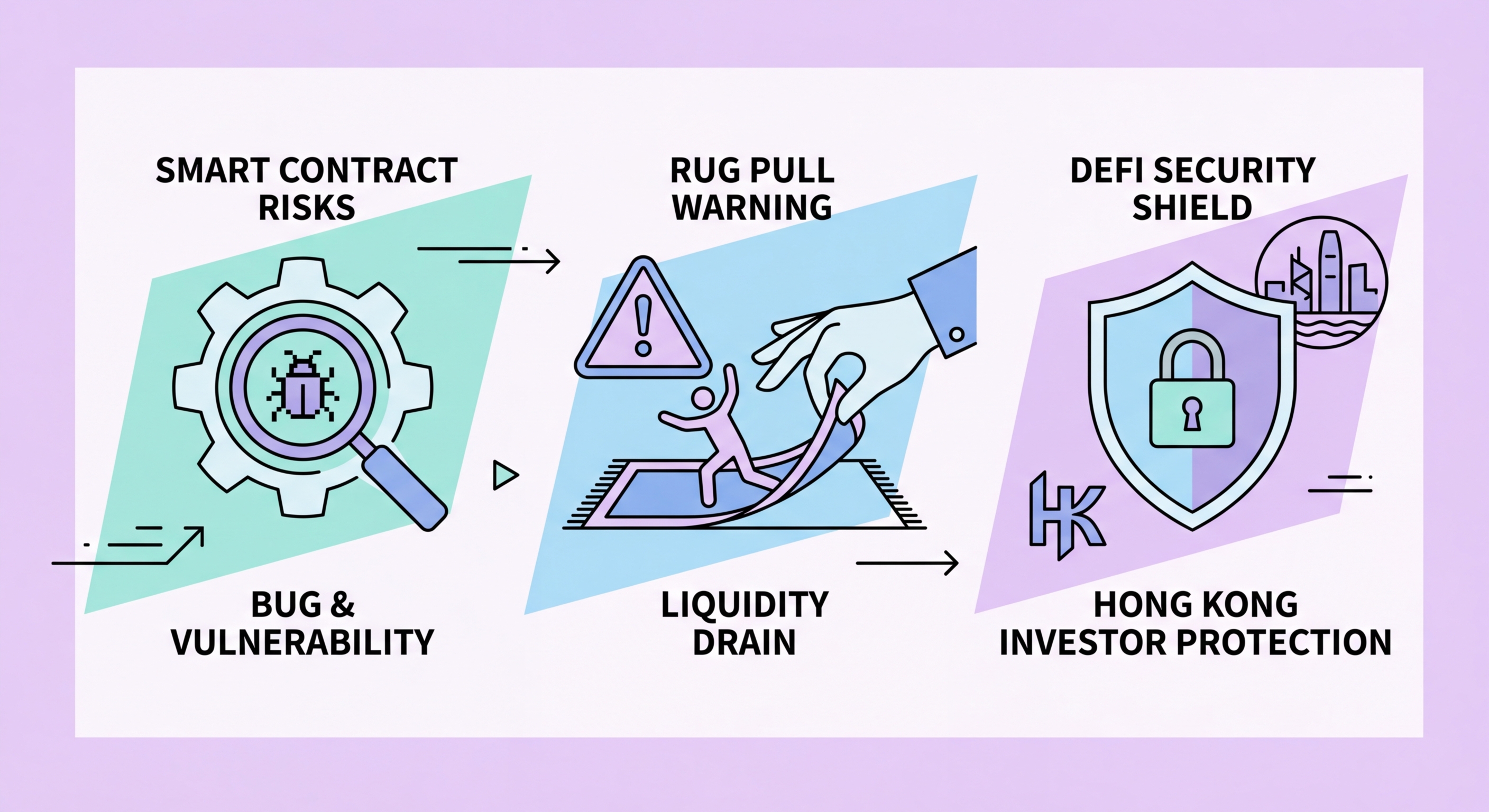
Understanding the unique risks of decentralised finance — smart contract vulnerabilities, rug pulls, liquidity attacks, and safe DeFi participation principles for HK investors.
Decentralised finance (DeFi) refers to financial services built on public blockchains — primarily Ethereum and its layer-2 networks — that operate through immutable smart contracts rather than centralised institutions. DeFi protocols enable lending, borrowing, trading, yield farming, and liquidity provision without traditional financial intermediaries. For Hong Kong investors accustomed to the regulatory protections of the HKMA-supervised financial system, the transition to DeFi's permissionless, self-custodied, code-governed environment represents a dramatic shift in the risk paradigm.
The DeFi risk landscape differs fundamentally from traditional finance risks. Smart contract bugs — errors in the programming logic of DeFi protocols — can be exploited by attackers to drain all funds locked in the protocol, sometimes within a single transaction block. Unlike traditional software where bugs can be patched, many DeFi contracts are designed to be immutable after deployment — bugs cannot be fixed without deploying an entirely new contract. This means the security of a DeFi investment is ultimately dependent on the quality of the underlying code, which non-technical investors have no way to personally verify.
The scale of DeFi losses globally is enormous. Chainalysis, a blockchain analytics firm, reported that DeFi protocols accounted for over US$3.8 billion in cryptocurrency losses in 2022 — from hacks, exploits, and fraudulent projects. For Hong Kong investors, the lack of regulatory protection compounds the financial loss: there is no equivalent of the HKDPB deposit protection, no ombudsman for dispute resolution, and no regulatory mechanism to compel protocol operators to compensate users. All on-chain transactions are final — there is no "undo" regardless of how the loss occurred.

Rug pulls — where DeFi protocol developers drain liquidity and disappear — represent a substantial portion of DeFi losses. The mechanics vary: in a "hard rug pull", developers include malicious code in the smart contract that allows them to mint unlimited tokens or withdraw all deposited funds at will. In a "soft rug pull", developers hold large allocations of a token, inflate its price through marketing and artificial demand, then sell their holdings simultaneously ("dump"), collapsing the price and leaving other investors with worthless tokens. Both result in the same outcome for investors: total or near-total loss.
Identifying rug pull red flags requires assessing the project's fundamentals before investing. Anonymous development teams — which describe a large proportion of DeFi projects — present higher risk because founders cannot be held legally accountable. Unaudited smart contracts, or contracts audited by low-reputation or self-affiliated audit firms, provide minimal assurance. Token distributions heavily concentrated in a few wallets (visible on blockchain explorers) indicate teams with the power to dump and destroy the price. Absence of time locks on developer wallet access — contracts typically have a time delay before developer-controlled funds can be moved — is a serious red flag. Genuine projects with long-term intent implement these safeguards to build investor confidence.
The marketing pattern of rug pulls follows a recognisable template: explosive social media promotion through paid influencers (often without disclosure), manufactured sense of urgency and FOMO (fear of missing out), promises of extraordinary yields (100%, 1000% APY), and a hyped launch event that briefly drives price upward before the team exits. The initial investors may profit at the expense of later entrants who hold when the rug is pulled. Hong Kong investors who encounter DeFi projects matching this pattern should treat them as fraudulent by default.

DeFi protocol interaction introduces wallet security risks that do not exist for simple cryptocurrency holding. When connecting a wallet to a DeFi site, you may be asked to approve token spending permissions (allowances), sign messages, or interact with smart contracts. Malicious DeFi sites — phishing clones of legitimate protocols, newly launched fraudulent projects, or compromised legitimate sites with injected malicious code — use these approval mechanisms to drain wallets. Understanding each type of wallet interaction and the associated risk is essential for DeFi participation without catastrophic losses.
Token approvals are the most commonly exploited DeFi wallet interaction. When you use a DeFi protocol for the first time, it typically asks for an "unlimited" token approval — permission to spend any amount of a specific token from your wallet at any future time. The unlimited approval is convenient (avoids repeated approval transactions) but allows the approved contract to withdraw all your tokens of that type at any time, including long after you've stopped using the protocol. Limiting approvals to the specific transaction amount, or revoking approvals after use, contains this risk. The gas cost of more limited approvals is typically only a few HK dollars and is well justified for the security benefit.
Phishing DeFi sites — malicious clones of legitimate protocols like Uniswap, Aave, Curve, or others — are distributed through search ads, social media posts, and direct messages. They look identical to legitimate sites but contain modified smart contract addresses that redirect funds to attackers. Always access DeFi protocols from trusted bookmarks, never from links in messages, Discord, or search ads. Verify the website URL against the official domain for the protocol before connecting your wallet. Use a purpose-built browser like Brave for DeFi interactions, which includes enhanced phishing protection and avoids search-ad-based phishing delivery.

Safe DeFi participation is not about avoiding DeFi entirely, but about applying risk management principles equivalent to those used in traditional finance to a higher-risk environment. Diversification across protocols limits the impact of any single exploit — concentrating all DeFi exposure in one protocol means a single smart contract bug can result in total loss. Limiting exposure to well-established, battle-tested protocols with multi-year track records and billions in total value locked (TVL) is the most reliable proxy for reduced smart contract risk, because protocols that have operated without exploit for extended periods under real market conditions have demonstrated some degree of security.
Position sizing for DeFi must reflect the unique total-loss risk profile. Unlike traditional financial assets where a bad investment might lose 30-50%, a DeFi protocol exploit can result in 100% loss of deposited funds in a single block. The appropriate DeFi allocation for risk-conscious Hong Kong investors is a small proportion of total cryptocurrency holdings — often cited as 5-15% — sized so that a total loss of the DeFi allocation would be painful but not financially catastrophic. Treating DeFi yields as a risk-compensated return for bearing smart contract and rug pull risk — not as "free money" — is the psychological framing that produces sound allocation decisions.
The SFC has warned Hong Kong investors about DeFi protocols and their regulatory status. DeFi protocols that offer investment products without SFC authorisation may be in breach of the Securities and Futures Ordinance. Participating in unauthorised DeFi investment products from Hong Kong carries both the technical risk of the protocol and potential regulatory risk if the activity falls within regulated financial services. Consulting a solicitor or compliance professional about the regulatory status of specific DeFi activities — particularly when participation involves pooling funds with other investors or token structures that may constitute collective investment schemes — is advisable for significant DeFi involvement.
