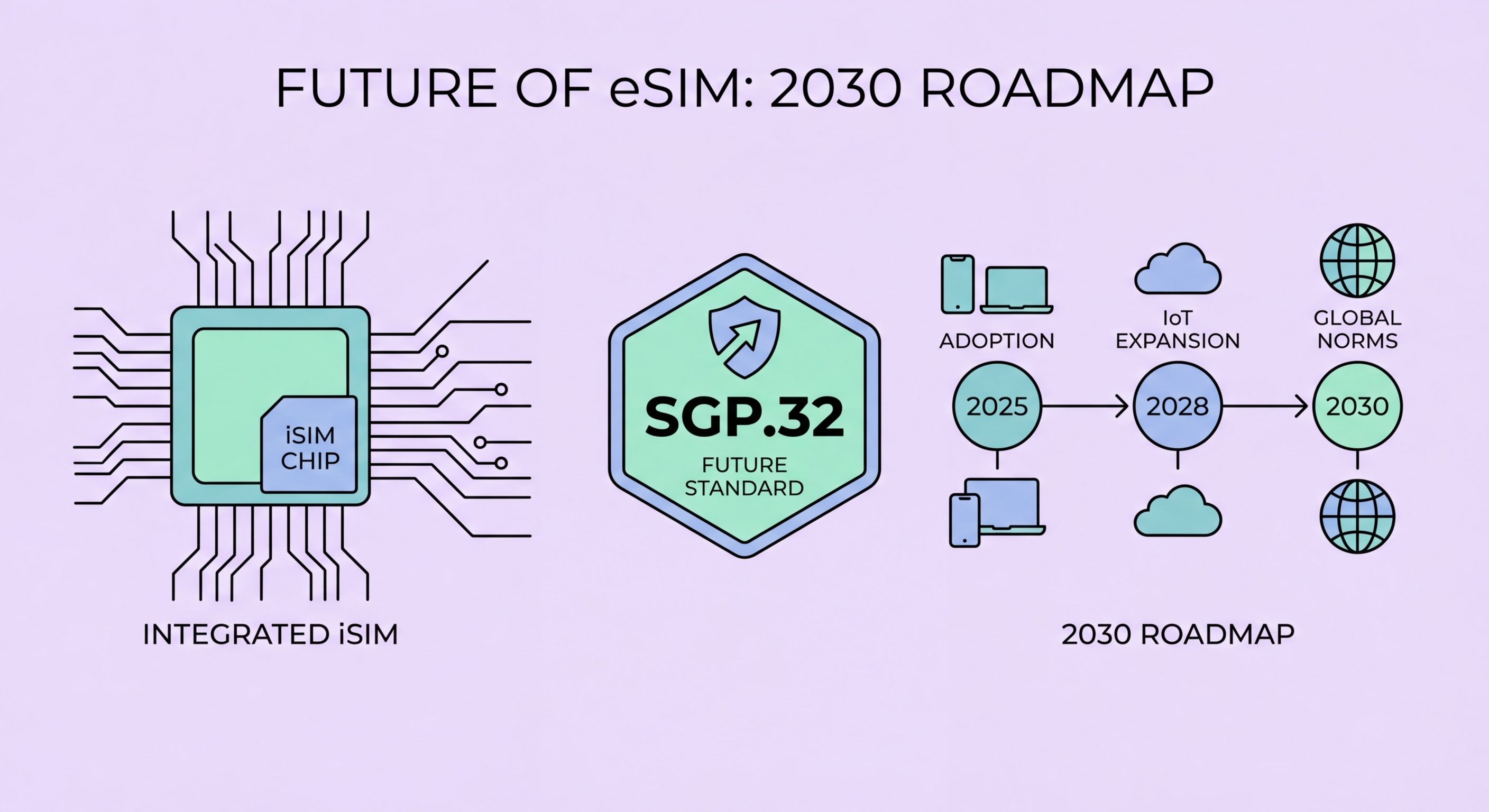
How eSIM technology is evolving — iSIM integration into the main processor, GSMA SGP.32 IoT standards enabling mass machine connectivity, eSIM expansion into wearables and connected vehicles, and what these developments mean for Hong Kong users.
The current eSIM architecture involves a dedicated, physically separate secure element chip (the eUICC) that is soldered to the device motherboard alongside the main application processor. While this provides strong security isolation, the dedicated chip requires board space and adds complexity to device design. iSIM (integrated SIM) takes the next step by integrating the SIM functionality directly into the main System-on-Chip (SoC) — the same chip that handles the device's CPU, GPU, and other critical functions. Qualcomm introduced iSIM integration in its Snapdragon platforms, and Apple has been progressively consolidating Secure Enclave functions with its primary silicon. The iSIM architecture eliminates the dedicated SIM chip entirely, reducing board space, simplifying manufacturing, and potentially improving power efficiency.
From a user perspective, iSIM looks and functions identically to eSIM — the same QR code activation process, the same carrier profiles, the same GSMA RSP provisioning architecture. The difference is entirely internal to the device hardware. However, iSIM has significant implications for device design at the form factor extremes — smartwatches, fitness trackers, and IoT sensors can be made even smaller when they do not need a dedicated SIM chip. The Apple Watch Series 4 and later already use an Apple-integrated form of eSIM that operates without a physical chip separate from the watch's main SoC, which is an early example of the iSIM integration direction. As more flagship smartphones adopt iSIM on their primary SoC, the cost and complexity of supporting mobile connectivity in ultra-compact devices decreases further.
For Hong Kong users considering device purchases, the practical relevance of iSIM vs eSIM is minimal today — both activate the same way, work with the same carriers, and provide the same user experience. The relevance increases as wearables become more independently connected. An Apple Watch or Samsung Galaxy Watch with iSIM-based cellular connectivity can send messages and take calls independently of the paired iPhone or Android phone — useful for exercise, short errands, and situations where carrying a phone is inconvenient. All four major HK carriers support eSIM/iSIM activation on Apple Watch models (from Series 4) and Samsung Galaxy Watch models that support independent cellular connectivity, allowing your watch to use a secondary number from your HK carrier or an extension of your primary number.
The GSMA's SGP.22 specification governs the eSIM provisioning architecture used in consumer smartphones — the standard that defines QR code activation, SM-DP+ server architecture, and the carrier certificate hierarchy. However, SGP.22 was designed with the assumption that a human user would interact with the device during provisioning — scanning a QR code, confirming the download on screen. IoT devices — connected sensors, smart meters, logistics trackers, connected vehicles, and industrial equipment — cannot rely on human interaction for SIM provisioning. The GSMA developed SGP.32 (released in 2022 and entering implementation in 2024–2026) specifically to address IoT eSIM management, enabling zero-touch provisioning, remote profile management, and autonomous carrier switching for machine-connected devices.
SGP.32 introduces a new architecture element called the eIM (eSIM IoT Remote Manager) that allows organisations to remotely manage eSIM profiles across large fleets of IoT devices without any on-device human interaction. A logistics company managing a fleet of 10,000 GPS tracking devices across Asia-Pacific can provision carrier profiles, switch carriers when moving through different geographic regions, and update device connectivity centrally through the eIM rather than physically accessing each device for SIM management. For Hong Kong businesses with IoT deployments — smart building sensors, connected fleet vehicles, construction site monitoring equipment — SGP.32-compliant eSIM provides a scalable connectivity management approach that physical SIM cards or first-generation eSIM simply cannot support at the required operational scale.
For Hong Kong users, the implications of SGP.32 are most visible through the connected services they interact with rather than directly. Smart electricity and gas meters deployed by HK utility companies, connected octopus-style payment terminals, logistics tracking for deliveries, and smart traffic sensors throughout Hong Kong's road network all benefit from the mass eSIM deployment enabled by SGP.32's zero-touch provisioning model. The broader smart city initiatives that the HKSAR government has been pursuing under the Smart City Blueprint for Hong Kong include significant IoT connectivity components where eSIM serves as the enabling technology for scalable, remotely manageable cellular connectivity across the city's infrastructure. As 5G networks in Hong Kong expand their low-latency massive machine-type communication (mMTC) capabilities, SGP.32 eSIM provides the SIM infrastructure layer that complements the network layer.
The automotive industry is one of the fastest-growing application domains for eSIM, with virtually all modern connected vehicles using eSIM (or iSIM) for their embedded connectivity. Tesla, BMW, Mercedes-Benz, Toyota, and increasingly Chinese electric vehicle manufacturers like BYD (which is expanding significantly in Hong Kong and mainland China) use eSIM in their vehicles for over-the-air software updates, real-time traffic data, emergency connectivity (eCall), and in-car entertainment streaming. Hong Kong's vehicle fleet is increasingly connected — the expansion of EV adoption driven by government incentives and the natural turnover of the vehicle fleet means that eSIM-connected vehicles are becoming a significant portion of Hong Kong's road traffic. The eSIM in a Tesla Model 3 allows it to receive software updates and navigate using real-time traffic data over cellular connectivity, independent of any passenger's smartphone.
Wearables beyond smartwatches are also expanding eSIM integration. Qualcomm's X35 and later cellular IoT chipsets target eSIM-enabled earphones, health monitoring devices, and smart glasses — categories where adding cellular connectivity has historically been impractical due to size and power constraints. As these chipsets mature and their energy consumption decreases, eSIM-enabled health monitoring wearables (continuous ECG monitors, glucose monitoring devices, fall detection devices for elderly care) become practical for Hong Kong's ageing population demographics. HKHA (Hong Kong Hospital Authority) and private healthcare providers in Hong Kong are actively piloting remote patient monitoring programs where eSIM-connected health devices transmit vital sign data from patients' homes to clinical monitoring centres.
Laptops with built-in LTE and 5G capabilities have offered physical SIM or eSIM slots for several years, but adoption has been slow due to the prevalence of portable WiFi hotspots. As 5G laptop eSIM speeds in Hong Kong urban areas (where 5G performance regularly exceeds 1 Gbps on devices with appropriate antennas) begin to match or exceed typical hotel and office WiFi speeds, the value proposition of built-in cellular for laptops strengthens. Microsoft Surface, Dell, HP EliteBook, and Lenovo ThinkPad X1 series all offer eSIM-capable 5G variants that HK carriers support for direct eSIM activation. For business users who frequently work from locations with unreliable WiFi — construction sites, client offices, conference centres — a 5G eSIM-equipped laptop provides reliable high-speed connectivity without dependence on venue WiFi.
The trajectory of eSIM technology points toward a world where virtually every networked device — from smartphones to smart meters to connected vehicles — uses some form of embedded SIM. For Hong Kong users, this means that the digital skills and familiarity with eSIM management that are currently somewhat niche will become mainstream competencies. Understanding how to manage multiple eSIM profiles, evaluate carrier and travel eSIM options, and troubleshoot connectivity issues will be as fundamental as understanding how to connect to WiFi is today. Hong Kong's position as an early eSIM adoption market — with comprehensive carrier support across all four major carriers and high device compatibility — positions local users well for this transition.
The regulatory environment for eSIM in Hong Kong is likely to evolve as the technology becomes more prevalent. OFCA (Office of the Communications Authority) has been supportive of eSIM adoption, and its oversight of carrier practices will extend increasingly to eSIM-specific consumer protection concerns — QR code security, carrier account protection requirements, SIM swap fraud prevention standards, and eSIM consumer disclosure obligations. Hong Kong's Personal Data (Privacy) Ordinance will be applied with increasing specificity to eSIM data collection practices as the technology matures and PDPO enforcement precedents develop. Users who stay informed about OFCA and PDPO developments relevant to eSIM will be best positioned to understand their rights and the obligations carriers have toward them.
The convergence of eSIM with 5G SA (Standalone) networks, network slicing, and edge computing creates a foundation for new services that are difficult to offer on today's network architecture. 5G network slicing allows carriers to create virtual network segments with guaranteed bandwidth and latency for specific applications — an eSIM profile on a 5G SA network could be associated with a specific network slice optimised for ultra-low-latency gaming, healthcare monitoring, or industrial automation, distinct from the general-purpose consumer data slice. In Hong Kong, where 3HK's 5G SA network is already operational, the building blocks for these advanced eSIM-enabled services are in place. As device support for 5G SA features matures over the next 2–3 years, Hong Kong users will likely be among the first globally to experience the full potential of what eSIM combined with 5G SA can deliver.