Best eSIM for Mainland China from Hong Kong

Your options for staying connected in mainland China — CMHK cross-border roaming, dedicated China eSIM services, network coverage realities, and critical notes about VPN access and the Great Firewall.

Best eSIM for mainland China from Hong Kong
1CMHK Cross-Border

CMHK: The Best Option for Frequent Cross-Border Travellers

China Mobile Hong Kong (CMHK) is the standout option for Hong Kong residents who travel to mainland China regularly, owing to its unique position as a subsidiary of China Mobile — the world's largest carrier by subscriber count and the dominant network operator across mainland China. CMHK's eSIM plans include mainland China roaming packages that use China Mobile's own domestic infrastructure rather than an inter-carrier roaming relationship. This distinction matters enormously for coverage quality: while other HK carriers rely on commercial roaming agreements with China Unicom or China Telecom (China's second and third-largest carriers), CMHK customers effectively travel on the home network of the parent company, accessing China Mobile's 4G LTE and 5G network across over 340 prefecture-level cities and rural areas where competitor coverage is sparse.

CMHK offers several plan structures for mainland China data access. Some monthly eSIM plans include a fixed mainland China data allowance (typically 3–10GB per month) at no additional charge beyond the base plan price. Separate mainland China day-pass add-ons are available for occasional travellers who do not need a permanent China data inclusion. The per-day rates for CMHK's China roaming add-on are competitive compared to the daily roaming rates other HK carriers charge for the same destination — typically HK$15–28 per day for unlimited data at local China Mobile network speeds, versus HK$80–120 per day for comparable roaming add-ons from other carriers. For travellers crossing the border to Shenzhen, Guangzhou, or elsewhere in the Greater Bay Area multiple times per month, the cost savings of CMHK's integrated China Mobile access add up significantly over time.

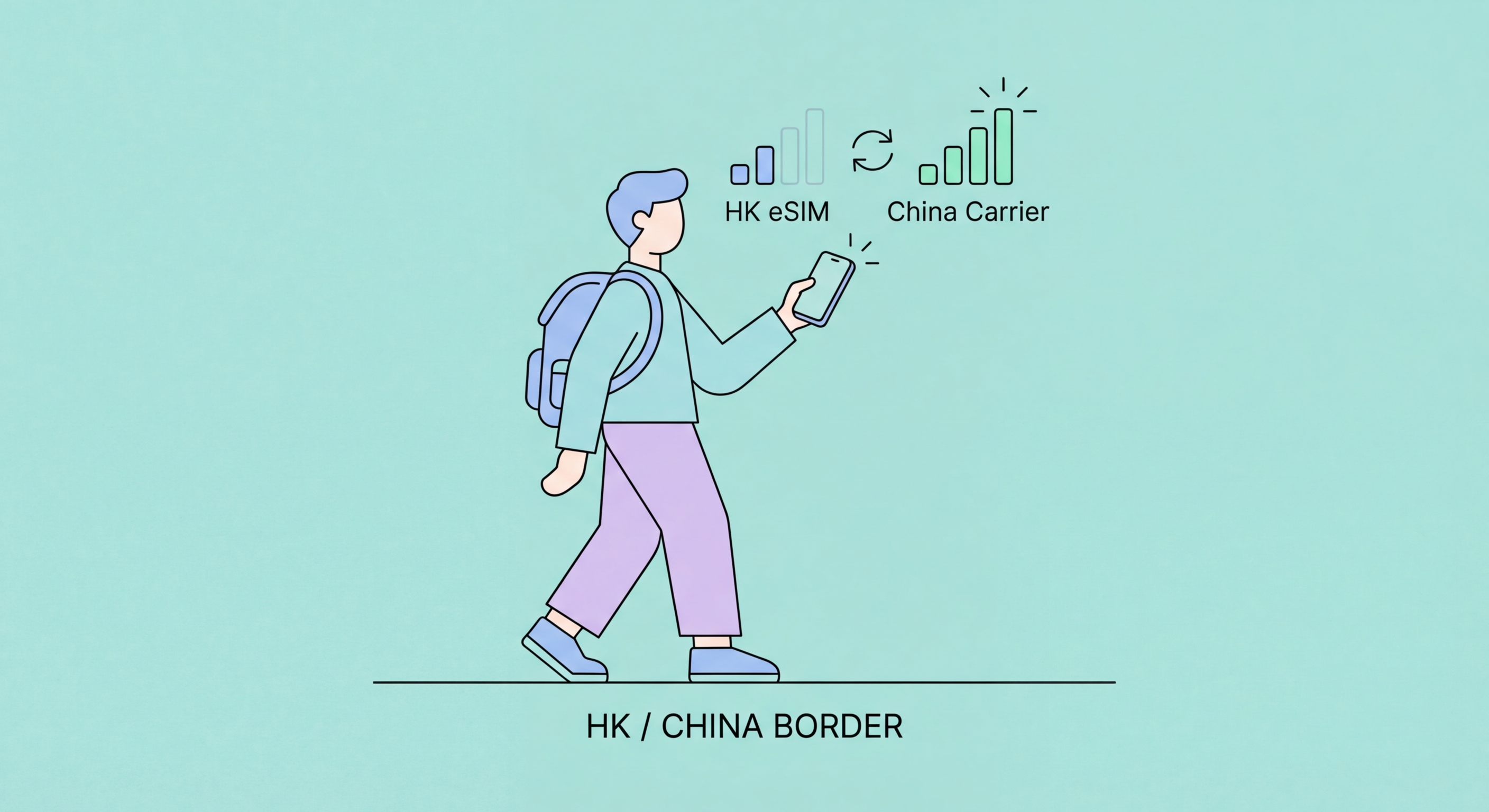
Activating a CMHK eSIM is straightforward for existing CMHK customers through the CMHK app, and new customers can sign up for a CMHK eSIM plan specifically selected for its mainland China capabilities without a store visit. When crossing the border from Hong Kong into mainland China, the CMHK eSIM automatically registers on the China Mobile mainland network — there is no manual network selection required. The handoff at border crossings (Lo Wu, Lok Ma Chau, Heung Yuen Wai, Lo Wu Express Rail Link portal) is typically seamless for CMHK customers. Upon returning to Hong Kong, the device reconnects to the HK CMHK network automatically. No APN changes or manual configuration are required for this cross-border roaming behaviour.

  • CMHK uses China Mobile's own network: Not a roaming partner relationship — CMHK customers effectively use the parent company's infrastructure.
  • Coverage across 340+ cities: China Mobile has the most extensive mainland coverage including rural areas where rivals are absent.
  • Integrated monthly data: Some CMHK plans include mainland China data allowance in the base monthly price.
  • Day-pass rates from ~HK$15–28: Significantly cheaper than the HK$80–120 other HK carriers charge for China roaming.
  • Automatic border handoff: No manual network switching required — connects seamlessly as you cross into mainland China.
  • App-based activation: CMHK eSIM setup and China data add-ons managed entirely through the CMHK app.
CMHK cross-border eSIM mainland China
2Other HK Carrier Options

3HK, SmarTone, and csl China Roaming on eSIM

For CMHK customers, mainland China access is clearly the best arrangement. But what about existing 3HK, SmarTone, or csl/HKT customers who need occasional mainland China connectivity without switching their primary HK carrier? All three carriers offer mainland China roaming day-pass add-ons that activate automatically when the device connects to a mainland China network. 3HK's roaming add-on activates the Three/Hutchison group's China roaming relationship through China Unicom or China Telecom partnership, providing acceptable coverage in major cities (Beijing, Shanghai, Shenzhen, Guangzhou, Chengdu) but with noticeably weaker coverage in rural areas, smaller cities, and some suburban zones compared to what CMHK/China Mobile provides.

The day-pass activation for 3HK, SmarTone, and csl China roaming is typically handled through their respective carrier apps or automatically on first data connection in mainland China. Rates are higher than CMHK's equivalent — typically HK$80–120 per day for unlimited or high-data roaming. For occasional travellers who cross the border fewer than 5–6 times per year, this cost may be acceptable, particularly if the rest of their plan is well-suited to their Hong Kong usage and they prefer not to change carrier. For anyone crossing the border more frequently, the economics of switching primary carrier to CMHK (or adding a secondary CMHK eSIM for mainland use) become increasingly compelling as travel frequency increases.

An increasingly popular approach for non-CMHK primary customers is maintaining a CMHK eSIM as a secondary line dedicated to mainland China use. This leverages the dual SIM capability of modern smartphones — keep your primary carrier eSIM or physical SIM for your main HK number and daily HK use, and activate the CMHK eSIM when crossing the border to mainland China. Configure the phone to switch data to the CMHK eSIM when entering mainland China. This approach requires a CMHK secondary plan (which can be a prepaid data-only eSIM at low monthly cost), but provides best-in-class mainland China coverage without requiring a primary carrier switch. It is particularly attractive for residents of Shenzhen Bay, Kowloon Bay, and other cross-border commuting zones in the Greater Bay Area.

  • 3HK China roaming uses China Unicom/Telecom partnership: Good in major cities, weaker in rural areas vs CMHK/China Mobile.
  • Day-pass rates HK$80–120: Acceptable for occasional travellers (under 5–6 border crossings per year).
  • Auto-activation on first mainland connection: Roaming day-pass typically activates automatically on all three non-CMHK carriers.
  • Secondary CMHK eSIM approach: Maintain CMHK as a second eSIM line for mainland use while keeping primary carrier for HK.
  • Prepaid CMHK data eSIM available: Low monthly cost secondary line gives access to China Mobile network without primary carrier change.
  • Greater Bay Area commuters benefit most: Frequent cross-border travellers gain most from CMHK primary or secondary eSIM arrangement.
Other HK carrier China roaming eSIM options
3International eSIM Providers

International Travel eSIM Providers for Mainland China

Most international eSIM marketplace providers — Airalo, Holafly, Saily, Roamless — do not offer mainland China coverage in their standard portfolios, or offer very limited coverage through narrowly constrained partnerships. The Chinese mobile market operates under a regulatory framework that limits foreign carrier involvement, and the Great Firewall content filtering applies to all mobile data connections within mainland China regardless of the carrier or eSIM provider used. International eSIM providers who do offer mainland China coverage typically do so through partnerships with China Unicom's international business arm, providing data that is technically functional but subject to the same content access restrictions as all mainland China mobile data.

Specialised China eSIM providers have emerged that are specifically licensed to operate data services within mainland China and offer eSIM profiles targeted at international visitors and Hong Kong cross-border travellers. These providers — including some China-focused eSIM services available through travel agencies and electronics retailers in Hong Kong — offer competitive data pricing for mainland use and are designed to handle the cross-border use case more gracefully than generic international eSIM marketplaces. When evaluating a dedicated China eSIM provider, look for explicit disclosure of which mainland Chinese carrier's network is used (China Mobile provides the best coverage), what data access restrictions apply (VPN use is prohibited on all licensed mainland Chinese networks), and whether the eSIM can also be used in Hong Kong or is China-only.

For Hong Kong residents who use VPN services to access globally-restricted content while in mainland China, it is important to understand the legal and technical realities. All licensed mobile networks operating within mainland China — including China Mobile, China Unicom, and China Telecom — apply the Great Firewall filtering to all data traffic, and VPN use on these networks is subject to China's VPN regulations. Hong Kong eSIMs that use mainland China infrastructure when roaming are subject to these same restrictions while physically present in mainland China. This is not a carrier policy that can be circumvented by choosing a different eSIM provider — it is a technical and regulatory reality of operating mobile data within the PRC. Users should plan their mainland China connectivity with this in mind.

  • Most international providers don't cover mainland China: Airalo/Holafly/Saily have limited or no standard mainland China eSIM offerings.
  • Great Firewall applies to all mainland mobile data: Content restrictions apply regardless of which carrier or eSIM provider is used.
  • Specialised China eSIM providers available: Dedicated China-licensed services available through HK travel retailers — check network partner.
  • Prefer China Mobile partner: China Mobile provides the best mainland coverage — verify network partner before purchasing a China eSIM.
  • VPN restrictions apply: VPN use on licensed mainland Chinese networks is subject to PRC regulations — factor this into connectivity planning.
  • CMHK remains the most practical option: For HK residents, CMHK's integrated China Mobile access is simpler and often cheaper than dedicated China eSIM services.
International eSIM providers China coverage
4Practical Tips

Practical Tips for Mobile Data in Mainland China

Before crossing the border, prepare your apps for the mainland China internet environment. Many apps used daily in Hong Kong — Google Maps, Gmail, WhatsApp, Instagram, Facebook, YouTube — are blocked in mainland China regardless of your mobile carrier. Download offline Google Maps for your mainland China destinations before leaving Hong Kong. Install WeChat for communication (widely used in mainland China as a substitute for WhatsApp), Amap (AutoNavi / 高德地图) as a navigation alternative, and Baidu Maps as a backup. Setting up WeChat Pay or Alipay linked to an international credit card before your trip enables cashless payment in mainland China where these apps are ubiquitously used for transactions.

On your phone's network settings, configure the APN settings correctly for your mainland China eSIM or roaming service if required. CMHK and other HK carriers typically configure APN settings automatically when roaming on the mainland China network — you should not need to make manual changes. If data does not work after crossing the border, try toggling Airplane Mode on and off to force a fresh network registration. On iPhone, check Settings > Cellular > Cellular Data Options > Data Roaming is enabled for the line you are using for China data. On Android Samsung, check Settings > Connections > Mobile Networks > Data Roaming is enabled for the appropriate SIM. Restarting the device is often the most reliable fix if data does not activate automatically after border crossing.

Battery management takes on added importance in mainland China for several reasons. The Great Firewall restrictions may cause apps that constantly poll blocked servers to drain battery faster than normal as they repeatedly time out connection attempts. Disable background app refresh for any app that will not work in mainland China to prevent battery drain from blocked connection attempts. If you rely on mobile data heavily for navigation and communication throughout the day, carry a power bank with sufficient capacity for your device — USB-C power banks of 10,000–20,000mAh capacity are compact enough for daily carry and provide 2–3 full charges for typical smartphones. Hong Kong convenience stores and electronics retailers stock reliable power banks from local and internationally recognised brands at competitive prices.

  • Download offline maps before departure: Google Maps offline areas, Amap, and Baidu Maps — do not rely on online-only mapping in China.
  • Install WeChat and payment apps in HK: Set up WeChat Pay or Alipay before crossing — easier on HK internet without Great Firewall.
  • Toggle Airplane Mode if data fails at border: Forces fresh network registration — most reliable first troubleshooting step.
  • Verify Data Roaming is enabled: Check iPhone Cellular Data Options or Android Mobile Networks settings for the active SIM.
  • Disable blocked app background refresh: Prevents battery drain from apps repeatedly attempting blocked server connections.
  • Carry a power bank: 10,000–20,000mAh provides 2–3 charges — essential for heavy data use days in mainland China.
Practical tips for mobile data mainland China from Hong Kong

Stay Connected When Crossing the Border

CMHK's China Mobile network access is the most reliable option for HK residents visiting mainland China — set it up as your primary or secondary eSIM before your next cross-border trip.

Related VPN Articles