How to implement effective phishing simulation training for your Hong Kong team — covering simulation platforms, designing realistic HK-relevant scenarios, delivering just-in-time training, and measuring and improving your organisation's phishing resilience.
Traditional security awareness training — annual compliance video modules, policy acknowledgement forms, and periodic security briefings — improves theoretical knowledge of security threats but has limited impact on employee behaviour under real phishing conditions. The gap between knowing that phishing exists and successfully identifying a convincing phishing email under the time pressure of a busy workday is substantial. Research consistently shows that employees who have completed security awareness training still click on phishing emails at significant rates when those emails are well-crafted and contextually relevant. The knowledge transfer problem is real: what employees retain from annual training modules is substantially less than what they needed to absorb, and the retention decays rapidly between training cycles.
Phishing simulation — sending realistic but fake phishing emails to employees and tracking who clicks, who submits credentials, and who reports the simulation — provides a fundamentally different learning experience. When an employee falls for a simulated phishing email, they receive immediate feedback that they failed a real-world test, which is psychologically more impactful than failing a multiple-choice question in a training module. The teachable moment occurs at the exact point of failure — when the employee has just demonstrated the specific mistake they need to avoid — making the training contextually relevant and immediately applicable. Research by security awareness training providers including KnowBe4 and Proofpoint demonstrates that regular phishing simulation reduces click rates from 30%+ for untrained employees to single-digit percentages for organisations with sustained simulation programmes.
For Hong Kong businesses, phishing simulation addresses specific local threat scenarios that generic global training programmes may not cover. HK employees are targeted by phishing themed around local authorities (HKPF, IRD, Immigration Department), local financial services (HSBC HK, Hang Seng, BOCHK online banking), local payment platforms (PayMe, Alipay HK, Octopus), and local government services (eTAX, iAM Smart). A phishing simulation programme that includes HK-specific scenarios — a simulated IRD tax notification, a fake HSBC security alert, or an Octopus account verification request — builds resistance to the specific phishing themes that employees in Hong Kong are most likely to encounter in genuine attacks.
Several commercial phishing simulation platforms are appropriate for Hong Kong businesses. KnowBe4 is the global market leader, offering the most extensive library of phishing templates including Asian-language and HK-specific scenarios, comprehensive reporting, and an integrated security awareness training curriculum with multilingual content including Chinese. Proofpoint Security Awareness Training provides deep integration with Proofpoint's email security gateway, using actual threats from your email environment in simulations. Microsoft Attack Simulator (included in Microsoft 365 Business Premium and Defender for Office 365 Plan 2) provides phishing simulation integrated directly into Microsoft 365 tenants — a cost-effective option for organisations already on qualifying Microsoft 365 plans.
Cofense PhishMe focuses specifically on conditioning employees to report phishing to the security team through their dedicated reporting button, creating an active reporting culture rather than only training passive recognition. Terranova Security (acquired by Fortra) provides strong multilingual content including Traditional Chinese relevant for HK workplaces. For smaller HK SMEs with limited budgets, GoPhish is a free open-source phishing simulation framework that provides basic simulation capability without the managed platform features of commercial solutions — it requires more technical configuration but provides the core simulation capability at no licensing cost. HKPC's Cybersecurity Training and Awareness programmes include phishing simulation components accessible to SMEs through their training offerings.
Platform selection should consider: language support for your workforce (bilingual English/Traditional Chinese content is important for many HK organisations); template library relevance (does the platform have HK-specific phishing templates, or will you need to create custom scenarios); integration with your existing email platform (Microsoft 365 or Google Workspace integration simplifies configuration and reporting); phishing reporting button availability (a toolbar button that employees click to report suspected phishing creates a reporting culture and provides real-time intelligence on active campaigns); reporting and analytics depth (management dashboard reports that show improvement over time support budget justification); and per-user pricing that fits your headcount and budget.
Effective phishing simulations use scenarios that employees genuinely believe could be real — scenarios that are too obviously fake train employees to spot only easy phishing attempts, leaving them vulnerable to sophisticated attacks. Designing realistic HK-relevant scenarios requires understanding the specific phishing themes that target Hong Kong employees: government notifications (HKPF notices, IRD tax documents, Immigration Department requests, eTAX notifications), financial services alerts (HSBC HK, Hang Seng, Bank of China HK, Standard Chartered HK security alerts and transaction notifications), payment platform messages (PayMe, Alipay HK, Octopus card alerts), and corporate impersonation (IT helpdesk password reset requests, HR benefit enrolment, CEO/CFO requests from slightly wrong-looking email addresses).
Scenario difficulty should be calibrated to your current workforce click rate and gradually increased as employees improve. Beginning simulations should use obviously suspicious scenarios — clear spelling errors, generic greetings, suspicious sender domains — to build basic recognition skills. Intermediate scenarios should use more convincing templates with correct branding, personalised greetings, and contextually relevant content. Advanced scenarios — deployed once basic click rates are low — should use highly sophisticated techniques: HTML smuggling, QR code phishing, business email compromise impersonating internal executives, and themed around actual corporate events that employees would expect to receive communication about. The goal is to always stay slightly ahead of employee capability, maintaining engagement and building resistance to increasingly sophisticated attacks.
Spear phishing simulations — targeted attacks using personal information about specific employees — test resistance to the most dangerous category of phishing attacks. A spear phishing simulation targeted at your CFO might impersonate a known supplier using the supplier's actual name and reference real contract details. Targeted at an IT administrator, it might impersonate a vendor whose products are actually deployed in your environment. These simulations require more preparation but produce the most valuable training — most high-consequence security incidents begin with successful spear phishing of a specific, high-value target. Including spear phishing scenarios for high-value roles (executives, finance staff, IT admins) in your simulation programme prepares these individuals for the specific attacks they are most likely to face.
The cultural framing of phishing simulation significantly affects programme effectiveness. Programmes framed as "catching employees doing something wrong" create anxiety, resentment, and a culture of hiding failures rather than reporting them. Programmes framed as "helping everyone build a skill that protects themselves, the company, and their colleagues" create engagement and willingness to learn from failures. Management communication before launching phishing simulation should emphasise that the programme measures organisational vulnerability, not individual culpability — that the goal is to reduce the organisation's phishing click rate as a whole, not to discipline individuals who fail simulated tests. Public naming or shaming of employees who click is counterproductive and should be explicitly avoided.
The most important cultural outcome of a phishing simulation programme is establishing a reporting reflex — the habit of reporting suspicious emails to the security team rather than ignoring them, deleting them, or (worst) clicking to investigate. A phishing reporting button in the email client lowers the friction of reporting to a single click, making it as easy to report as to delete. Rewarding and publicly acknowledging employees who report phishing (including simulated phishing) reinforces this behaviour. Organisations with strong reporting cultures detect actual phishing campaigns hours or days faster than they would through automated detection alone — a single employee's report of a suspicious email can trigger a company-wide alert that protects everyone else from clicking on the same campaign.
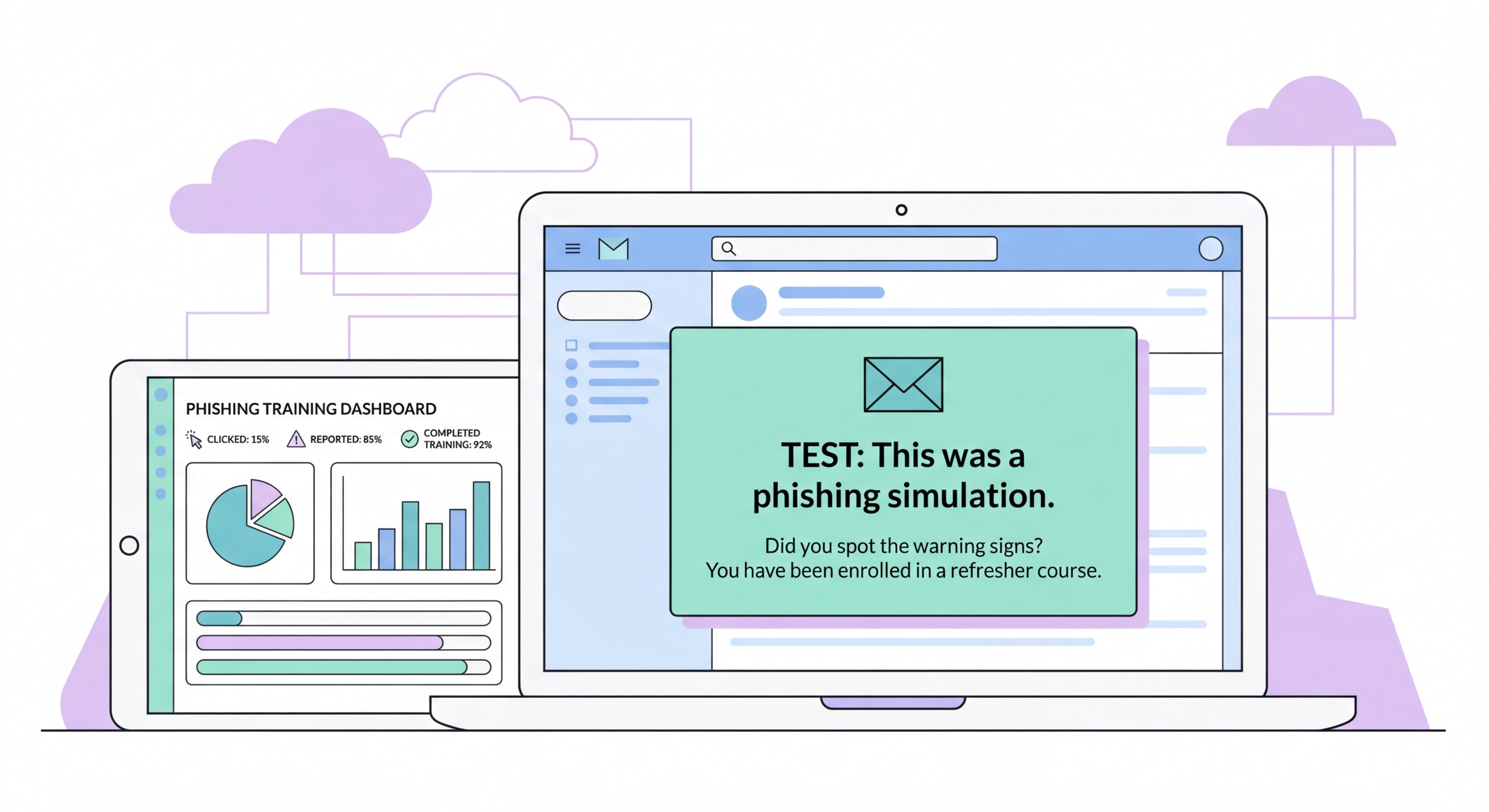
Measuring and communicating phishing simulation results tracks programme effectiveness and provides data for ongoing management reporting. Key metrics include: phishing simulation click rate (the percentage of recipients who click the simulated phishing link — trend over time is more meaningful than point-in-time values); credential submission rate (of those who clicked, the percentage who submitted credentials — the most dangerous behaviour); phishing report rate (the percentage of simulations reported through the reporting button — increasing report rates indicate improving security culture); and time to report (how quickly reports are submitted after simulation deployment — faster reporting means faster real-world threat detection). Present these metrics in quarterly security reports to management, showing improvement trends that demonstrate the value of continued investment in security awareness.