How to plan, prioritise, and justify cybersecurity spending for Hong Kong small and medium businesses — from maximum-value first investments to building a mature security programme on a realistic SME budget.
How much should a Hong Kong SME spend on cybersecurity? Industry benchmarks suggest organisations should allocate 5-15% of their IT budget to cybersecurity, with higher percentages appropriate for businesses in high-risk sectors (financial services, healthcare, legal) and lower percentages acceptable for businesses with minimal digital footprint and limited data exposure. In absolute terms, Gartner research indicates that medium-sized businesses typically spend $1,000-2,000 USD per employee annually on cybersecurity across all tools, services, and staff time. For a 50-person HK SME, this implies a security budget in the HK$400,000-800,000 range annually — a significant investment, but one that must be weighed against the cost of an unmitigated incident.
The cost comparison that most persuasively justifies cybersecurity investment is incident cost versus prevention cost. The average cost of a data breach for a small business exceeds USD$2.5 million according to IBM Security research, inclusive of incident response, business disruption, regulatory fines, and reputational impact. The average ransomware recovery cost (excluding ransom) for a business with 100 employees is typically HK$2-5 million, including system rebuild, data recovery, business disruption, and reputation management. The annual cost of a comprehensive SME security stack — endpoint protection, MFA, email security, firewall, backup, and staff training — is a fraction of a single incident cost. Framing cybersecurity budget requests in terms of incident cost avoidance rather than technology cost makes the investment case accessible to non-technical management and directors.
HK government and industry support programmes can supplement SME cybersecurity budgets. The HKPC offers subsidised cybersecurity assessment, training, and advisory services through its Cyber Security Centre and various SME support programmes. The Hong Kong Trade Development Council (HKTDC) and SME Centre provide cybersecurity resources and referrals. Enterprise Support Scheme and other HKSAR government SME support programmes may fund technology adoption including security tools. Sector-specific bodies including the Hong Kong General Chamber of Commerce, the Federation of Hong Kong Industries, and the Fintech Association of Hong Kong provide member resources on cybersecurity relevant to their industries. Exploring these programmes before committing full commercial budget expenditure can stretch security investment further.
When cybersecurity budgets are constrained — as they always are for SMEs — prioritising investments by risk reduction impact per dollar spent is essential. Not all security controls provide equal risk reduction: some controls address the most common and damaging attack vectors at low cost, while others are expensive solutions to relatively rare problems. A rational prioritisation framework for Hong Kong SMEs begins with the controls that address the highest-probability, highest-impact threats first: MFA for all cloud applications and remote access, which stops the majority of credential-based attacks at near-zero marginal cost; patching automation, which eliminates the exploitation of known vulnerabilities; and endpoint protection, which prevents malware from executing on devices.
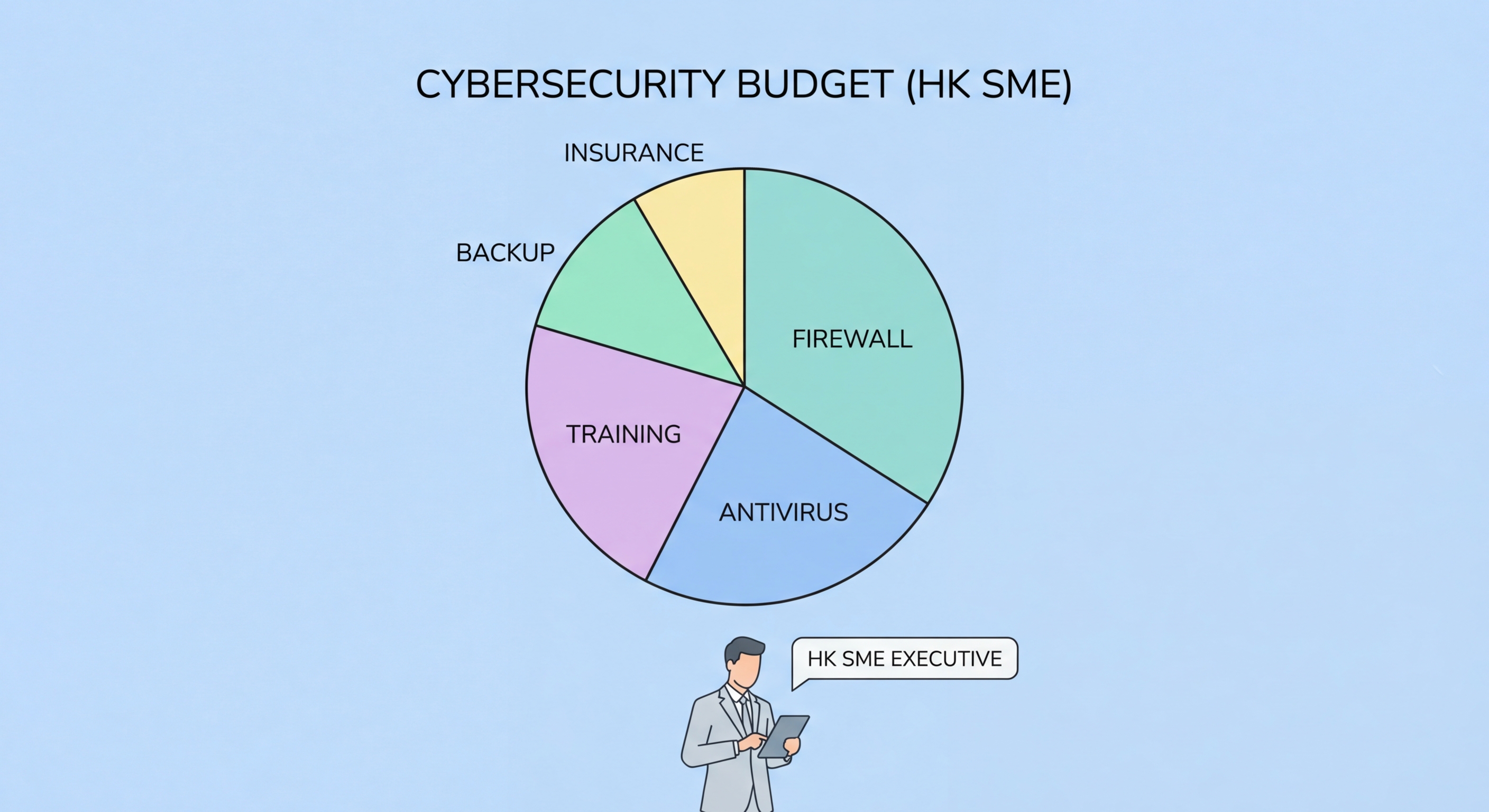
The security investment stack for HK SMEs, ordered by priority and typical cost-effectiveness, looks like: (1) MFA deployment on all Microsoft 365, Google Workspace, and VPN accounts — typically included in existing subscriptions; (2) Microsoft 365 Business Premium or Google Workspace Business Standard — the licensing tier that includes MDM, email security, and basic EDR; (3) Password manager deployment for all staff; (4) Security awareness training (covered in the phishing simulation training article); (5) Business firewall with UTM features; (6) Cloud backup for Microsoft 365 or Google Workspace data; (7) Cyber insurance. This ordering reflects both risk reduction impact and the reality that many HK SMEs are paying for Microsoft 365 Business Premium's security features without using them — activating features in existing subscriptions costs time, not money.
Free and low-cost security tools can provide substantial security value for HK SMEs operating under tight budgets. Cloudflare Gateway's free DNS filtering tier blocks access to known malicious domains for unlimited users. Microsoft Secure Score in Microsoft 365 provides a prioritised security improvement roadmap at no additional cost. Have I Been Pwned's domain monitoring notifies businesses when company email addresses appear in data breaches for free. CISA's free cybersecurity services including vulnerability scanning for internet-facing systems, Malicious Domain Blocking and Reporting, and the Known Exploited Vulnerabilities Catalog are available to all organisations. Windows Defender (now Microsoft Defender for Business at the Business Premium licensing tier) provides solid endpoint protection at no marginal cost for Microsoft 365 Business Premium subscribers.
Many cybersecurity capabilities can either be built in-house with staff and tools, or purchased as managed services from external providers. For most Hong Kong SMEs, managed security services — where an external provider delivers 24/7 security monitoring, incident response, and security management as a subscription service — provide more security value per dollar than attempting to build equivalent capabilities internally. The economics are straightforward: a 24/7 security operations capability requires multiple security analysts across shift rotations, specialised tooling, and continuous training — a cost structure that is prohibitive for all but the largest SMEs. An MSSP (Managed Security Service Provider) amortises these costs across hundreds of customers.
Managed Detection and Response (MDR) services — where an MSSP deploys and monitors EDR technology on your behalf, investigating alerts and responding to incidents 24/7 — are particularly valuable for HK SMEs without in-house security expertise. EDR technology like CrowdStrike Falcon, SentinelOne, and Microsoft Defender generates security alerts that require skilled analysts to investigate and prioritise. Without ongoing monitoring, EDR alerts go unreviewed and provide no detection value. MDR services provide the monitoring and response capability that makes EDR investment effective, at per-user monthly costs that are accessible to SME budgets. Several Hong Kong-based MSSPs offer MDR services with local language support, local compliance expertise, and HK-jurisdictional incident response capability.
The build vs buy decision for specific security capabilities should consider: the frequency of need (a security operation needed daily justifies in-house capability; one needed annually is better purchased as a service); the available skill pool in the HK market (security skills in Hong Kong are scarce and expensive — hiring security staff competes against banks and large enterprises who pay premium salaries); the criticality of the capability (mission-critical capabilities where 24/7 coverage is required are often better managed externally); and total cost comparison over three years (managed service subscription costs versus total employment cost including recruitment, salary, benefits, and retention risk). For most HK SMEs, managed services for security monitoring, patch management, and security awareness training are more cost-effective than equivalent in-house capabilities.
Cybersecurity investment proposals fail in boardrooms and with SME owners when they are presented in technical terms that business decision-makers cannot connect to financial impact. The most effective security budget justifications quantify risk in business terms: the financial impact of likely incidents (ransomware, BEC fraud, data breach), the probability of those incidents based on current security posture and industry threat intelligence, and the reduction in expected loss from the proposed investment. A presentation showing "this HK$50,000 annual investment reduces our expected annual loss from BEC fraud from HK$500,000 to HK$100,000" is far more compelling to a business owner than a technical description of email security features.
Using real Hong Kong incidents reported by HKPF CSTCB and documented in media coverage makes the risk concrete for HK business leaders. The HKPF publishes annual cybersecurity crime statistics that document the number of cases and total financial losses in HK each year — citing these statistics in budget proposals contextualises the threat locally rather than relying on global statistics that directors may discount as irrelevant to their specific context. Case studies from HKPC's published incident reports and news coverage of HK business cyber incidents — anonymised but specific enough to resonate — demonstrate that comparable businesses in Hong Kong are experiencing these exact scenarios. The goal is shifting perception from "this probably won't happen to us" to "this regularly happens to businesses like ours."
Regulatory and compliance obligations provide a different justification angle that is particularly effective for regulated businesses and those with enterprise customers who conduct supplier due diligence. PDPO compliance requirements, HKMA and SFC cybersecurity guidelines for financial services firms, and increasingly common cybersecurity requirements in enterprise customer contracts (particularly from multinational customers with global security standards) create obligations that are not optional. Framing security investments as compliance requirements — "our largest client's supplier assessment requires evidence of these controls" or "PDPO Principle 4 requires these data protection measures" — removes the discretionary framing that allows security spending to be deferred in favour of direct revenue-generating investment.