Tax Season Scams Targeting Hong Kong Residents
How to identify IRD impersonation calls, fake tax refund emails, and government authority scams that target Hong Kong taxpayers during and after the annual tax filing season.
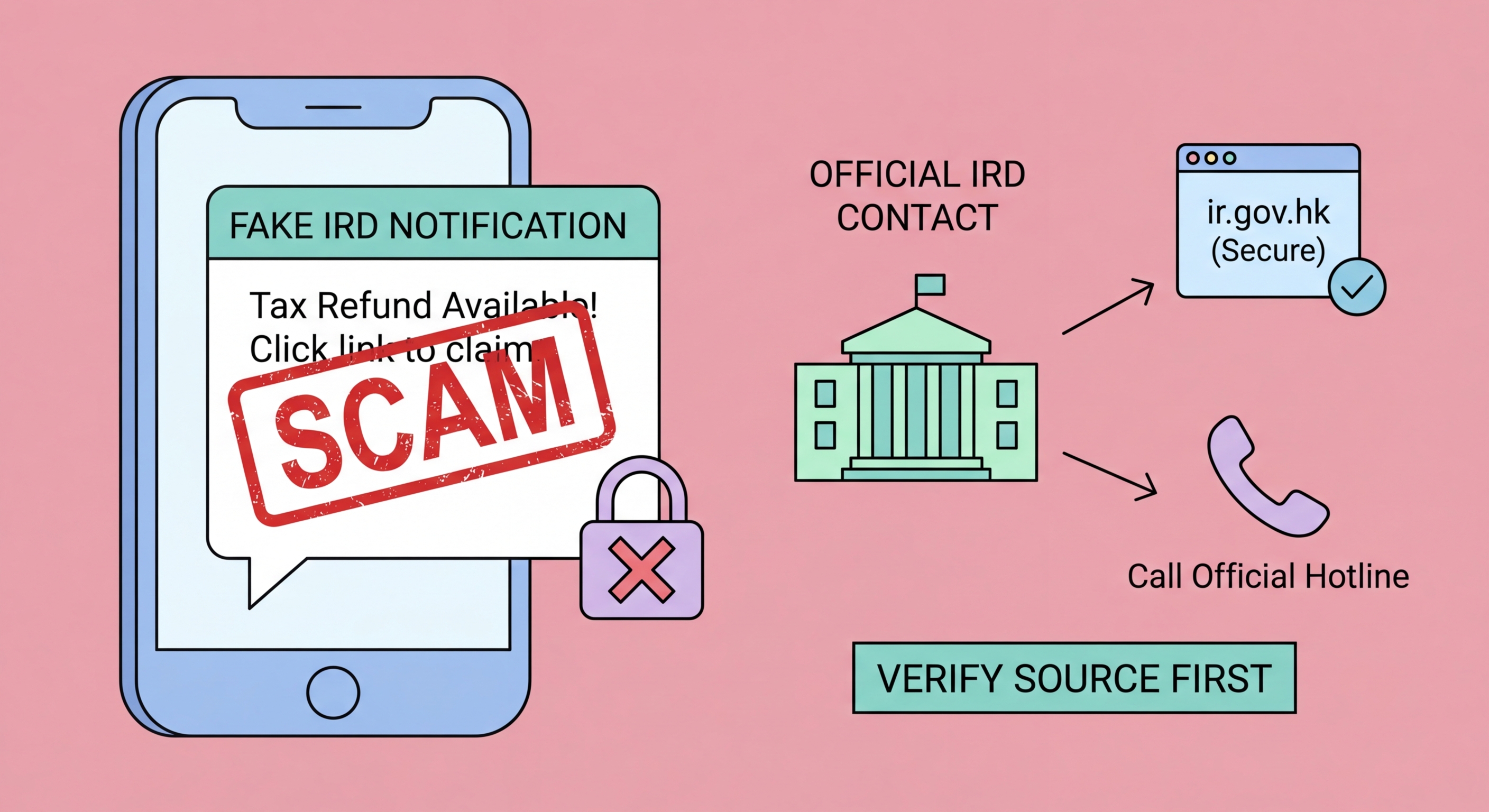
How to identify IRD impersonation calls, fake tax refund emails, and government authority scams that target Hong Kong taxpayers during and after the annual tax filing season.
The Inland Revenue Department (IRD) is one of the most impersonated government agencies by fraudsters targeting Hong Kong residents. Tax season — when IRD issues assessment notices, payment demands, and refund notifications — creates a natural window during which taxpayers are already primed to respond to IRD communications. Fraudsters exploit this temporal context to make their impersonations more believable, launching coordinated campaigns of calls, SMS messages, and emails that mimic genuine IRD communications with increasing sophistication.
The telephone impersonation variant is particularly prevalent and financially damaging. Callers claim to be IRD officers, providing fake staff numbers and case references, alleging that the victim has underpaid taxes, failed to file returns, or is under investigation for tax evasion. The "officer" creates extreme urgency — threatening immediate arrest, asset freezing, or legal action unless the "outstanding tax liability" is settled immediately via a wire transfer to a nominated bank account or by purchasing convenience store prepaid cards and reading the codes over the phone. The genuine IRD does not demand immediate payment by phone and does not accept prepaid card payments for tax liabilities.
Fake tax refund emails and SMS messages take the opposite approach: instead of threatening consequences, they offer unexpected windfalls. "You are entitled to a tax refund of HK$X,XXX — click here to claim" messages direct recipients to cloned IRD websites that capture HKID numbers, banking credentials, or card details under the pretence of processing the refund. The IRD does issue genuine refunds, but these are processed automatically to the bank account on file — the IRD does not email or SMS citizens to click links to claim refunds. Any such message is fraudulent.

Phishing emails claiming to be from the IRD are carefully crafted to replicate the visual style of genuine IRD communications — government logo, official header formats, formal language, and reference numbers that appear authentic. The links within these emails lead to cloned IRD websites (ird.gov.hk clones registered on similar-looking domains) that prompt users to log into a fake eTAX portal, entering their eTAX login credentials, HKID number, or banking information for a supposed refund claim.
Identifying fake IRD communications requires checking the sender's email address domain — genuine IRD emails come from @ird.gov.hk, not @ird-gov.hk.com or @hk-tax-refund.net. The IRD's official website is at ird.gov.hk — any variation of this domain is not the genuine site. For SMS messages, the IRD uses the sender ID "IRD HK" — messages from random phone numbers or lookalike sender IDs are not genuine. The eTAX portal is at etax.ird.gov.hk — accessing eTAX from a bookmark or by typing the URL directly eliminates the risk of phishing link misdirection.
Smishing (SMS phishing) targeting tax topics peaks around the annual tax filing deadlines — typically May for salaries tax and December/January for profits tax. Messages claiming "your tax return has been flagged", "there is an overdue payment on your tax account", or "a tax refund is available" are all common pretexts. These messages are designed to trigger immediate action that bypasses careful consideration. The appropriate response to any unsolicited SMS about tax matters is to ignore the link entirely and check your eTAX account directly via the official portal.

Tax season scams are part of a broader pattern of government authority impersonation fraud that operates throughout the year in Hong Kong. Beyond the IRD, fraudsters impersonate the Hong Kong Police Force, Immigration Department, Customs and Excise Department, the Social Welfare Department, and even the courts. Each impersonation variant tailors the threat to the impersonated agency — police arrest warrants for money laundering, immigration overstay or visa violations, customs investigations into imported goods, welfare fraud investigations, or court summonses for civil proceedings.
The "police arrest warrant" variant deserves particular attention because it causes the largest individual losses. Callers claim to be police officers investigating money laundering or drug trafficking offences, telling the victim their bank account has been "used for illegal transactions". They instruct the victim to cooperate with the "investigation" by transferring funds to a designated "safe account" controlled by the investigation, or to avoid arrest by paying a "bail amount". These calls often involve multiple speakers — a "junior officer" who initiates the call, a "senior officer" who confirms the investigation, and sometimes even a fake "public prosecutor". The orchestrated production quality makes victims believe the call is legitimate.
The consistent thread across all government authority impersonation fraud is the demand for money — either directly (wire transfer, prepaid cards) or indirectly (providing banking credentials "for verification"). No genuine Hong Kong government agency will contact citizens demanding immediate payments by phone, request transfers to personal bank accounts, or threaten immediate arrest unless funds are transferred within hours. The intensity of the threat and the urgency to act immediately are themselves the fraud signal — genuine government proceedings involve documented processes with written notices and legal timelines, not panicked phone calls demanding immediate action.

Protecting yourself from tax season scams requires both awareness and practical procedures that family members and colleagues share. The most effective protection is internalising the fundamental principle that legitimate government agencies use formal, documented processes — paper notices delivered by post to your registered address, formal legal proceedings served by officers through established channels, and payment mechanisms with official receipts through government payment systems. Any deviation from these formal channels — an unexpected phone call, an email with a link, a WhatsApp message — should trigger immediate suspicion.
Managing your genuine tax affairs through official channels removes the ambiguity that scammers exploit. Filing returns on time through the genuine eTAX portal, keeping your registered address updated with the IRD, understanding your approximate tax liability so unexpected demands seem incongruous, and being aware of the actual payment deadline calendar all reduce your vulnerability to manipulation. When you know your tax affairs are in order and understand how the IRD actually communicates, fraudulent communications are far easier to identify as inconsistent with your actual situation.
Reporting tax scams serves the wider community. The IRD, HKPF, and relevant agencies actively use reports of scam campaigns to publish warnings, initiate investigations, and coordinate with telecommunications operators to block known fraudulent numbers. Report tax-related scam calls to the HKPF at 2527 7177 (CSTCB) or via the 999 crime reporting line. Report fraudulent emails or websites to the IRD directly at [email protected] or through the form on ird.gov.hk. Sharing experiences with family, colleagues, and in community channels like LIHKG helps warn others before they become victims.
