Vendor and Supply Chain Risk Management

How Hong Kong businesses can assess, contract with, and monitor suppliers and third-party vendors to manage cybersecurity risk introduced through the supply chain — covering vendor assessment, data processing agreements, and ongoing oversight.

Vendor supply chain risk management Hong Kong
1Supply Chain Risk

Understanding Supply Chain Cybersecurity Risk for HK Businesses

Supply chain cybersecurity risk arises when your business's security posture is undermined through a third-party vendor or supplier who has access to your systems, networks, or data. High-profile supply chain attacks — including SolarWinds, Kaseya VSA, and 3CX — demonstrated that sophisticated attackers compromise widely-used software vendors and managed service providers to gain simultaneous access to thousands of downstream customers. For Hong Kong businesses, supply chain risk is particularly relevant given the region's concentration of financial services, professional services, and trading companies that rely on extensive webs of technology vendors, IT managed service providers, and outsourced business function providers.

The third-party risk landscape for a typical Hong Kong SME includes: IT managed service providers with privileged administrative access to your servers and endpoints, cloud services that store or process your customer data (accounting platforms, HR systems, CRM), business software vendors whose products are installed on your network, professional service firms (accountants, lawyers, consultants) with access to sensitive business data, and logistics or supply chain partners connected to your business systems. Each of these relationships represents a potential pathway for attackers to reach your business. A breach at your IT MSP can expose your systems through the same administrative tools used for legitimate maintenance. A breach at your accounting SaaS vendor can expose your financial data and customer records without your systems being directly compromised.

Hong Kong's PDPO imposes direct obligations on data users (your business) for the security of personal data even when that data is processed by a third party. A data breach at a processor you engaged — your CRM vendor, your HR system provider, your cloud accountant — can result in PCPD complaints and investigations directed at your business as the data user, even though the breach occurred at the processor. Principle 4 of the PDPO requires data users to use contractual means and other practicable steps to prevent personal data held by processors from unauthorised or accidental access. This creates a legal imperative, not merely a best practice, for supply chain security management by HK businesses.

  • IT MSP risk: Your IT managed service provider typically has privileged access to all your systems — a breach at your MSP is effectively a breach of your organisation
  • SaaS vendor risk: Cloud applications holding customer data, financial records, or employee data represent significant supply chain risk if the vendor is breached
  • PDPO data processor obligations: PDPO Principle 4 requires contractual protections for personal data held by processors — you are legally responsible for your vendor's data security
  • Software supply chain: Software installed on your systems from vendors with poor security practices can introduce vulnerabilities or backdoors that compromise your network
  • Payment processor security: Payment processors and POS vendors with access to your payment infrastructure require careful security assessment
  • Cross-border data transfers: Vendors who process HK customer data in jurisdictions outside Hong Kong create additional PDPO obligations for cross-border data transfer due diligence
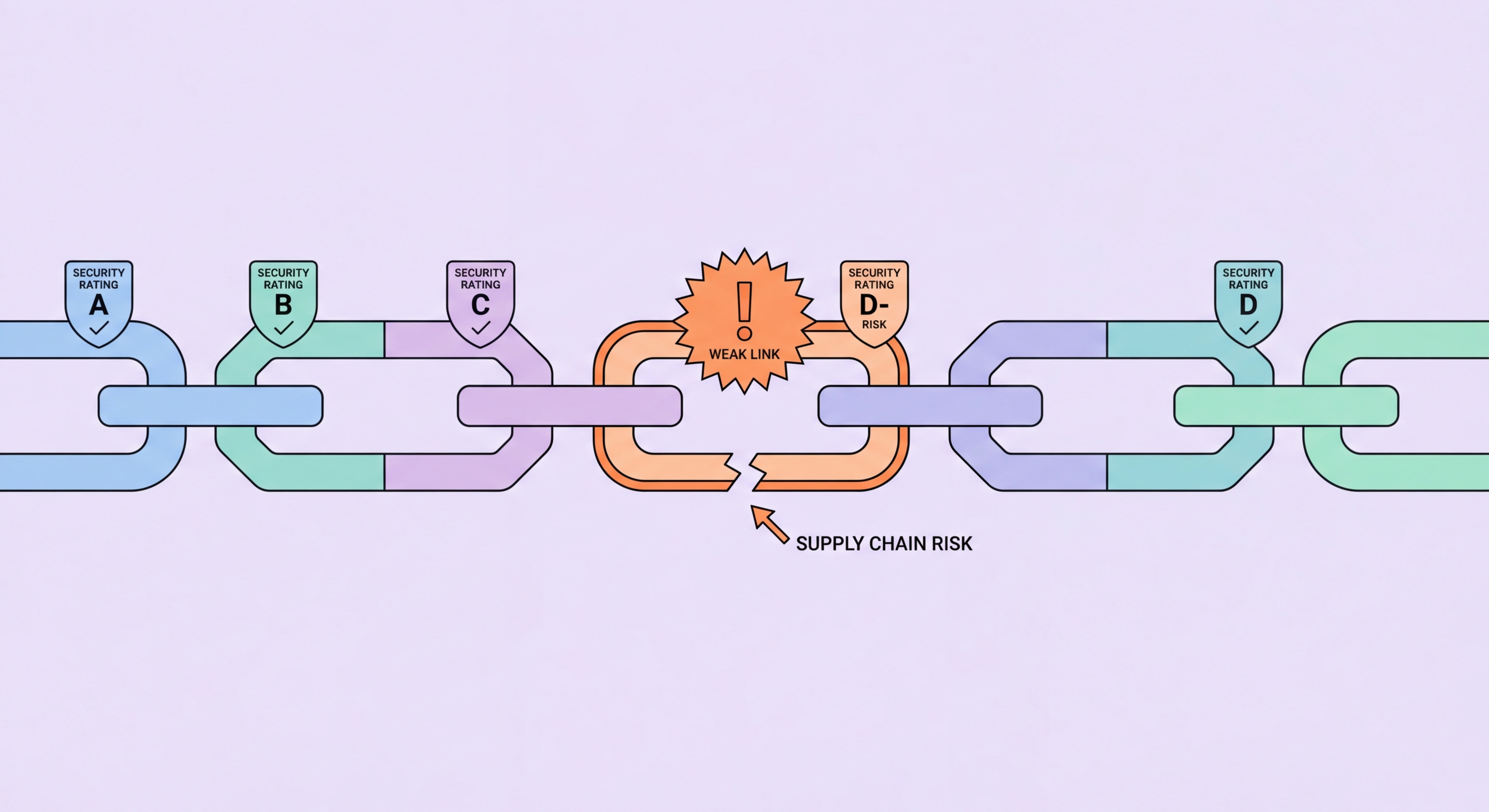
Supply chain risk landscape
2Vendor Assessment

Assessing Vendor Cybersecurity Before Engagement

Vendor security assessment before engagement is the first line of defence against supply chain risk. The depth of assessment required should be proportional to the level of access the vendor will have to your systems and data. A vendor who will have direct administrative access to your IT infrastructure requires a more thorough assessment than a vendor who provides a SaaS application that employees use with standard credentials. Tier your vendors by risk level and apply assessment effort proportionally — this makes supply chain risk management practical for SMEs without dedicated third-party risk teams.

For high-risk vendors (IT MSPs, cloud services holding sensitive data, software with network access), key assessment areas include: security certifications held by the vendor (ISO 27001 certification, SOC 2 Type II reports, cloud-specific certifications like CSA STAR); security breach history and disclosure practices; patch management and vulnerability response procedures; data handling practices including encryption at rest and in transit; subprocessor disclosure — whether they in turn share your data with other parties; incident response and notification procedures; and business continuity capabilities. Most reputable enterprise-grade vendors publish trust portals or security documentation that addresses these questions. For IT MSPs specifically, reviewing their own security practices, access management procedures, and whether they have completed a third-party security assessment themselves is critical.

Security questionnaires provide a structured framework for vendor assessment. CAIQ (Consensus Assessments Initiative Questionnaire) from the Cloud Security Alliance provides a comprehensive questionnaire for cloud service providers covering all security domains. SIG (Standardised Information Gathering) questionnaire and VSAQ (Vendor Security Assessment Questionnaire from Google) provide similar structured assessment frameworks. For smaller HK businesses without vendor risk management resources, a simplified questionnaire covering the most critical security questions — incident notification procedures, data encryption practices, access management, and security certification — provides meaningful risk reduction without requiring extensive resources.

  • Vendor risk tiering: Classify vendors by access level and data sensitivity — IT MSPs and data processors warrant deeper assessment than low-access software vendors
  • ISO 27001 and SOC 2: Prefer vendors holding ISO 27001 certification or SOC 2 Type II reports — these provide independent assurance of security management practices
  • Breach history review: Research whether vendors have suffered data breaches — how they handled previous incidents reveals their security maturity
  • Security questionnaire: Use a standardised security questionnaire (CAIQ, SIG, or your own) for all high-risk vendor engagements
  • Subprocessor disclosure: Require vendors to disclose their subprocessors — data you share with one vendor may be shared with many others
  • Assessment before contract: Complete security assessment before contract signing — leverage is greatest during procurement, minimal after vendor is embedded in operations
Vendor security assessment
3Contractual Protections

Contractual Security Requirements for HK Vendors

Contracts with vendors who process personal data or have access to your systems must include specific security provisions to satisfy PDPO obligations and establish clear rights and responsibilities in the event of a security incident. A PDPO-compliant data processing agreement must require the processor to implement adequate security measures, restrict processing to your documented instructions, prohibit subprocessing without your consent, notify you promptly of any data breach, permit you to audit the processor's security practices, and return or destroy data at the end of the engagement. Template data processing agreements compliant with HK PDPO requirements are available from law firms and the PCPD itself provides guidance on minimum requirements.

Security-specific contract clauses that HK businesses should include in vendor agreements beyond the basic PDPO data processing requirements include: minimum security standards (requiring the vendor to maintain specified security controls, certifications, or compliance with defined frameworks); breach notification timelines (specifying a maximum number of hours for notifying you of any incident affecting your data or systems — 72 hours is a common contractual standard); penetration testing and audit rights (the right to require annual penetration testing results or to conduct your own security assessments); insurance requirements (requiring vendors to maintain appropriate cyber liability insurance); and indemnification provisions covering losses arising from vendor security failures.

Access management contractual requirements are particularly important for IT MSPs and vendors with privileged network access. Contracts should specify: that the vendor will use dedicated, individually attributed accounts rather than shared credentials for accessing your systems; that access will be limited to the minimum required for service delivery; that all access is logged and logs are available to you upon request; that access is revoked immediately upon staff changes at the vendor affecting your account; and that the vendor will use multi-factor authentication for all privileged access to your systems. These requirements should be operationally verified — not merely contractually asserted — through periodic access reviews and log audits.

  • PDPO data processing agreement: Require a PDPO-compliant data processing agreement with all vendors who process personal data — this is a legal obligation under PDPO Principle 4
  • 72-hour breach notification: Specify a maximum 72-hour contractual notification requirement for any incident affecting your data — gives you time to meet your own notification obligations
  • Audit rights: Include the contractual right to require security assessment results or conduct your own vendor audits — without this right, you cannot verify vendor claims
  • Minimum security standards: Specify minimum security requirements in contracts — patch management timelines, MFA requirements, encryption standards
  • Cyber insurance requirement: Require vendors with significant access to carry appropriate cyber liability insurance — provides financial recourse for breach-related losses
  • Termination security: Include data return/destruction obligations at contract end — prevents your data remaining with former vendors indefinitely
Vendor security contracts
4Ongoing Monitoring

Ongoing Vendor Risk Monitoring for HK Businesses

Vendor security assessment at the point of engagement is only the starting point — ongoing monitoring is required because vendor security postures change, staff turn over, vulnerabilities emerge in vendor software, and vendors themselves are acquired or change their security practices over time. The SolarWinds supply chain attack illustrated that a vendor's security posture can change dramatically and rapidly. A vendor that passed your assessment two years ago may have significantly deteriorated in security capability. Annual reassessment of high-risk vendors maintains current understanding of their security posture rather than relying on point-in-time assessments that are stale within months.

Practical ongoing vendor monitoring for Hong Kong SMEs includes: subscribing to vendor security advisory mailing lists and monitoring for security vulnerability notifications affecting products you use; tracking vendor breach news through technology media and HKPC alerts; reviewing vendor-provided security reports (SOC 2 reports updated annually provide current security assessment data); monitoring the access your vendors use on your systems through privileged access management logs; reviewing vendor-issued invoices and contacts for signs of vendor account compromise (BEC fraud frequently targets accounts payable staff with fake vendor banking detail changes); and conducting periodic reviews of the data each vendor currently holds on your behalf.

Vendor offboarding is a security-critical process that is frequently neglected. When you stop using a vendor, every access path that vendor had to your systems must be explicitly removed: user accounts created for the vendor deleted, API keys and OAuth authorisations revoked, network access rules permitting vendor IP addresses removed, VPN credentials deactivated, and data returned or verifiably destroyed per contract requirements. Accumulating former vendor access over time creates an invisible attack surface — former vendors whose credentials remain active in your systems represent unmonitored access pathways. A semi-annual vendor access audit — reviewing all active vendor accounts, API connections, and network access rules against your current vendor list — identifies and remediates orphaned access from former vendor relationships.

  • Annual vendor reassessment: Reassess high-risk vendors annually — point-in-time assessments become stale as vendor security practices and circumstances change
  • Vendor breach monitoring: Monitor technology news and HKPC alerts for breaches at vendors you use — early awareness allows protective action before attackers exploit the breach against you
  • Vendor access log review: Periodically review logs of vendor access to your systems — unusual patterns indicate either compromise or policy violations
  • SOC 2 report currency: Require annually updated SOC 2 Type II reports from critical vendors — outdated reports do not reflect current security posture
  • Vendor offboarding procedure: Implement a formal offboarding checklist for terminated vendor relationships — explicitly revoke all access paths, accounts, and data holdings
  • Semi-annual access audit: Review all active vendor accounts and connections against your current vendor list — remove orphaned access from relationships that have ended
Ongoing vendor monitoring

Manage Your Vendor and Supply Chain Risk

Explore our complete Business Cybersecurity guide for all aspects of third-party risk and security management for Hong Kong businesses.

Related VPN Articles