Ransomware Protection for Hong Kong Businesses

A complete guide to ransomware prevention, detection, and recovery for Hong Kong businesses — covering the attack lifecycle, technical controls, backup strategy, and response procedures for HK organisations of all sizes.

Ransomware protection Hong Kong businesses
1Understanding Ransomware

How Modern Ransomware Attacks Work Against HK Businesses

Modern ransomware attacks against Hong Kong businesses bear little resemblance to the opportunistic, spray-and-pray ransomware of a decade ago. Today's ransomware operations are sophisticated criminal enterprises operating Ransomware-as-a-Service (RaaS) platforms, where developers create the ransomware and affiliates conduct targeted attacks in exchange for a percentage of ransom payments. LockBit, BlackCat/ALPHV, Cl0p, and their successors specifically target businesses in Hong Kong's financial, professional services, and logistics sectors because these industries can afford to pay substantial ransoms and are operationally dependent on continuous data access. The HKPF CSTCB has reported ransomware as among the most financially damaging cybercrime categories affecting HK businesses.

The ransomware attack lifecycle typically unfolds over days to weeks. Initial access occurs through phishing emails, exploitation of unpatched VPN or Remote Desktop Protocol (RDP) vulnerabilities, compromised credentials, or supply chain compromise through a managed service provider. Following initial access, attackers spend time in the network performing reconnaissance — mapping systems, identifying domain controllers and backup infrastructure, escalating privileges, and moving laterally to reach high-value targets. This dwell period, which may last weeks without detection, allows attackers to ensure maximum impact when encryption is finally deployed. Before encrypting, modern ransomware operators exfiltrate sensitive data to leverage in "double extortion" — threatening to publish stolen data publicly if ransom is not paid in addition to refusing to provide decryption keys.

Double extortion has become standard practice for major ransomware groups targeting HK businesses, fundamentally changing the risk calculus. Historically, organisations with tested backups could recover without paying ransom. With double extortion, even organisations that successfully restore from backup face the threat of sensitive customer data, financial records, and business correspondence being published on ransomware group leak sites. For Hong Kong businesses subject to PDPO obligations, this creates a data breach notification requirement independent of whether systems are restored. Industries with strict confidentiality obligations — legal, medical, financial — face particularly severe reputational consequences from data publication, creating pressure to pay even when technical recovery is possible.

  • RaaS business model: Modern ransomware is operated by criminal enterprises using affiliate structures — sophisticated, targeted attacks rather than opportunistic malware
  • Extended dwell time: Attackers spend days to weeks in networks before encrypting — early detection during this dwell period can prevent encryption entirely
  • VPN and RDP targeting: Unpatched VPN appliances and exposed RDP are the most common initial access vectors for ransomware targeting HK businesses
  • Double extortion: Data exfiltration before encryption means even organisations with clean backups face data breach consequences — backup alone is no longer a complete defence
  • Backup destruction: Ransomware operators specifically seek and destroy backup copies during dwell time — accessible backups are not safe backups
  • HK sector targeting: Financial services, professional services, and logistics companies in HK are high-value ransomware targets due to data sensitivity and operational dependence on systems
Ransomware attack lifecycle
2Prevention Controls

Technical Controls That Prevent Ransomware Attacks

The most effective ransomware prevention stack combines controls that address each phase of the attack lifecycle: reducing the attack surface to limit initial access opportunities, detecting and blocking the reconnaissance and lateral movement that occurs during dwell time, and preventing encryption even if an attacker reaches a system. No single control eliminates ransomware risk, but the layered combination substantially reduces both the probability of a successful attack and the blast radius when one occurs. The Australian Cyber Security Centre's "Essential Eight" provides a well-regarded framework for ransomware prevention that is directly applicable to Hong Kong business contexts.

Addressing initial access vectors is the first priority. Patch all internet-facing systems — particularly VPN appliances, firewalls, remote desktop gateways, and web-facing applications — within 14 days of critical security update release. Ransomware operators actively scan for unpatched VPN and firewall vulnerabilities to exploit within days of public disclosure. Disable RDP on internet-facing systems entirely if not required, or place RDP behind a VPN with MFA. Enable MFA on all VPN, remote access, and cloud applications — credential-based initial access through compromised accounts without MFA is the most common ransomware entry path. Deploy phishing-resistant email filtering to prevent malicious attachments and links from reaching employee inboxes.

Blocking lateral movement limits damage if an attacker achieves initial access. Network segmentation (separating workstations from servers, isolating backup infrastructure) prevents a compromised workstation from directly reaching servers and backup systems. Disabling Server Message Block (SMB) version 1 on all systems eliminates the protocol used by EternalBlue-based ransomware variants. Restricting domain administrator account usage to domain controllers prevents credential theft that enables rapid lateral movement. Implementing privileged access workstations (PAWs) or at minimum enforcing MFA for all domain admin access prevents attackers from escalating to domain admin through stolen credentials. Monitoring for unusual lateral movement patterns — a workstation attempting to connect to dozens of other systems — provides early warning of active ransomware activity during the dwell period.

  • Patch internet-facing systems within 14 days: VPN, firewall, and RDP vulnerabilities are the most-exploited initial access vectors — rapid patching eliminates the majority of ransomware entry paths
  • MFA on all remote access: MFA on VPN, RDP gateway, and cloud applications prevents credential-based initial access even when passwords are compromised
  • Disable SMBv1: SMB version 1 is exploited by ransomware spreading via EternalBlue and similar exploits — disable on all Windows systems via Group Policy
  • Network segmentation: Isolate workstations, servers, and backup infrastructure on separate network segments with firewall-controlled paths between them
  • Application execution control: Block execution from user-writable directories (%temp%, %appdata%) where ransomware typically lands after phishing delivery
  • Privileged account protection: Restrict domain admin and local admin usage, enforce MFA for privileged access, and monitor privileged account activity for anomalies
Ransomware prevention controls
3Detection and Response

Detecting Ransomware Early and Responding Effectively

Early detection during the dwell period — before encryption is deployed — is the most valuable outcome of any ransomware defence programme. Ransomware operators in the network conducting reconnaissance generate detectable signals: unusual lateral movement between systems that have no legitimate communication need, access to large numbers of files on file servers in a short time period, administrative tool usage from workstations (use of PsExec, WMIC, PowerShell remoting), connection to unusual external IP addresses, and changes to backup configuration or deletion of volume shadow copies. An EDR solution that detects these behavioural indicators and alerts your security team can interrupt an attack before encryption occurs — converting a potential catastrophic incident into a contained intrusion.

When ransomware is discovered — typically by an employee seeing encrypted files and a ransom note, or by an EDR alert on encryption behaviour — the immediate response priorities are: containment (stopping the spread), preservation (capturing forensic evidence), and notification (alerting the security team, management, insurer, and potentially law enforcement). Containment involves isolating infected systems from the network — disconnecting from ethernet and disabling WiFi — to prevent the encryption spreading to additional systems and network shares. Do not immediately power off infected systems, as this may destroy volatile memory evidence useful for forensic investigation. Isolate rather than shut down where possible.

The decision whether to pay a ransom should be made carefully and never under time pressure alone. Before any payment: notify your cyber insurer and obtain pre-approval (required by most policies); engage a ransomware specialist from your insurer's incident response panel; consult legal counsel on the specific ransomware group's sanctions status; verify that payment will actually result in data recovery (many groups do not provide functioning decryption tools even after payment); and consider whether backup restoration is viable. The HKPF CSTCB recommends against ransomware payment and should be notified of any significant ransomware incident. Payment does not guarantee data recovery, does not prevent data publication in double extortion scenarios, and funds continued criminal operations.

  • EDR for dwell time detection: EDR solutions detect ransomware behavioural indicators during the dwell period — lateral movement, shadow copy deletion, mass file access — before encryption deploys
  • Shadow copy monitoring: Alert on deletion of Volume Shadow Copies — this is a near-universal pre-encryption action by ransomware operators and indicates imminent encryption
  • Immediate isolation on detection: Isolate infected systems from the network immediately — containment speed directly limits the number of systems encrypted
  • Preserve evidence before rebuilding: Forensic image infected systems before wiping — volatile memory and disk images contain evidence required for investigation and insurance claims
  • Insurer notification before ransom decision: Notify cyber insurer before any ransom consideration — most policies require pre-approval for ransom payment
  • HKPF CSTCB reporting: Report significant ransomware incidents to HKPF CSTCB — law enforcement notification is important regardless of payment decision
Ransomware response procedures
4Recovery and Resilience

Recovering from Ransomware and Building Lasting Resilience

Recovery from a ransomware attack without paying ransom requires clean backups, a systematic recovery process, and the patience to fully verify eradication before restoring business operations. The recovery sequence matters: restore domain controllers and critical infrastructure first, then file servers and application servers, then workstations. Before restoring any system from backup, verify that the backup predates the attacker's initial access — restoring from a backup that already contains the attacker's backdoor or tools restores the compromise. Work with a forensic investigator to establish the attacker's initial access date and select backup restoration points that predate this compromise window.

Full eradication of ransomware operators from your environment before restoration is critical. Ransomware operators frequently maintain persistence through multiple backdoors — if any attacker persistence mechanism survives the recovery process, the attackers will return and potentially deploy ransomware again within days. Eradication requires: identifying all compromised accounts and forcing credential resets across all systems (not just the ones you know were compromised); reviewing all user accounts for attacker-created accounts; reviewing scheduled tasks, services, and autostart locations on all systems for persistence mechanisms; patching the initial access vulnerability; and rebuilding systems where the compromise scope is unclear rather than trusting incomplete remediation. Security forensic investigators from your insurer's panel are essential for thorough eradication.

Post-recovery resilience improvements address the specific gaps that allowed the attack to succeed. Most ransomware investigations reveal a specific chain of security failures: an unpatched VPN vulnerability that provided initial access, absence of MFA on admin accounts that enabled credential theft, insufficient network segmentation that allowed lateral movement, and accessible backups that were destroyed before encryption. Each link in this chain represents a specific security improvement opportunity. A post-incident review with your security team or external consultants that maps the attack chain and implements controls to break each link substantially reduces the risk of a successful repeat attack. The HKPC provides post-incident security advisory services to Hong Kong businesses through its cybersecurity support programmes.

  • Clean backup restoration: Verify backup predates attacker access before restoring — forensic investigation establishes the compromise timeline to select the appropriate restoration point
  • Prioritised recovery sequence: Restore domain controllers first, then critical servers, then workstations — do not restore workstations before verifying server environment is clean
  • Complete credential reset: Force password reset for all accounts, not just known compromised accounts — attackers may have harvested credentials from systems that appear unaffected
  • Full eradication before business resumption: Confirm complete eradication through forensic review before restoring normal operations — partial eradication results in repeat ransomware within days
  • Attack chain analysis: After recovery, map the full attack chain and implement controls to break each link — the specific gaps that allowed this attack will be exploited again if unaddressed
  • HKPC post-incident support: Engage HKPC cybersecurity advisory services for post-incident security improvement planning — available to Hong Kong businesses through HKPC programmes
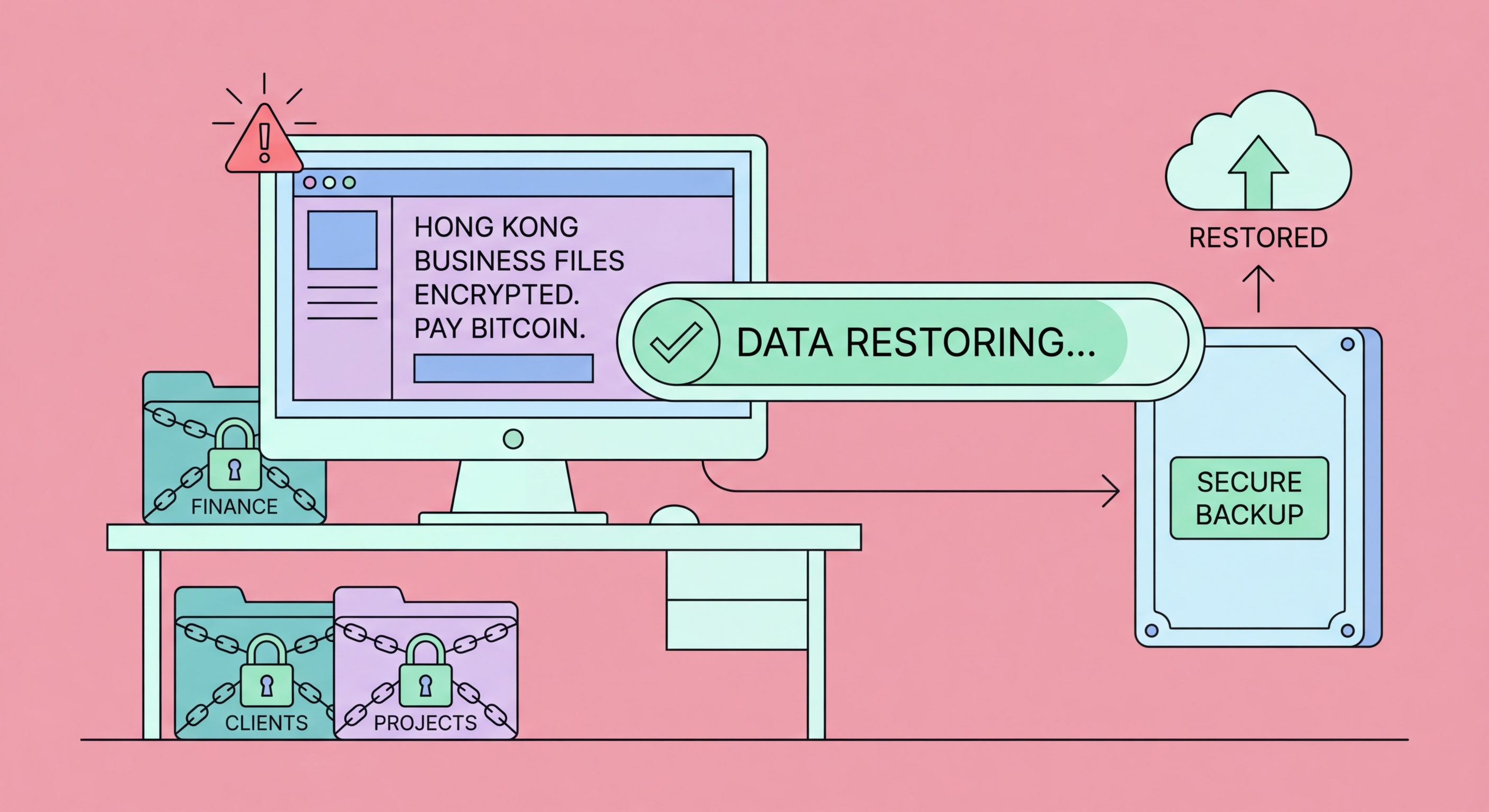
Ransomware recovery process

Protect Your Business from Ransomware

Explore our complete Business Cybersecurity guide for comprehensive ransomware prevention and all security guidance for Hong Kong businesses.

Related VPN Articles